
Closed Loop Marketing vs Performance Marketing for B2B SaaS
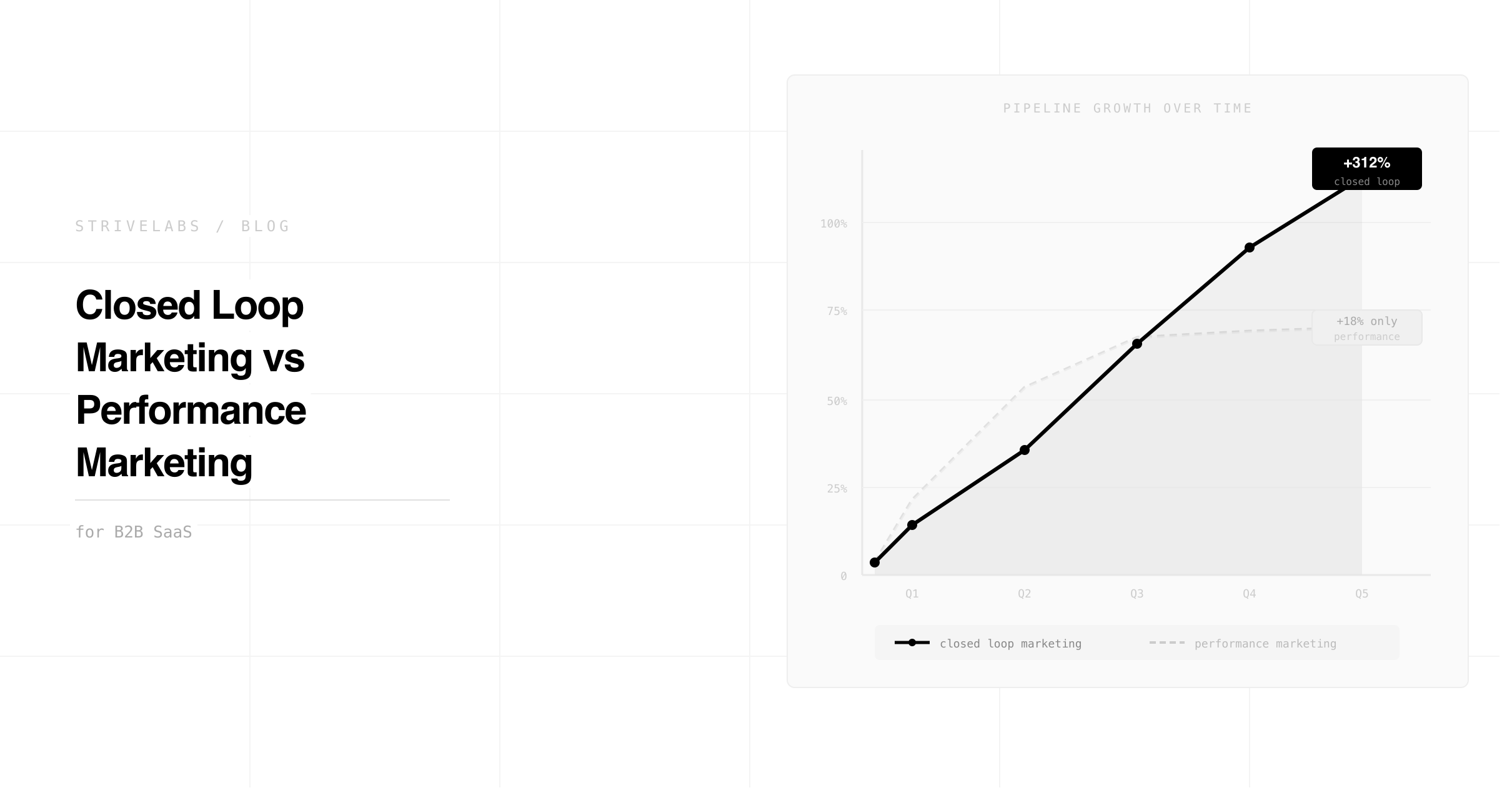
Performance marketing tells you what happened. Closed loop marketing tells you why it mattered.
That distinction sounds simple. In practice it is the difference between a marketing team that defends its budget in every CFO conversation and one that loses it. A campaign that generates 50 MQLs looks like a success on a performance marketing dashboard. If those 50 MQLs convert to pipeline at 2%, it generates one opportunity. A campaign that generated 10 MQLs at 40% pipeline conversion generated four opportunities. Performance marketing ranks the first campaign higher. Closed loop marketing ranks the second campaign higher by a factor of four.
This post covers the specific attribution gap between performance marketing and closed loop marketing, why it matters more in B2B SaaS than any other business model, and how the Agentic Marketing Engine closes that loop automatically across paid, SEO and CRM.
At a Glance
-
Performance marketing measures activity. Closed loop marketing measures revenue impact. Both are necessary. Neither alone is sufficient.
-
The industry average for closed-won deals with at least one marketing touch attributed is 55-65%. The Stage 4 benchmark is 80-90%. The gap between average and best-in-class is the attribution infrastructure.
-
The human-in-the-loop model applies to closed loop attribution too, the Strivelabs agent connects paid data to pipeline data automatically, but every budget reallocation recommendation waits for marketer approval before executing.
-
Organisations implementing multi-touch attribution see an average 19% improvement in marketing ROI within the first year, according to Forrester research.
Performance Marketing Tells You What Happened — and What It Misses
Performance marketing is not broken. It is incomplete for B2B SaaS.
It works exceptionally well for what it was designed for: real-time optimisation of campaign activity. Which ad creative is getting higher CTR? Which audience segment is converting at lower CPC? Which landing page variant is generating more form fills? These are questions performance marketing answers accurately, in near real-time, with excellent data.
The problem is that in B2B SaaS these questions are about the first two days of a 121-day buying journey. A campaign that generates 50 MQLs looks like a success. The performance dashboard shows high volume, acceptable CPL, solid conversion rate from click to form fill. Leadership sees a green dashboard.
Ninety days later, the sales team reports that the 50 MQLs from that campaign converted at 2% to pipeline. One opportunity generated. Meanwhile, a campaign that looked underwhelming on performance metrics, 10 MQLs, higher CPL, lower conversion rate, generated four opportunities because those 10 MQLs were high-intent accounts that closed at 40%.
Performance marketing allocated budget to the first campaign. Closed loop marketing would have allocated it to the second. The budget decision was wrong because the measurement stopped at MQL volume.
Where performance marketing specifically breaks down in B2B SaaS:
Multi-stakeholder buying committees. A single deal involves 11+ people from IT, finance and operations. Performance marketing tracks individual user behaviour. It sees one person's click. It does not see the five other committee members who read the same content, attended the webinar, and influenced the buying decision without ever filling out a form.
The 90-day attribution window. Performance marketing attribution windows are typically 7-28 days. A B2B SaaS deal that closes 121 days after the first touch will not be attributed to the campaign that started it if the attribution window expired months before the deal closed.
Offline influence invisibility. A sales call, a demo, a lunch meeting, a Slack conversation between a champion and a sceptic — none of these appear in performance marketing data. Yet they are often the moments that move a deal. 61% of B2B marketing managers say they have no clear view of the customer journey according to Forrester. The gap is not data quality. It is data coverage.
What Closed Loop Marketing Adds That Performance Marketing Cannot
Closed loop marketing connects the first marketing touchpoint to the last sales outcome. It traces the full path, from the ad click that brought a buyer to the site, through the content they consumed, to the deal stage they reached and whether it closed.
Three specific metrics that closed loop marketing provides that performance marketing cannot:
Sourced pipeline by campaign. Not MQL volume. Dollar value of opportunities created, which specific campaigns started conversations that became active sales opportunities. This is the number the CFO wants and the one performance marketing cannot produce without CRM data connected.
Opportunity creation rate by source. Of all the MQLs a campaign generated, what percentage converted to sales opportunities? This is what exposes the 50 MQL vs 10 MQL example. Campaign A has a 2% opportunity creation rate. Campaign B has 40%. The performance dashboard hid this. The closed loop report surfaces it immediately.
Influenced ARR. Which marketing touchpoints appeared in the attribution paths of deals that closed? A blog post that appeared in 14 closed-won deals last quarter has influenced ARR, a measurable revenue contribution, even if it never generated a form fill. Performance marketing cannot see this. Closed loop marketing attribution can.
Better decisions start with better infrastructure.
Most mid-market teams pick a channel and hope. Strivelabs gives you the data to know, and the infrastructure to act on it.
Book a Demo →
Closed Loop Marketing vs Performance Marketing — Side by Side
| Performance marketing | Closed loop marketing | |
|---|---|---|
| Primary metric | Clicks, CPL, MQL volume, ROAS | Sourced pipeline, opportunity rate, influenced ARR |
| Time horizon | 7-28 day attribution window | Full sales cycle — 90-218 days |
| Data sources required | Ad platforms + GA4 | Ad platforms + GA4 + CRM |
| Decision it enables | Tactical: which creative, audience, bid to optimise | Strategic: which channels generate revenue, where to allocate budget |
| What it misses | Downstream pipeline, multi-touch influence, offline interactions | Real-time creative optimisation, platform-level bid management |
| B2B SaaS fit | Strong for daily tactical decisions | Essential for quarterly budget allocation |
The answer is not to replace performance marketing with closed loop marketing. It is to run both simultaneously, performance marketing for the daily tactical layer, closed loop for the strategic budget allocation layer. 60% of B2B organisations are shifting from lead-volume metrics to revenue attribution as their primary marketing KPI in 2026. The shift is not abandoning performance data, it is using pipeline data to interpret it correctly.
Why B2B SaaS Teams Need Closed Loop Not Just Performance Marketing
The case is specific to the business model. In e-commerce, a conversion is a purchase. The gap between performance marketing and closed loop marketing is small, what someone clicked and what they bought are the same event. Performance marketing is close to complete.
In B2B SaaS, a conversion is a demo request or form fill. The purchase happens 121 days later, requires agreement from 11 people, and may be influenced by a dozen marketing touchpoints that occurred before the form fill was ever submitted. Performance marketing measures the form fill. Closed loop marketing measures the deal.
For most B2B SaaS mid-market teams with 50-200 leads per month, the practical starting point is multi-touch attribution connected to HubSpot, which is what the Strivelabs closed loop marketing architecture delivers without requiring a dedicated attribution platform.
The attribution gap explained simply:
Campaign A: 50 MQLs, 2% opportunity rate, $40k pipeline. Performance marketing ranks this campaign first on volume.
Campaign B: 10 MQLs, 40% opportunity rate, $200k pipeline. Closed loop marketing ranks this campaign first on revenue.
If the budget is allocated by performance marketing metrics, Campaign A gets more spend. If allocated by closed loop metrics, Campaign B gets more spend. Over 12 months, the compounding effect of this allocation decision is significant. A team optimising for MQL volume will fund a channel that generates activity. A team optimising for pipeline will fund a channel that generates revenue.
The Attribution Gap That Makes Performance Marketing Misleading
The attribution gap is the specific distance between a marketing activity and its revenue outcome, and why standard tools cannot cross it without CRM data.
Three places the gap opens in every B2B SaaS marketing operation:
UTM inconsistency. A campaign runs across Google Ads, LinkedIn and email. Google Ads UTMs are correctly formatted. LinkedIn UTMs are missing the campaign name field. Email UTMs use a different naming convention from paid. When these touch a HubSpot record, three different campaigns get credit for the same buyer. The attribution model cannot reconcile them. Pipeline attribution shows as "unknown source" for 30% of deals.
CRM field gaps. When a lead is created in HubSpot without a first-touch campaign source field, that lead becomes unattributable. Even if the buyer came from a specific Google Ads campaign, the connection is broken. The industry average for closed-won deals with at least one marketing touch attributed is 55-65%, which means 35-45% of closed revenue has no marketing attribution in the average B2B SaaS company. That is not a small gap. It is the majority of the evidence a marketing team needs to defend its budget.
The 90-day lag. Performance marketing data is available in 24-48 hours. Pipeline attribution data requires waiting for deals to close, which takes 121 days at the mid-market average. This creates a fundamental tension: the marketing team needs to make budget decisions faster than the attribution cycle completes. The solution is to use performance data for daily tactical decisions and pipeline data for quarterly strategic decisions, running both layers simultaneously.
How to Run Performance Marketing Inside a Closed Loop System
The practical implementation for a lean B2B SaaS marketing team:
Week 1 — UTM governance. Define a single UTM naming convention and enforce it across every paid, email and organic campaign. The convention needs four fields at minimum: source, medium, campaign name, content. Every link, whether a paid ad, an email, or a content piece, gets UTMs applied automatically. No manual tagging.
Week 2 — CRM field requirements. Make first-touch campaign source and last-touch campaign source mandatory fields in HubSpot. If a contact is created without these fields populated, the record is incomplete. This prevents the attribution gap from widening on every new lead.
Week 3 — Pipeline attribution report. Build the weekly report that shows, for every active opportunity in HubSpot, which marketing campaigns appeared in the contact's attribution path. This does not require a dedicated attribution platform, it requires HubSpot deal records connected to contact activity, which is the standard HubSpot configuration.
Ongoing — Weekly reconciliation. Every Friday, compare the performance marketing dashboard (which campaigns generated MQLs this week) against the pipeline attribution report (which campaigns appear in active opportunities). The gap between these two views is where budget misallocation lives. Campaigns that look strong on performance and weak on pipeline attribution get scrutinised. Campaigns that look weak on performance but strong on pipeline attribution get protected.
What Closed Loop Marketing Looks Like When an Agent Runs It
The Agentic Marketing Engine connects the paid performance layer and the pipeline attribution layer automatically, without weekly manual reconciliation.
Inside Strivelabs, here is what that looks like:
The agent reads Google Ads, LinkedIn Ads and Meta performance data continuously. It reads HubSpot pipeline data, deal stages, opportunity creation, closed-won records, continuously. It connects them. When a campaign that looks strong on performance metrics is generating MQLs that are converting to pipeline at below-average rates, the agent flags it with the specific diagnosis: high MQL volume, low opportunity creation rate, recommended reallocation. The marketer reviews the recommendation with the pipeline data attached, not just the performance data, and approves or adjusts before any budget change executes.
The AI Agents for Paid Media post covers the paid media mechanics. The AI Agents for CRM post covers how pipeline signals connect back to marketing actions. The closed loop architecture is what connects both.
Three specific outputs every week:
Pipeline-weighted performance report. Not just which campaigns generated MQLs. Which campaigns generated MQLs that converted to opportunities and at what rate. The standard performance dashboard plus the pipeline conversion layer on top.
Attribution gap alerts. When the percentage of closed-won deals without marketing attribution drops below 70%, meaning more than 30% of deals have no attributed marketing touch, the agent flags it as a data quality issue and identifies which UTM or CRM field is the most likely source of the gap.
Budget reallocation recommendations. Based on 90-day rolling pipeline attribution data, not 7-day performance data. Which campaigns are generating pipeline that closes? Which are generating activity that does not convert? Recommendations surfaced with reasoning, waiting for approval before any budget changes.
The marketing engineer function, delivered as software.
See how Strivelabs gives mid-market teams the operational capacity without the hiring cost.
Explore Strivelabs →
Frequently Asked Questions (FAQs)
What is the difference between closed loop marketing and performance marketing?
Performance marketing measures marketing activity, clicks, impressions, CPL, conversion rate, ROAS. It optimises for the activity layer and is accurate within a 7-28 day window. Closed loop marketing measures revenue impact, sourced pipeline, opportunity creation rate by campaign, influenced ARR. It requires CRM data connected to ad platform data and a full sales cycle to complete. Both are necessary. Neither alone is sufficient for a B2B SaaS team with a 90+ day sales cycle.
Do B2B SaaS companies need closed loop marketing?
Yes, specifically because of the sales cycle length. In e-commerce a conversion is a purchase and performance marketing is close to complete. In B2B SaaS a conversion is a form fill and the deal closes 121 days later involving 11+ stakeholders. Performance marketing measures the form fill. Without closed loop attribution you do not know whether that form fill became revenue, which means budget allocation decisions are made on incomplete data every quarter.
Can you run performance marketing and closed loop marketing simultaneously?
Yes, and this is the correct operating model. Use performance marketing for daily tactical decisions: which creative, audience and bid to optimise. Use closed loop attribution for quarterly strategic decisions: which channels are generating revenue and where to allocate budget. The two layers answer different questions on different time horizons. Running both simultaneously gives you the tactical speed of performance marketing and the strategic accuracy of closed loop attribution.
What data do you need to close the attribution loop?
Three connected sources: your ad platforms (Google Ads, LinkedIn Ads) for the activity layer, GA4 for on-site behaviour, and HubSpot for the pipeline layer, specifically deal records with first-touch and last-touch campaign source fields populated. UTM governance across every campaign link is the foundation. Without consistent UTM tagging, the connection between ad activity and CRM records breaks and attribution shows as unknown source.
How does Strivelabs connect performance marketing data to pipeline attribution?
Strivelabs connects to Google Ads, LinkedIn Ads, HubSpot, Search Console and GA4 via OAuth. The agent reads performance data and pipeline data simultaneously and surfaces the intersection, which campaigns are generating MQLs that convert to opportunities at above-average rates and which are generating volume that does not convert. Budget reallocation recommendations are generated with pipeline attribution data attached. The marketer reviews and approves before any budget change executes.
Related Posts
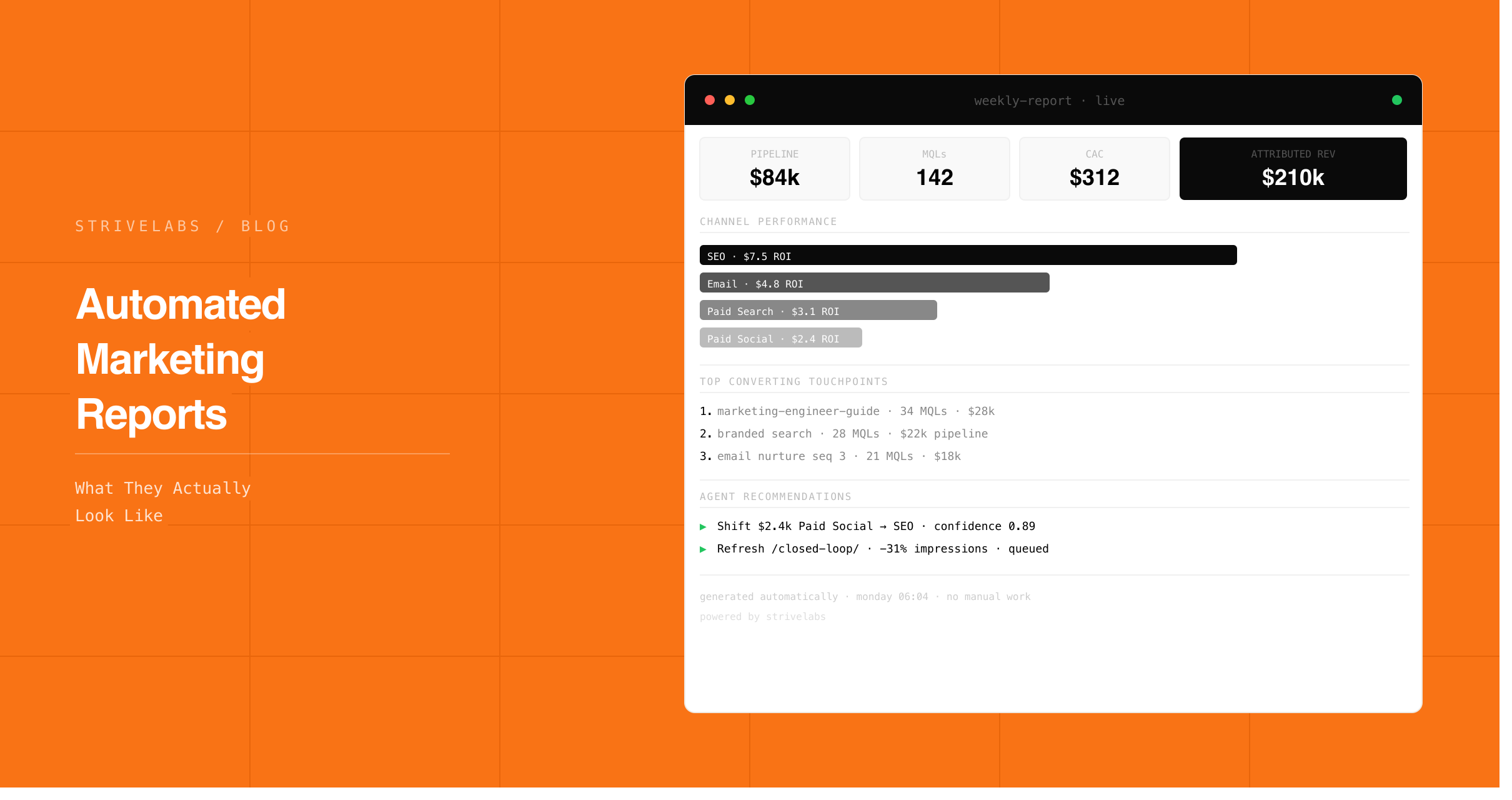
Automated Marketing Reports: What They Actually Look Like
Automate marketing reports across Google Ads, HubSpot and Search Console — Strivelabs builds your weekly report, surfaces anomalies and queues actions for your approval.
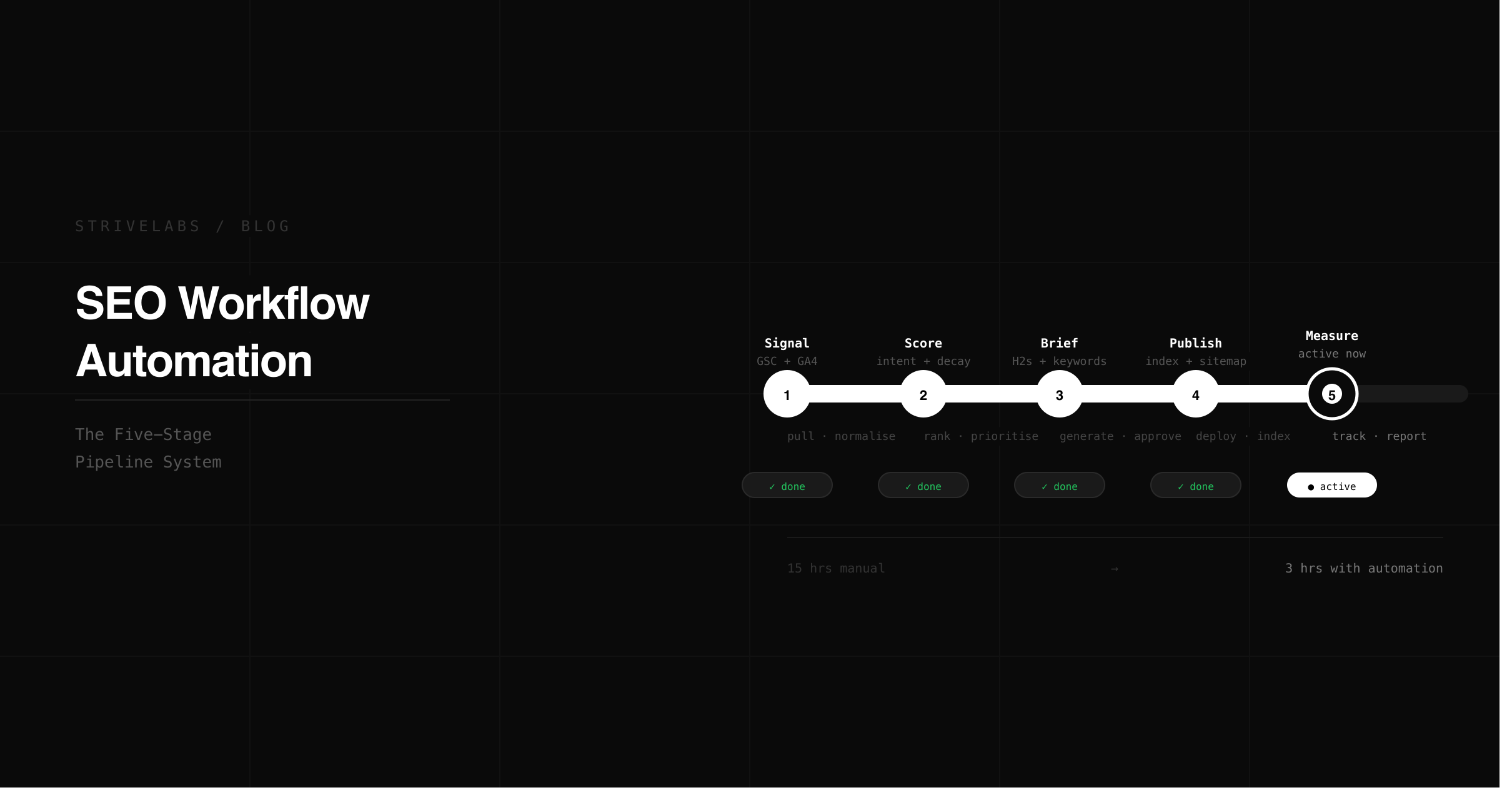
SEO Workflow Automation: The Five-Stage Pipeline System
SEO workflow automation that runs signal detection, diagnosis, brief generation and pipeline attribution automatically — with marketer approval at every stage.
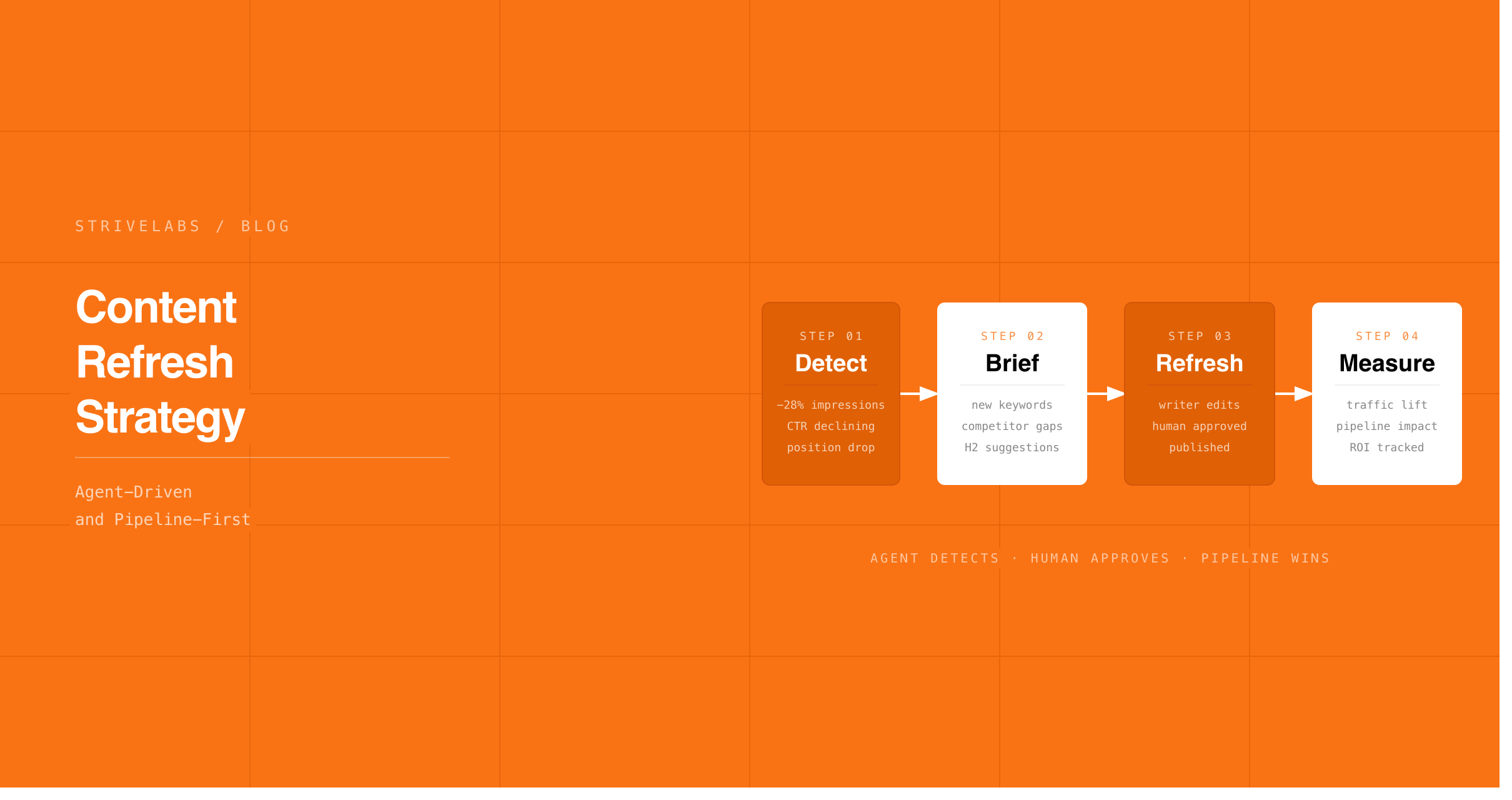
Content Refresh Strategy: Agent-Driven and Pipeline-First
A content refresh strategy that runs before traffic drops. Strivelabs detects decay signals, connects them to HubSpot pipeline data, and generates refresh briefs automatically.