SEO tools show you what is happening. An automated SEO workflow does something about it.
Most B2B SaaS marketing teams have the tools, Search Console, GA4, Ahrefs or Semrush, a CMS. The data exists. The problem is the gap between the signal and the action. A keyword gap surfaces in Semrush on Monday. The marketer flags it Wednesday. A brief gets written Friday. A writer picks it up the following week. The content goes live three weeks after the original signal.
B2B SaaS clients adopting AI-driven SEO workflows experience 35% higher keyword ranking stability amid 2026 algorithm updates, particularly in competitive verticals like martech and fintech. The stability comes not from better tools but from a shorter gap between signal and action. Automation closes that gap. Not by removing the marketer from the process, by removing the manual data assembly, diagnosis and brief-writing stages that sit between the signal and the marketer's decision.
This post covers the five-stage SEO workflow automation that Strivelabs runs for B2B SaaS teams, from signal detection through pipeline attribution, with the specific inputs, outputs and marketer approval points at every stage.
At a Glance
-
SEO workflow automation is not about publishing faster. It is about connecting every piece of content to pipeline impact — knowing which posts are generating revenue and which are silently losing it.
-
Nearly 70% of businesses report higher ROI from incorporating AI into their SEO strategy, with the most consistent driver being productivity gains — teams saving 5-15 hours per week on tasks like content drafting, meta description generation and keyword clustering.
-
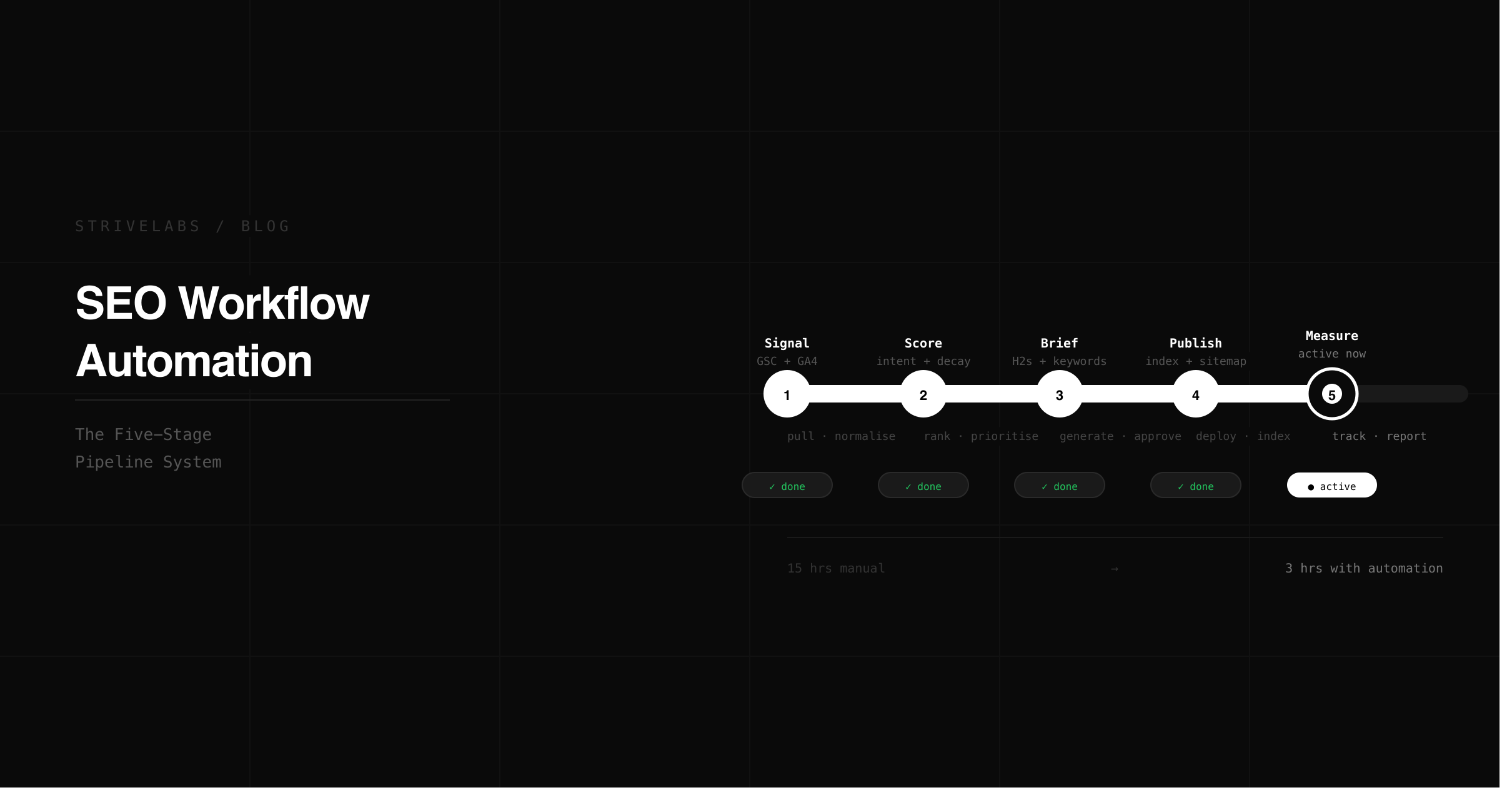
The five stages are: signal detection, diagnosis, brief generation, draft production, publish and pipeline loop. Each stage has a specific agent output and a specific marketer approval step. No stage publishes autonomously.
-
The system that stops at publishing is a content factory. The system that connects to HubSpot pipeline attribution is an SEO workflow.
-
Setup takes under five minutes per integration via OAuth. No engineering required.
Why SEO Workflow Automation Fails Before It Starts
Most SEO automation attempts fail at the same point, the gap between the data layer and the action layer.
Teams automate the wrong stages first. They set up publishing workflows before they have reliable signal detection. They build brief templates before they have diagnosis logic. They connect their CMS before they connect their CRM. The result is a system that publishes content faster without knowing whether the content is the right content or whether it is generating pipeline when it lands.
Three specific failure modes the Strivelabs SEO agent is built to avoid:
Publishing without pipeline connection
A content workflow that stops at "published" has no way to know whether the post is generating revenue. Without connecting page-level events to HubSpot deal records, SEO success is measured in traffic and rankings, not in the pipeline that justifies the content investment.
Briefs without diagnosis
A brief built from a keyword research template tells a writer what to cover. A brief built from a specific decay diagnosis, this page is losing CTR on a commercial intent query because a competitor published more comprehensive coverage on this specific sub-topic, tells a writer exactly what to fix. The second brief produces a refresh that works. The first produces a surface-level update that does not recover the ranking.
Manual handoffs between stages
When a brief sits in Notion for three days waiting for a writer, or a draft waits in a shared document for an editor, the SEO workflow is not automated, it is a manual process with an automated brief at the front. Each manual handoff is a point where the workflow stalls, particularly when a team member is unavailable.
What a Real SEO Workflow Covers — Most Teams Stop at Tools
Zero-click searches now account for 60% of all searches according to Semrush 2025 data, and organic CTR dropped from 1.76% to 0.61% for queries where AI Overviews appear. In this environment, an SEO workflow that only optimises for traditional search rankings is optimising for a shrinking pool of clicks.
A complete SEO workflow covers six connected functions, and most tools only handle one or two of them:
Signal detection
continuous monitoring of Search Console and GA4 for decay signals, opportunity gaps and intent shifts. Most teams do this manually on a weekly or bi-weekly cycle.
Diagnosis
root cause analysis of detected signals. Is the CTR drop a title tag issue, a competitor gain, an intent shift, or a technical problem? Different causes need different fixes. Most teams skip diagnosis and go straight to "refresh the post."
Brief generation
building a data-driven brief from the diagnosis. Not a template, a specific document that tells the writer exactly what to fix, why, and what the post needs to rank and convert in the current SERP.
Draft production
writing the first draft from the brief. Including internal links, meta tags, schema recommendations, and a scoring assessment before it reaches the marketer.
Publish and pipeline loop
pushing to the CMS with complete attribution tracking, then monitoring post-publication performance and connecting page events to HubSpot deal records.
Attribution close
connecting published content performance back to pipeline in HubSpot, which posts appeared as touchpoints in closed-won deals, which are generating MQLs that convert, which are losing attribution as they decay.
The Agentic Marketing Engine runs all six functions continuously. The marketer approves at every transition point, signal to diagnosis, diagnosis to brief, brief to draft, draft to publish. Nothing moves forward without explicit sign-off.
Better decisions start with better infrastructure.
Most mid-market teams pick a channel and hope. Strivelabs gives you the data to know, and the infrastructure to act on it.
Book a Demo →
The Five-Stage SEO Workflow Automation That Runs Continuously
Stage 1 — Signal detection
What happens manually: Weekly Search Console check. Marketer scans top pages for impression drops and CTR changes. Misses slow-moving decay because the check happens too infrequently to catch gradual decline. Misses cross-signal patterns, a page whose CTR is dropping while position holds, which indicates a competitor improved their snippet rather than a ranking change.
What the Strivelabs agent does: Reads Search Console, GA4 and competitive signals daily. Detects five specific decay patterns: impressions falling on commercial intent queries, CTR dropping while position holds, session duration falling on organic traffic, SERP feature loss, and assisted conversion rate dropping in HubSpot. When two or more signals fire on the same page, the page enters the detection queue.
What the marketer approves: Detection thresholds, how sensitive the system is and which signal combinations trigger a diagnosis. This prevents the queue from filling with false positives. The marketer adjusts thresholds based on site size, traffic volume, and how aggressively they want to catch early-stage decay.
Stage 2 — Diagnosis
What happens manually: The marketer or an SEO specialist investigates the flagged page. Checks the SERP manually, looks at competitor posts, reviews the page's technical health, makes an educated guess about the root cause. Takes 45-90 minutes per page. Gets the diagnosis wrong roughly 40% of the time because manual diagnosis misses cross-signal patterns.
What the Strivelabs agent does: Runs four automated checks. Has a competitor published more comprehensive content on the same keyword in the last 60 days? Has the SERP composition changed, informational to commercial or vice versa? Are there technical issues, slow load time, crawl errors, broken internal links, that correlate with the performance drop? Did CTR fall before the ranking dropped, which indicates a meta or title issue rather than a content issue? The agent generates a diagnosis with a confidence score and three possible root causes ranked by likelihood.
What the marketer approves: The diagnosis itself. Does the root cause assessment seem right? If the agent diagnoses a competitor content gap but the marketer knows the competitor post is low quality, they can override the diagnosis and reframe the brief accordingly. The agent's reasoning is visible, the marketer is not approving a black box.
Stage 3 — Brief generation
What happens manually: The marketer or editor writes a brief using a template. Pastes in competitor URLs. Notes the target keyword. Adds some context. The writer receives a brief that tells them what to cover but not specifically what to fix, because the brief was not built from a diagnosis.
What the Strivelabs SEO agent does: Builds the brief from the diagnosis, not from a template. Includes: the primary keyword with current intent mapping, a SERP gap analysis showing specifically what the top three competing posts cover that this page does not, sections to update or add, internal linking recommendations based on the site architecture, HubSpot context showing which audience segments visited this page and what they converted to, and a specific experiment to run with the metric to track.
What the marketer approves: The brief before it reaches a writer. Brand voice, strategic angle, competitive claims. A brief that recommends head-on competitive comparison needs different approval consideration than a brief that recommends adding a case study section. The marketer reads the brief, adjusts where needed, and approves.
Stage 4 — Draft production
What happens manually: Writer works from the brief, researches, drafts, submits for review. Multiple revision cycles. Back-and-forth between writer and editor. Typically 3-5 business days from brief to approved draft.
What the Strivelabs agent does: The content agent generates a first draft against the approved brief, scored against keyword coverage, intent match and brief completeness before it reaches the marketer. The draft includes: keyword-optimised content built from the SERP gap analysis, internal links to relevant existing pages, meta title and description options, schema recommendations, and a brief scoring assessment, how well the draft covers the brief requirements before it reaches the marketer.
What the marketer approves: The draft before it reaches a writer for final polish, or approves the draft directly if it is a refresh brief where the agent's first draft is close to publish-ready. Brand voice, factual accuracy, competitive claims. The marketer reads and approves. Nothing reaches the CMS without sign-off.
Stage 5 — Publish and close the pipeline loop
What happens manually: Writer or editor pushes to the CMS. UTM parameters added manually, or forgotten. HubSpot tracking attached, or not. Post goes live. Nobody knows whether it generates the pipeline until someone manually cross-references GA4 and HubSpot three months later.
What the Strivelabs agent does: Publishes to the CMS with complete attribution parameters attached automatically. Sends page-level events to HubSpot, which contacts viewed the page, when, and as part of which deal journey. Monitors the post-publication performance window: if impressions and CTR do not recover within 30 days of a refresh, a second diagnostic runs automatically.
What the marketer approves: Final publish. The marketer sees the complete picture before the post goes live, which HubSpot rules and deal mappings will receive attribution events, who the attributed writer is, the audit log for the approval chain from signal to publish. One click to approve. The system handles execution.
What Your SEO Week Looks Like When the Workflow Runs Automatically
| Manual SEO workflow | Automated SEO workflow with Strivelabs |
|---|---|
| Weekly manual Search Console review — 2 hours | Daily decay signals surfaced automatically — 0 hours |
| Manual diagnosis per flagged page — 45-90 minutes | Agent diagnosis with confidence scoring — 0 hours |
| Template brief writing — 60-90 minutes per brief | Data-driven brief generated from diagnosis — 0 hours |
| Brief to writer handoff — 1-3 days lag | Brief approved and queued immediately — same day |
| Manual UTM and HubSpot setup on publish | Attribution parameters applied automatically |
| Weekly report built manually — 2-3 hours | Pipeline attribution report built automatically |
The recovered hours go to three things: reviewing and approving the agent's work, running experiments that the reclaimed capacity makes possible, and strategic decisions that the pipeline attribution data makes better-informed.
How to Measure Pipeline Impact From SEO Workflow Automation
The marketing attribution post covers the full multi-touch model. For SEO workflow automation specifically, three metrics show whether the system is working:
Content velocity
How many briefs approved and posts published per week before the system vs after. This is the leading indicator, it measures whether the automation is actually accelerating output or just adding complexity.
Signal-to-publish time
How many days between a decay signal firing and a refreshed post going live. Target: under 7 days. Manual workflows typically run 21-28 days. This metric proves the efficiency gain to leadership.
Pipeline attribution rate
What percentage of published and refreshed posts appear as touchpoints in closed-won HubSpot deals within 90 days of publication? This is the metric that justifies the investment. A post that ranks but generates no pipeline attribution is an SEO metric. A post that appears in 12 closed-won deals' attribution paths is a business metric.
How Strivelabs Runs the Full SEO Workflow Automatically
Strivelabs connects to Search Console, GA4 and HubSpot via OAuth in under five minutes per integration. No engineering required. Once connected the SEO agent begins the detection stage immediately, the first decay signals and opportunity gaps surface within 24 hours.
The weekly SEO workflow:
Daily: Agent reads Search Console and GA4 data. Flags pages showing two or more decay signals. Runs diagnosis on flagged pages. Generates briefs for approved diagnoses.
Monday review: Marketer reviews the week's flagged pages, diagnoses and briefs. Approves or adjusts. Three to five briefs move to the writer queue each week, capped at what the team can execute rather than what the system can detect.
Through the week: Writers work from approved briefs. Drafts return for marketer review. Approved drafts published with full attribution tracking.
Continuous monitoring: Published and refreshed posts monitored for 30-day recovery windows. Posts that do not recover trigger a second diagnostic automatically.
Spendflo 3x'd published content. Obbserv saved days of manual ops work monthly. Everstage runs 4x more experiments per quarter. The time saving is not from moving faster, it is from eliminating the detection, diagnosis and brief-writing stages from the marketer's weekly calendar entirely and connecting every published post to the pipeline data that proves its value.
The marketing engineer function, delivered as software.
See how Strivelabs gives mid-market teams the operational capacity without the hiring cost.
Explore Strivelabs →
Frequently Asked Questions (FAQs)
What is SEO workflow automation?
SEO workflow automation is a five-stage system that connects signal detection, diagnosis, brief generation, draft production and pipeline attribution into a continuous loop — without requiring the marketer to manually trigger each stage. The agent monitors data, detects decay and opportunity signals, generates briefs and drafts, and connects published content to HubSpot pipeline records. The marketer approves at every transition point before anything publishes.
How is an SEO automation agent different from an SEO tool like Ahrefs or Semrush?
Ahrefs and Semrush show you data, rankings, keyword gaps, backlink profiles. They require the marketer to log in, interpret the data, and decide what to do. An SEO automation agent reads that data continuously, generates a diagnosis, produces a recommended action and queues it for approval. The distinction is between a tool that informs decisions and a system that prepares decisions. The marketer still decides — but the preparation work happens automatically.
What is the minimum data needed to start SEO workflow automation?
Three connected sources give you a working first cycle: Search Console for signal detection, GA4 for engagement and conversion data, and HubSpot for pipeline attribution. Without HubSpot, the system detects and acts on SEO signals but cannot connect content performance to revenue. That connection, which posts are appearing in closed-won deals' attribution paths, is what justifies the investment and guides prioritisation.
How do you prevent automated content from hurting E-E-A-T?
Human approval at every stage is the primary E-E-A-T protection. The agent generates briefs and drafts. The marketer reviews for brand voice, factual accuracy, competitive claims and strategic alignment before anything reaches a writer or publishes. No content goes live without explicit sign-off. The audit trail, who approved what, when, based on which diagnosis, is automatic and available for every piece of content the system produces.
How quickly can you see results from SEO workflow automation?
Content velocity improvements, more briefs approved and posts published per week, are visible within the first two weeks. Signal-to-publish time reduction, from 21-28 days manually to under 7 days, is measurable within the first month. Pipeline attribution improvements, which posts are appearing in closed-won deal paths, require one full sales cycle, typically 60-90 days for B2B SaaS.