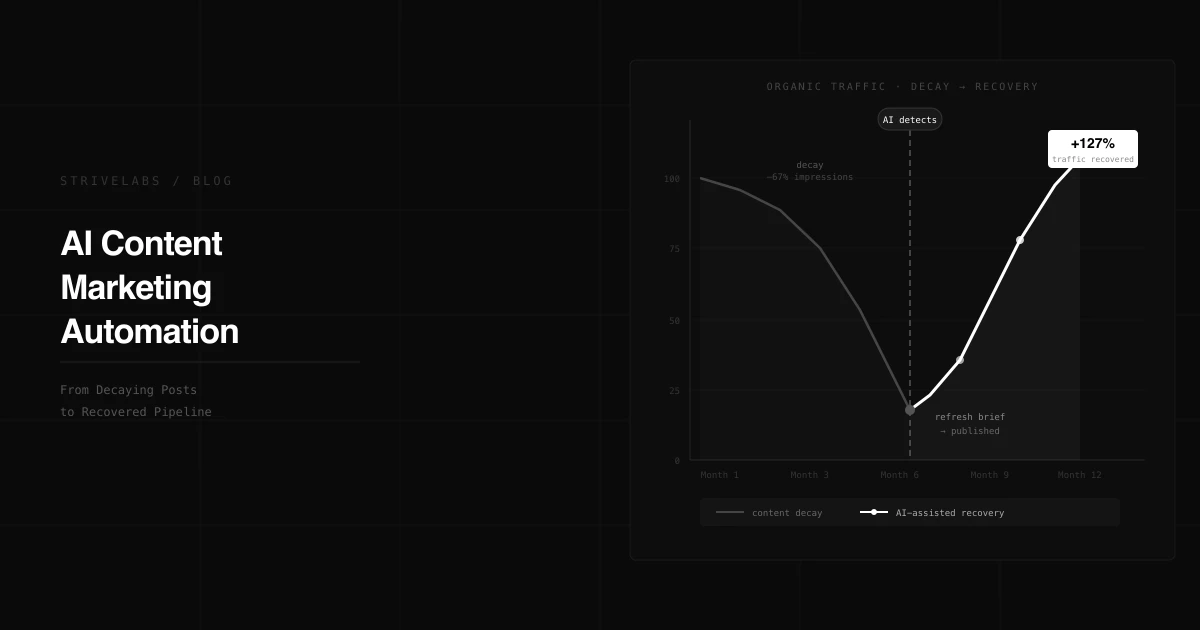
Most B2B SaaS marketing teams discover content decay the same way. A traffic alert on a Friday afternoon. A post that used to drive demo requests, sitting quietly on page two. Rankings slipped three weeks ago. The pipeline impact started two weeks after that. By the time anyone noticed, a full quarter of attributed touches had already gone with it.
This is not an SEO problem. It is a content ops problem, and it is almost entirely structural. Manual workflows create a lag between the signal and the action. In a 90-day B2B SaaS sales cycle, that lag is expensive. A high-intent post falling off page one does not just lose traffic. It removes a touchpoint that was actively influencing deals in progress.
AI content marketing automation closes that lag. This guide covers how specifically Strivelabs connects Search Console, GA4 and HubSpot to detect decay, generate briefs, produce drafts and connect every content decision back to pipeline impact. Not in theory. In practice, for a lean B2B SaaS marketing team running content alongside paid and CRM with a team of one or two.
At a Glance
-
Content decay in B2B SaaS is a pipeline problem first and an SEO problem second. A post that stops ranking removes attributed touchpoints from deals in progress.
-
The gap between signal and action is where the pipeline is lost. Manual workflows create a 7-21 day lag. Automated workflows close it to 48 hours or less.
-
AI content marketing automation does not replace the marketer. It removes the ops layer — monitoring, diagnosis, brief generation — so the marketer focuses on review and approval.
-
The pipeline connection is what separates content automation from content tools. Connecting GSC and GA4 data to HubSpot deals shows exactly which posts are driving revenue and which are silently losing it.
-
Human approval stays at every step. The agent detects, diagnoses and drafts. The marketer reviews and approves before anything goes live.
Why content marketing automation exists, and what it is actually solving
The problem is not that marketers are slow. It is that the workflow between signal and action requires too many manual steps.
A page drops from position three to position eleven. The signal exists in Search Console. The marketer checks Search Console on Fridays or on a good week, on Wednesdays. By Friday they have the signal. They spend an hour diagnosing why. They decide a refresh is needed. They brief a writer using a template that was last updated six months ago. The writer gets the brief in two days. The draft comes back in a week. The marketer edits and approves. The post goes live three weeks after the original signal.
In a 90-day sales cycle, three weeks is not a small delay. A buyer who found that post in week one of their research is now in week four. If the post dropped off page one in week two and was not refreshed until week five, that buyer found a competitor's post instead. The content was never bad. The ops were too slow.
AI content marketing automation solves the ops problem. Not the writing problem. Not the strategy problem. The gap between signal and action, that is what it closes.
| Manual workflow | AI content marketing automation | |
|---|---|---|
| Signal to brief | 7-21 days | Under 48 hours |
| Decay detection | Reactive — noticed after traffic drops | Proactive — caught as impressions fall |
| Brief quality | Template-based, static | Data-driven, built from live GSC signals |
| Pipeline connection | Manual CRM cross-reference | Automatic — HubSpot deals mapped to pages |
| Human involvement | Every step | Review and approval only |
What your content marketing week looks like before automation
Monday: Check Search Console manually. Flag two posts that look like they might be dropping. Add them to a spreadsheet to investigate later.
Tuesday and Wednesday: Actual work. Writing, campaigns, meetings. The flagged posts sit in the spreadsheet.
Thursday: Revisit the spreadsheet. One post has definitely dropped. Write a brief. Realise the brief template is from last year and the competitive landscape for that topic has changed entirely.
Friday: Brief is half-done. Pulled into a reporting meeting. The brief waits until next week.
The post continues dropping. By the time the refreshed version is live, it has lost three weeks of impressions on a high-intent keyword that was directly attributed to four deals in the last quarter. This is not a skill failure. It is a structural one.
What content marketing automation actually looks like when it runs
AI content marketing automation does not replace the marketer's judgment. It replaces the ops layer that sits between the signal and the marketer's judgment.
Inside Strivelabs, here is what that looks like in practice:
Daily monitoring runs automatically.
The Strivelabs SEO agent reads Search Console and GA4 data every day. It is not waiting for the Friday check. It watches impressions, click-through rates, ranking positions and assisted conversions continuously, for every page on the site.
When a signal fires, the agent diagnoses, not just alerts.
Most tools send an alert. 'Page X dropped from position 3 to position 12.' The marketer still has to figure out why. Strivelabs' agent investigates. It checks whether a competitor published a more comprehensive post on the same keyword. It checks whether the page's click-through rate dropped before the ranking did, which usually signals a meta description issue, not a content issue. The agent brings a diagnosis, not a data point.
The brief is generated from the diagnosis.
Not from a template. From the specific signals that caused the drop. The brief includes the target keyword with current intent mapping, the competitor content that is now outranking the page, the specific sections that need updating, and internal link recommendations based on HubSpot deal data.
The draft is queued for review.
The agent produces the first draft. The marketer reviews it. Nothing goes live without approval. The audit trail is automatic.
The pipeline connection is always visible.
Because Strivelabs connects GSC data to HubSpot, the marketer can see not just that a post is losing traffic, but that the post was an attributed touchpoint in eleven deals last quarter. That changes the priority calculation entirely.
Learn more about how closed loop marketing connects campaigns to pipeline.
Better decisions start with better infrastructure.
Most mid-market teams pick a channel and hope. Strivelabs gives you the data to know, and the infrastructure to act on it.
Book a Demo →
Content decay — the specific signals that mean a post is losing pipeline, not just traffic
Not every traffic drop is a pipeline problem. These are the specific signals that indicate pipeline-relevant decay:
-
Falling impressions on high-intent queries. In Search Console, filter by queries containing commercial intent terms, 'best,' 'vs,' 'pricing,' 'alternative,' 'how to.' If impressions for these queries are falling on a specific page over a 90-day rolling window, the page is in decay on the terms that matter most.
-
Assisted conversions dropping in HubSpot. When a page's assisted conversion rate, the number of deals where this page appeared as a touchpoint, starts falling, the page is losing pipeline impact whether or not overall traffic has moved.
-
Click-through rate falling while position holds. A competitor has improved their title tag or meta description and is stealing clicks. The page has not dropped yet. It will. This is a 2-3 week warning.
-
Session duration falling on referral traffic. Visitors arriving from search and leaving quickly means the content no longer matches what they expected. The keyword intent has shifted.
-
SERP feature loss. If the page previously held a featured snippet or People Also Ask position and no longer does, a competitor has taken that position. Featured snippets in B2B SaaS typically drive 20-30% of total clicks for informational queries.
The four-level content monitoring framework — where does your team sit?
Most content teams operate at Level 1 or Level 2. Strivelabs operates at Level 4.
| Level | What you get | Who does it |
|---|---|---|
| Level 1 — Detection | "Rankings dropped." You find out when you check Search Console. Usually Friday. Usually 2-3 weeks after the damage started. | You, manually |
| Level 2 — Diagnosis | "Rankings dropped and here is probably why." You spend an hour investigating. You are right about 60% of the time. | You, manually |
| Level 3 — Recovery | Rankings dropped, brief is ready, draft is queued. Time from signal to live page: 48-72 hours instead of 3-4 weeks. | System + your approval |
| Level 4 — Pipeline connection | Rankings dropped, brief ready, draft queued — and this post was attributed to $280k in pipeline last quarter. Refreshing it is a revenue recovery task, not an SEO task. | Strivelabs + your approval |
How AI Content Marketing Automation Runs the Full Loop
Step 1 — Signal
Strivelabs' SEO agent reads GSC and GA4 data daily. It flags pages showing two or more decay signals. Pages with high HubSpot deal attribution are prioritised automatically.
Step 2 — Diagnosis
The agent runs four checks: competitor analysis, intent shift detection, technical audit, and CTR analysis. Different root causes need different fixes. The agent identifies which before producing a brief.
Step 3 — Brief generation
The brief is built from the diagnosis, not from a template. It includes: primary keyword with current intent mapping, SERP gap analysis, specific sections to update, internal linking recommendations, and HubSpot context on which audience segments visited this page.
Step 4 — Draft production
Strivelabs produces the first draft against the brief. The draft is scored before it reaches the marketer, checked against keyword coverage, intent match and completeness. Low-scoring drafts are flagged before review, not after.
Step 5 — Human review and approval
The marketer reviews the draft. Brand voice, strategic accuracy, competitive claims, factual details. They approve or request changes. Nothing goes live without sign-off. The audit trail is automatic.
Step 6 — Publish and monitor
The updated post goes live. Strivelabs continues monitoring it. If the refresh does not recover the ranking within 30 days, a second diagnostic runs automatically.
Why Content Marketing Automation Is a Revenue Play Not SEO
A post that is losing traffic is described as an SEO problem. Refresh it, recover the ranking, recover the traffic. That is the standard framing. For a B2B SaaS company with a 90-day sales cycle, that framing is incomplete.
A post that was an attributed touchpoint in twenty deals last quarter is not just a page with declining impressions. It is infrastructure that was actively influencing buyers during their research phase. When it falls off page one, those buyers find a competitor's post instead. The touchpoint does not disappear from the buyer's journey, it gets replaced by someone else's.
Strivelabs makes this visible. Because GSC data and HubSpot deal data are connected, the agent does not just flag that a post is losing impressions. It flags that a post is losing impressions and that post was attributed to $340k in pipeline last quarter.
A content team that prioritises refreshes based on traffic data will fix their highest-traffic declining pages first. A content team that prioritises based on pipeline attribution will fix their highest-revenue declining pages first. Those are rarely the same list.
AI Content Marketing Automation Still Needs Human Judgment
The AI agent handles detection, diagnosis, brief generation and first-draft production. The marketer handles everything that requires judgment.
Brand voice.
The agent produces a draft that is accurate, well-structured and keyword-optimised. It does not know that your brand never uses a particular phrase, or that a competitor comparison is legally sensitive. The marketer reads for the brand before approving.
Strategic topic prioritisation.
The agent prioritises by pipeline attribution and ranking potential. It does not know that you are repositioning the product or that the content calendar is intentionally lighter for the next six weeks. Strategic calls stay with the marketer.
Competitive claims.
Any content that makes specific claims about competitors needs human review before it goes live. The marketer decides how aggressively to address competitive gaps.
Factual accuracy.
For technical or highly specific content, the marketer or a subject matter expert checks facts before approval. The agent is accurate on the signals it reads. It is not a replacement for domain expertise.
Start Your First AI Content Marketing Automation With Strivelabs
You do not need to automate everything on day one. Start with one post. Find the highest-pipeline post on your site that is currently in decay, declining impressions on high-intent queries, falling assisted conversions in HubSpot, or a ranking drop in the last 60 days.
-
Week 1: Connect GSC, GA4 and HubSpot to Strivelabs via OAuth. It takes under five minutes. No engineering required. The SEO agent starts reading your data immediately and surfaces the top five pages showing decay signals.
-
Week 2: Pick the page with the highest HubSpot pipeline attribution that is in decay. Review the agent's diagnosis. Check whether you agree with the root cause assessment. Approve the brief or adjust it.
-
Week 3: Review the agent's draft. Edit for brand voice, strategic accuracy and competitive claims. Approve and publish.
-
Days 30-90: Monitor the page's recovery. Track impressions, click-through rate and assisted conversions in HubSpot. The pipeline impact of the refresh becomes visible within one full sales cycle.
Want to go deeper on measuring what works? Read the marketing experimentation operating model.
Most Strivelabs customers see the first assisted conversion recovery from a refreshed post within 60-90 days. By 2028, 60% of brands will use agentic AI — teams that build the content ops infrastructure now will compound that advantage. That is the proof of concept. From there, expanding the workflow to five pages, then ten, then the full site is straightforward.
Conclusion
AI content marketing automation solves a specific problem: the lag between a content signal and a content action. For B2B SaaS teams with a 90-day sales cycle, that lag is not a minor inefficiency, it is a pipeline risk.
Strivelabs closes the lag by connecting GSC and GA4 signals to HubSpot pipeline data, running daily monitoring, generating data-driven briefs and producing first drafts for review. The marketer stays in control of brand voice, strategy and approval. The agent handles the ops layer that was previously eating three weeks of time for every single refresh.
Start with one decaying post. Connect your data. Let the agent run the first diagnostic. The pipeline connection becomes visible within the first week.
The marketing engineer function, delivered as software.
See how Strivelabs gives mid-market teams the operational capacity without the hiring cost.
Explore Strivelabs →
Frequently Asked Questions (FAQs)
How is agentic AI different from generative AI for content marketing?
Generative AI produces content from a prompt. Agentic AI runs a continuous loop — monitoring performance signals, diagnosing root causes, generating briefs, producing drafts and measuring outcomes — without being prompted each time. The key difference is that agentic AI acts on data continuously. Generative AI responds to instructions when asked.
What does content decay mean in pipeline terms for B2B SaaS?
A decaying post is a content touchpoint losing its ability to reach buyers during their research phase. In a 90-day sales cycle, a high-intent post dropping off page one removes an attributed touchpoint from deals in progress. The revenue impact is calculable: multiply the post's previous assisted conversion rate by average deal size to see the pipeline at risk.
How quickly can content marketing automation show ROI for B2B SaaS?
Most teams see measurable assisted conversion recovery within 60-90 days of refreshing a high-pipeline decaying post. This aligns with a typical B2B SaaS sales cycle. The fastest signal is click-through rate recovery — usually visible within 2-4 weeks of a successful refresh.
What is the first step to connecting content performance to CRM data?
Connect Google Search Console and HubSpot to Strivelabs via OAuth. The integration maps page-level traffic data to HubSpot deal records. Once connected, the agent shows which specific pages appear as touchpoints in open and closed deals — giving content decisions a pipeline value, not just a traffic value.
Does AI content marketing automation replace the content team?
No. Automation removes the ops layer, monitoring, diagnosis, brief generation, first drafts. Human judgment stays essential for brand voice, strategic topic selection, competitive claims and factual accuracy. The best content operations run when the agent handles the data-heavy work and the marketer handles the decisions that require expertise and context.