Machine suggestions are getting sharper every day. But if you are a marketing leader, that speed creates a real risk. Control matters. When an AI marketing platform tries to shift $100,000 between your accounts or kill a winning audience, you need a safety net. While fast execution is a goal, nobody's looking to accelerate straight off a cliff. Guardrails keep your operations from crashing.
Why does the human in the loop matter so much? This guide looks at which tasks require your manual check. Inside, see how to build approval steps that don't cause a bottleneck.
The right question is not whether your agent should be autonomous. The right question is which actions deserve autopilot, which deserve batch approval, which deserve one-by-one approval, and which should never leave a human owner.
It's a balance where confidence scores and audit logs protect you as you move toward autonomy. For your pilot, you can find vendor workflows and checklists. If you are a decision-maker weighing AI marketing platform options, use these rules to pick what stays manual and what the system handles.
At a Glance
-
An ai marketing platform stays fast and safe when human in the loop ai checks are there to catch major risks.
-
Skipping manual gates during big budget shifts or price changes often leads to hits you don't want.
-
94% of marketers plan to use AI for content creation in 2026. The teams scaling fastest aren't the ones with the most autonomy, they're the ones with the clearest approval frameworks.
-
Reliable software uses confidence scores to filter tasks. While simple jobs finish alone, uncertain work won't pass without a look from you.
-
Every automated or manual step needs a detailed audit trail. This lets the team see exactly what's happened at each stage.
What to know about AI marketing platforms
An ai marketing platform blends automation with human oversight. It spots trends and suggests actions, but it doesn't take over because it leaves the final call to you. Your team moves faster without losing control. It is about balance.
Marketing leaders see real gains. You get quick advice and a solid audit trail for reviews, which helps you stay on top of compliance. That makes ownership clear.
Follow these three tips.
-
Use automation for easy tasks like minor bid changes or swapping old ad images.
-
Have a manager review bigger moves, like shifting budgets or blocking specific audiences.
-
Set a rule for manual sign-off on anything that affects your revenue or legal status.
Why human-in-the-loop matters in AI marketing
Human oversight is the guardrail that keeps fast models from turning into legal liabilities. As automation scales, you'll notice that balancing speed and safety is a real challenge. You protect your brand from reputation damage by setting clear boundaries. This keeps things secure.
-
Your staff provides the context code doesn't often catch, like logistics hitches or unannounced product debuts.
-
Risk assessment takes a specific judgment that raw data do not replicate for your brand identity.
-
Giving an algorithm total control can lead to a financial drain if errors aren't checked by a supervisor.
-
Real people manage the edge cases. Through manual tweaks, you teach the system how to improve future accuracy.
Actions AI should not run
Using an ai marketing platform without human oversight often leads to legal headaches or wasted money. While automation saves time, certain marketing steps are just too dangerous to leave on autopilot. You'll want to verify these actions before they go live. Managing those boundaries is the only way to stay safe because every category carries a different risk level.
| Action type | Risk level | Business impact | Recommended approval owner |
|---|---|---|---|
| Major budget shifts | High | Big spending changes can kill your pacing or empty accounts | Marketing head or Finance |
| Audience exclusion tasks | High | Poor data limits your reach and may violate privacy statutes | Channel owner and Legal |
| Price and checkout edits | Very high | Wrong prices damage your revenue and your brand's name | Product lead and Finance |
High-value budget changes
Establish firm boundaries before your software begins shifting funds. It's fine to automate minor adjustments, but larger shifts usually require a person to check the math first so you don't end up with a massive bill.
-
You should require approval for any move exceeding 10 percent of your weekly budget or any single transfer over 10,000 dollars.
-
A common risk involves burning through cash too quickly or managing bots that try to execute conflicting strategies simultaneously.
Audience suppression operations
Removing users from a campaign shifts who interacts with your brand. This move is a gamble because it involves data consent and strict privacy laws. Because these lists fall under heavy regulation, you don't want to get this wrong or risk a fine.
-
One common error includes accidentally blocking active shoppers during a holiday sale or ignoring regional data rules that vary by location.
-
Poor suppression leads to missed revenue, messy algorithm training, and potential legal trouble regarding how your system handles personal info.
Pricing and checkout updates
Setting prices is far too sensitive for a computer to manage alone. Small errors in the checkout process can destroy your profit margins, making the risk simply too high.
-
You might find prices falling below your actual costs or see an old SKU set as the default, which confuses shoppers immediately.
-
These errors cause customer frustration and lead to a pile of refunds while your staff works to fix the damage.
Budget decisions are where attribution data matters most, see how closed loop marketing connects spend decisions to closed revenue before you let an agent touch your budget
Better decisions start with better infrastructure.
Most mid-market teams pick a channel and hope. Strivelabs gives you the data to know, and the infrastructure to act on it.
Book a Demo →
Designing approval gates
Building an approval gate is mostly about transforming machine output into human decisions quickly. You don't want a human in the loop setup to slow things down or create a massive queue. True speed happens when the team sees exactly what they need to make a call without digging through irrelevant files.
Approval workflow components
Every approval gate should include a predictable set of elements so your reviewers never have to hunt for context.
-
Reviewers should see the specific trigger or event that caused the system to make its suggestion.
-
Every recommendation must list clear next steps and describe the likely outcome if a user follows the automated advice.
-
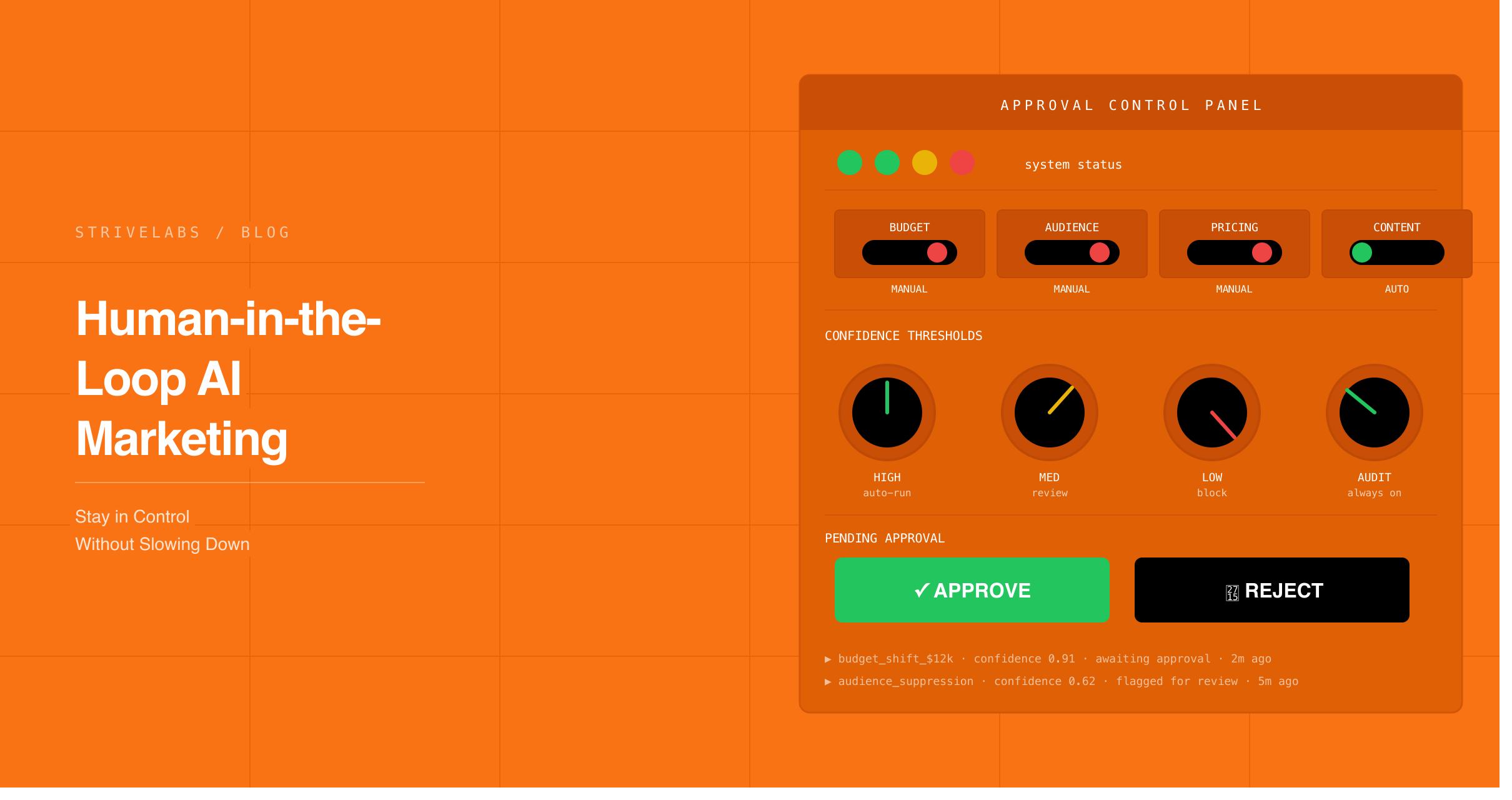
A visible confidence score lets people judge how sure the model is about its logic.
-
When you assign a specific role to a task, the person responsible for the final outcome is always obvious.
-
High-speed situations benefit from buttons that let you approve or reject a task with a single click.
-
An audit log tracks every input and notes exactly when a human made their final decision.
Notification vs. action
Not every alert needs a signature. Some events just need a quick look, though others require a formal sign-off before anything moves. Why force a manager to click "okay" for a typo fix?
-
You might get passive notifications that just record data without asking for any feedback or input.
-
Actionable alerts give you a path forward and enough background to hit "approve" right away.
-
If the first owner doesn't respond in time, the system passes the task to the next person in the chain.
How confidence scoring and thresholds work
How sure is the human in the loop ai about a specific tip? Using confidence scores lets you sort tasks and bypass some manual checks.
-
If the risk is low and the score is high, let the system finish the task and just log what happened.
-
Tasks with middle-range confidence scores should go to a manager for a fast check before they go live.
-
High-stakes decisions or low-confidence model results usually require a senior staff member to step in.
-
The agent making these recommendations runs on the same infrastructure a marketing engineer would build manually, the difference is it's managed for you
Approval UX best practices for AI marketing platforms
Good design keeps your staff from getting burned out. It makes it easier to stay in control without spending all day on a single screen.
-
Focus on the two or three metrics that matter most instead of staring at a massive wall of data.
-
It is easier to act when you can click once from a notification, maybe adding a quick note about why you chose that path.
-
The interface should clearly show who is in charge and how many minutes are left before the deadline passes.
-
Errors happen, so make sure there is a quick way to undo an action without starting from scratch.
Dumping rows of raw data on a user is a mistake. If people have to click through five pages to approve a small edit, the design has failed. Being clear is always better than being deep.
Audit trails and explainability in human in the loop AI
Good logs reveal who made a choice and why. Build trails that are simple to scan.
-
Every entry tracks the trigger, data state, and your human in the loop ai version. Include confidence scores and the approver.
-
These records help you spot mistakes while meeting regulatory standards. If data is clear, stakeholders trust the system more.
-
You might store data for one year or seven years. It depends on your industry. Don't skip bulk exports for legal reviews.
-
Give a short reason for each recommendation. When signals are visible, reviewers see why your model wanted a change.
Scaling from human supervision to autonomy
Reaching full autonomy takes time. Start with tight constraints. Watching metrics carefully helps you know when the system is ready to operate freely. Invest in human-in-the-loop governance before a public incident makes it urgent. The median mid-market marketing team spent $1,200 per month on AI tools in Q1 2025 and $3,400 per month in Q1 2026, the spend is scaling faster than the governance frameworks that protect it.
How to set approval tiers
Assign risk levels to specific roles to avoid delays and manage friction throughout the workflow.
-
Minor tasks run on autopilot while owners monitor a simple dashboard for errors.
-
For standard updates, a team lead provides a quick approval before things go live.
-
Executives must provide a manual signature for any major legal or marketing changes.
Signals that reduce oversight
What data proves that you can finally stop worrying?
-
High accuracy is clear when machine suggestions consistently turn into wins for the brand.
-
If rollbacks are rare, it is a sign that automated actions don't need fixing.
-
Steady outcome scores stay within your expected bounds during the whole test window.
Start with alerts first. Move to one-click sign-offs next. Eventually, the machine handles the work while you monitor the dials. Keep a kill switch ready.
The technical architecture that makes safe autonomy possible i.e. data pipelines, orchestration, and audit layers, is covered in the marketing engineer tech stack guide.
How Strivelabs handles approvals
Approval checkpoints sit directly inside the Strivelabs agent workflow. These agents suggest paths and explain their confidence levels. Once you verify these options, use the simple buttons to maintain an organized audit trail. It's fast.
-
Every suggestion lists a logic summary, the expected benefit, and the actual data points.
-
The system won't send changes to your billing or ad settings until you give the final go-ahead.
-
It links tools like Slack or Google Ads with current market shifts so you'll get the whole picture.
-
Your history logs track which model ran and who authorized it to simplify troubleshooting.
Conclusion
Stick to Human-in-the-loop setups. By pairing an ai marketing platform with careful manual oversight, you capture speed while stopping dangerous errors. That balance usually relies on tiered thresholds and scoring that flag when humans should intervene. Audit trails help too, so you don't lose accountability. You should begin with limited tasks and only grow that autonomy once your specific metrics prove the system is reliable.
The marketing engineer function, delivered as software.
See how Strivelabs gives mid-market teams the operational capacity without the hiring cost.
Explore Strivelabs →
Frequently Asked Questions (FAQs)
How does a confidence score affect an AI-recommended marketing action?
Confidence levels show how much a machine trusts its own advice. If the software hits a high percentage, it might just go ahead and log the action automatically. But if that number falls below your set threshold, the process stops until you take a look. This setup keeps a human in the loop so the technology never goes rogue with your budget.
Can our human-in-the-loop AI workflows become fully automated over time?
Routine tasks that don't carry much risk can often run on autopilot once the tech proves it can handle them. Still, you should probably wait to turn off the manual oversight until the success rate stays steady for months to keep your data safe.
What happens if a high-risk AI marketing action is approved by mistake?
If a major blunder happens, a deep audit trail shows which model version was active and who clicked the "approve" button. You can use rollback tools to undo the mess right away. Once things calm down, you can figure out what went wrong. Adding more approval steps might prevent the same slip-up from happening again.
How can we ensure our AI's audit trail is sufficient for regulatory compliance?
Meeting regulations means you have to record every single input, the specific model version, and the confidence score for each choice. You also need to keep track of who gave the final okay and exactly when they did it. Saving these files in a basic format makes things much easier if a legal team ever needs to check your work.
Does implementing human approval workflows for AI require a dedicated team?
You do not usually need to hire a whole new team just to handle these checks. Most of the time, the software sends the task to the person who is already managing that part of your business. For instance, an ad manager might review small tweaks to a campaign while someone in finance signs off on the daily spend.