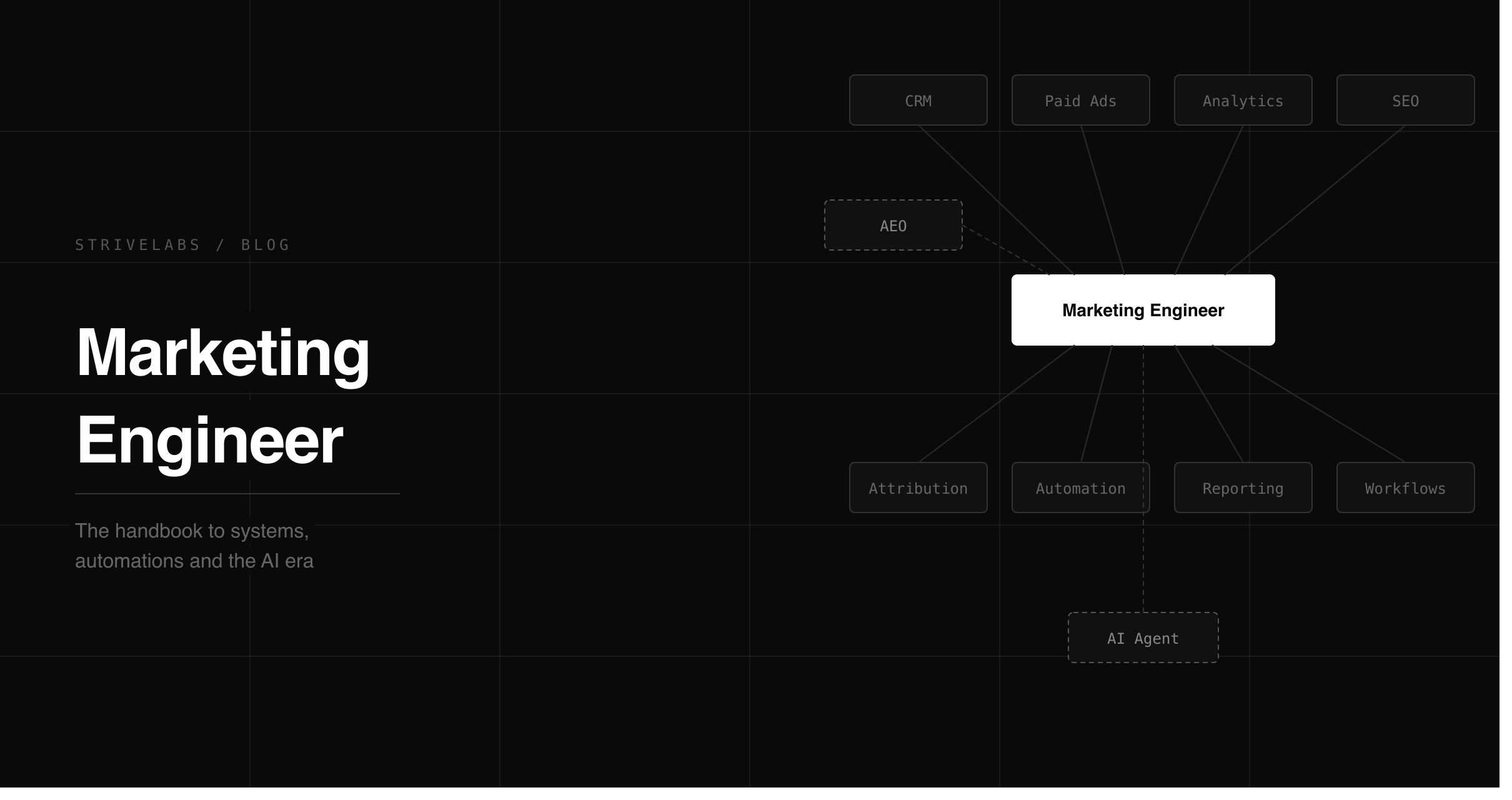
A marketing engineer sits at the intersection of marketing strategy, data systems, and automation, and the reason most mid-market teams are either desperately hiring for one, or quietly going without.
Marketing engineering is one of the most consequential, and least understood functions in a modern marketing team. This guide breaks it down completely. We cover what marketing engineering is, what it does, why it's hard to get right, what it looks like when it's working, and what the AI era changes about all of it.
What is a marketing engineer?
Marketing has split in two. On one side: strategy, creative, positioning, story. On the other: data pipelines, martech integrations, automated workflows, attribution models, and the logic that ties it all together. The first half has always had a home. The second half, the operational, systems-thinking, build-and-run-it half, is what a marketing engineer owns.
A marketing engineer is the person (or system) responsible for making the operational side of marketing actually work: connecting tools, automating recurring work, building measurement infrastructure, and ensuring that marketing execution scales without proportional headcount growth.
The title surfaces under several names: digital marketing engineer, technical marketing engineer, marketing automation engineer, or simply full stack marketer. What unifies them is the same underlying capability: understanding both what marketing needs to accomplish and how to build the systems that accomplish it.
The role emerged from necessity. As the average marketing technology landscape swelled past 15,000 solutions, teams discovered that buying software was the easy part. Connecting it, maintaining it, extracting signal from it, and building automated workflows on top of it. That required a different kind of thinking than traditional marketing provided.
Unlike a demand gen marketer who runs campaigns or a product marketer who crafts messaging, the marketing engineer thinks in systems. Their job isn't to write the email, it's to build the infrastructure that sends the right email to the right person at the right time, without anyone having to manually trigger it.
What marketing engineering actually does for a business
Strategy is only as good as its execution. For most marketing teams, the gap between what they plan and what actually ships, consistently, at scale, with proper measurement, is where growth leaks out. Marketing engineering plugs those leaks.
Connects your martech stack into one working system
The average mid-market team runs 12–20 marketing tools. CRM, email platform, ad accounts, CMS, analytics, SEO tools, attribution software, chat, scheduling, forms. Each was bought to solve a specific problem. None of them talk to each other by default.
A marketing engineer, or an agentic system performing that function, identifies the canonical data flows the business actually needs, builds the integrations, and maintains them as tools change. The result is a stack that works as a system rather than a collection of silos.
Replaces manual marketing work with automated workflows
Most marketing teams spend the majority of their time doing the same things repeatedly: drafting content variations, routing leads, updating segments, pulling performance reports, monitoring competitor activity, refreshing SEO metadata. These aren't strategic decisions, they're executional tasks that happen to require judgment.
Marketing engineering replaces that recurring execution with automated routines that run on schedule or on triggers. A well-built routine executes consistently, with defined guardrails, and surfaces its outputs for human review rather than bypassing judgment entirely.
The distinction matters: good marketing engineering isn't about removing humans from the loop. It's about removing humans from the parts of the loop that don't require them, so they can focus on the parts that do.
Builds attribution and reporting that actually reflects reality
Last-click attribution is a comfortable lie that most marketing teams quietly rely on. A technical marketing engineer builds the measurement infrastructure to tell a more honest story: which channels are actually influencing pipeline, where funnel velocity is slowing, and what the real return on each program looks like.
This isn't just a reporting exercise. When attribution is accurate, budget allocation becomes defensible. When reporting is automated, marketing leaders spend their time acting on insights rather than assembling them.
| Capability | Without marketing engineering | With marketing engineering |
|---|---|---|
| Lead routing | Manual, delayed, inconsistent | Automated on trigger, within minutes |
| Attribution | Last-click, per-platform reporting | Multi-touch, connected to revenue |
| Reporting | Weekly manual assembly, 4+ hours | Always-on, auto-generated |
| Content at scale | One writer, one output at a time | Routines draft variants, human approves |
| Competitive intel | Ad hoc, when someone remembers | Monitored automatically, alerts on change |
| Audience management | Static segments, manually updated | Dynamic, behavior-triggered, always current |
Why marketing engineering is hard to get right
If marketing engineering were easy, every team would have it. Most don't, and the ones that try to hire for it discover that the role is harder to staff, harder to retain, and harder to scale than almost any other function in the marketing org.
The tools are complex and constantly changing
The martech landscape doesn't stand still. New platforms emerge, existing ones release breaking API changes, integrations that worked last quarter need to be rebuilt. Staying current requires sustained effort, and the moment you stop investing, the system starts degrading.
For mid-market teams without a dedicated technical marketing function, this often shows up as a slow accumulation of broken automations, stale segments, and reports that stopped reflecting reality months ago.
The maintenance trap: Most teams underestimate the ongoing work required to keep a marketing stack healthy. Building it once takes months. Keeping it working indefinitely requires someone whose job it is to watch, fix, and evolve it continuously.
It sits between two teams that speak different languages
Marketing engineers translate constantly. They need to understand what a demand gen manager actually needs from a lead scoring model, and then build something that engineering's API infrastructure can support. They need to explain to a CMO why their attribution numbers look different from what the ad platforms are reporting, and why that gap is expected.
The skills required, technical depth, marketing fluency, communication that spans both, are genuinely rare. Which is part of why the marketing engineer barely exists as a staffed role in most mid-market companies, even when the need for the function is acute.
Building it from scratch takes months
| Phase | Description |
|---|---|
| Discovery and documentation | Understanding what's in the stack, how data flows today, and what's broken or missing. This alone takes 2–4 weeks. |
| Integration architecture | Designing the data model and determining which integrations to build, buy, or deprecate. Another 3–6 weeks. |
| Workflow design | Mapping the recurring work that should be automated and designing the logic to handle it, including edge cases and guardrails. |
| Build and test | Actually constructing the automations, running them in staging, handling failures gracefully. |
| Measurement infrastructure | Attribution models, reporting pipelines, dashboards that give the team a reliable picture of what's working. |
| Ongoing iteration | Monitoring outputs, updating logic as the business changes, onboarding new tools, deprecating old ones. |
By the time this is complete, the business has changed. Marketing engineering is never "done," it's a continuous function that needs to evolve with the company's motion.
There's no one to mentor them — and no way to know if they're good
A marketing engineer in a mid-market company is almost always the only one. There is no senior marketing engineer above them to learn from, no peer to pressure-test decisions with, and no manager who can evaluate whether their architecture choices are sound or their automations are well-built.
This creates a quiet but serious organizational problem. Performance reviews become guesswork. The CMO can see outputs, campaigns running, reports appearing, but has no frame of reference to assess the quality of the underlying systems. Is the lead scoring model actually accurate, or just seemingly functional? Is the integration layer robust, or one API change away from breaking? Without the expertise to evaluate the work, it's nearly impossible to give meaningful feedback.
The downstream consequence is retention. Marketing engineers who are good enough to build something meaningful are also good enough to know when they're stagnating. Without mentorship, without challenge, and without a clear path to grow into a more senior version of the role, because that role often doesn't exist either, they leave. The systems they built leave with them, or worse, get inherited by someone who doesn't fully understand them.
The invisible retention problem: Most companies lose their marketing engineer not because the role was wrong but because the organizational infrastructure to support it never existed. The hire was made. The systems were built. The growth path was missing.
Better decisions start with better infrastructure.
Most mid-market teams pick a channel and hope. Strivelabs gives you the data to know, and the infrastructure to act on it.
What marketing engineering looks like in practice
Marketing engineering has two distinct layers that are easy to conflate. The first is the engineering work underneath, unglamorous, largely invisible, and genuinely hard to get right. The second is what the business experiences as a result of that work being done well. Both matter. Most conversations about marketing engineering only cover the second.
The engineering challenges underneath
Before any automation runs reliably, a significant amount of foundational infrastructure has to be built and maintained. This is the work that rarely gets talked about but determines whether everything built on top of it holds up.
| # | Capability Area | Description |
|---|---|---|
| 01 | Integration architecture and API maintenance | Every tool in the stack exposes data through an API. Each one has its own schema, rate limits, authentication model, and deprecation cycle. A marketing engineer designs the integration layer that connects them, and rebuilds it when platforms release breaking changes. This isn't a one-time project. It's a continuous maintenance obligation that quietly consumes significant engineering capacity. |
| 02 | Data sync and consistency across systems | When a lead's company changes size in the CRM, does that update propagate to the lead scoring model, the ad audience, the nurture sequence, and the attribution report? In most stacks it doesn't, without deliberate engineering work to keep data consistent across systems. Designing sync logic, handling conflicts, and ensuring the canonical record is always current is foundational infrastructure that most teams don't have. |
| 03 | Taxonomy and schema management | Marketing data is only as useful as the structure it lives in. Campaign naming conventions, UTM taxonomies, contact property schemas, event naming, these need to be defined once, enforced consistently, and evolved carefully as the business changes. Without governance here, reporting becomes unreliable, attribution breaks down, and the data layer quietly degrades over time. |
| 04 | Scalable and reliable workflow runtime | Running an automation once is easy. Running it reliably at scale, handling failures gracefully, retrying on transient errors, logging outputs, alerting on anomalies, and ensuring it degrades cleanly when a downstream system is unavailable, is engineering work. Most marketing automation platforms abstract some of this, but the edge cases surface quickly when workflows run in production at volume. |
| 05 | Agent runtime infrastructure in the AI era | As marketing engineering shifts toward agentic execution, a new layer of infrastructure emerges: prompt management, model versioning, output validation, hallucination guardrails, approval workflows, and observability into what the agent is doing and why. This is genuinely new engineering territory, and building it reliably, at a pace that keeps up with the underlying model capabilities, is one of the defining technical challenges of modern marketing infrastructure. |
What gets delivered when the infrastructure is right
When the engineering layer is built properly and maintained consistently, the outputs that reach the business feel almost effortless. Here's what a functioning marketing engineering layer actually delivers for a mid-market B2B team day to day.
| # | Capability Area | Description |
|---|---|---|
| 06 | Automated lead qualification and routing | Inbound leads are scored against ICP criteria in real time: firmographic fit, behavioral signals, intent data. Leads above threshold are routed to the right sales rep with full context attached. Below-threshold leads enter nurture sequences calibrated to where they are in the funnel. No one manually touches a lead to move it through this process. |
| 07 | Competitive intelligence on autopilot | Competitor positioning pages, pricing pages, and product announcements are monitored continuously. When material changes are detected, a structured summary is surfaced to the relevant team: product marketing, sales enablement, leadership. Signal reaches the right person at the right time, without anyone manually watching for it. |
| 08 | Cross-channel attribution connected to revenue | Every marketing touchpoint, paid, organic, email, content, events, is mapped into a unified model that traces back to pipeline and closed revenue. Marketing leaders can answer "what's actually working" with data that accounting and sales would recognize, not just platform-reported impressions and clicks. |
| 09 | Campaign performance monitoring without manual reporting | Performance data across all active campaigns rolls into a live reporting layer. Anomalies, unexpected spend spikes, conversion rate drops, audience fatigue signals, trigger alerts automatically. Weekly performance summaries are generated and delivered. The team reviews outputs and makes decisions, not spreadsheets. |
| 10 | Audience and segmentation management at scale | Audience segments are defined once, with behavioral and firmographic logic, and maintained dynamically. As contacts move through the funnel, they enter and exit segments automatically. Suppression lists stay current. Personalization works because the data powering it is clean, consistent, and governed. |
The engineering challenges and the delivered outcomes are inseparable. Teams that try to get the outputs without investing in the infrastructure end up with automations that work intermittently, attribution that can't be trusted, and a stack that degrades faster than it improves.
What makes marketing engineering different in the AI era
Marketing engineering has existed in some form since the first marketing automation platform went live. What's changed, fundamentally, is the cost and accessibility of building it.
For most of the last decade, doing marketing engineering well required expensive technical talent (marketing automation engineers and full stack marketers don't come cheap), significant time investment to build and maintain the systems, and a tolerance for complexity that most marketing leaders didn't have bandwidth for. The result: marketing engineering was effectively reserved for enterprise teams with resources to staff it.
The shift: from staffing to software
AI-native marketing systems can now perform the core functions of a marketing engineer: discovery, system design, workflow construction, monitoring, iteration, at software cost and software speed. An agentic marketing platform analyzes your business, designs automations tailored to your actual data, and runs the recurring 80% of marketing execution while surfacing outputs for human review.
This doesn't eliminate the need for marketing engineering judgment. It eliminates the need to hire three people to deliver it.
According to a recent McKinsey article, it is estimated that agentic AI will come to power as much as two-thirds of current marketing activities, accelerating campaign creation and execution by ten to fifteen times compared to traditional workflows. For mid-market teams, the implication is significant: the operational capacity that once required a dedicated marketing engineering hire is increasingly accessible as infrastructure.
| Traditional marketing engineering | Agentic marketing engineering |
|---|---|
1–3 dedicated hires | Software-delivered capacity |
Months to build | Days to deploy |
Static automations | Adaptive routines |
Reactive monitoring | Continuous monitoring |
Ad hoc iteration | Natural language design |
Is marketing engineering right for your business?
Marketing engineering isn't a luxury feature for companies past a certain scale. It's the operational layer that determines whether marketing actually compounds over time, or stays stuck in a cycle of manual execution that doesn't scale.
The question isn't whether your business needs marketing engineering. It's whether you can afford to keep doing without it.
The mid-market is where the gap is most acute. Enterprise companies have engineering resources. Early-stage startups can move fast enough to get by without systems. Mid-market teams, 50 to 500 employees, $5M to $100M in revenue, are too complex to operate informally but too lean to staff a proper marketing engineering function.
That's exactly who agentic marketing was built for.
Upgrade to an Agentic Marketing OS
Connect your stack, get content work routed to the right person with enforced approvals. No more decisions made blind to what you're spending on paid.
Frequently Asked Questions (FAQs)
What is a marketing engineer?
A marketing engineer is the person, or system, responsible for the operational infrastructure of a marketing team. This includes connecting the martech stack, building and maintaining automated workflows, designing attribution models, and ensuring that recurring marketing execution runs reliably without manual intervention. The role sits at the intersection of marketing strategy and technical systems thinking. It is sometimes called a digital marketing engineer, technical marketing engineer, or marketing automation engineer, but the underlying function is the same: making the operational side of marketing actually work at scale.
What does a marketing engineer do day to day?
Day to day, a marketing engineer builds and maintains the systems that make marketing execution consistent and scalable. This includes designing integration architecture between tools like CRMs, ad platforms, and analytics systems; building automated workflows for lead routing, lifecycle email, content distribution, and reporting; managing data taxonomy and schema consistency across the stack; monitoring automation health and fixing failures; and building attribution infrastructure that connects marketing activity to revenue. In the AI era, this also includes designing and overseeing agentic workflows, systems that plan, execute, and iterate on marketing tasks autonomously within defined guardrails.
How is a marketing engineer different from a marketing operations manager?
Marketing operations tends to focus on process management, platform administration, and campaign execution within existing tools: configuring HubSpot, managing workflows in Marketo, pulling reports. A marketing engineer goes deeper into the technical layer: building custom integrations, writing logic for data pipelines, designing scalable runtime infrastructure, and architecting systems that marketing operations then uses. The distinction is roughly the same as the difference between using software and building it. In smaller teams the roles often overlap significantly, but as complexity grows, the engineering depth required becomes a dedicated function.
Why is it so hard to hire a marketing engineer?
Marketing engineers require a rare combination of skills: technical depth in APIs, data pipelines, and automation infrastructure; genuine marketing fluency in campaign logic, attribution, and funnel mechanics; and the communication ability to translate between both. Candidates who are strong engineers often have limited marketing context. Candidates who are strong marketers often lack the engineering depth to build reliable systems. Beyond the skill gap, the role is structurally hard to retain, marketing engineers typically operate without a peer, mentor, or manager with matching expertise, which means performance evaluation is guesswork and career growth stalls. Most mid-market teams that try to hire for the role either fail to find a candidate or lose them within 18 months.
What is agentic marketing and how does it relate to marketing engineering?
Agentic marketing refers to the use of AI agents that can plan, execute, and iterate on marketing tasks autonomously, without needing to be manually triggered for each step. It is the natural evolution of marketing engineering in the AI era. Where traditional marketing engineering required humans to design and maintain every automation explicitly, agentic systems can design workflows from a natural language description, monitor their own outputs, detect anomalies, and propose improvements. The marketing engineer function shifts from building and maintaining systems by hand to designing the constraints, reviewing outputs, and improving the agent's operating context. For teams without a dedicated marketing engineer, agentic platforms deliver the same function at software cost.
Can an AI replace a marketing engineer?
An AI agent can perform the executional and systems-building functions of a marketing engineer, connecting tools, designing automations, monitoring performance, and iterating on workflows, at software cost and speed. For mid-market teams that do not have a marketing engineer and cannot realistically hire one, an agentic marketing platform delivers the same operational capacity the role would have provided. For teams that do have a marketing engineer in house, AI functions as a force multiplier: the human engineer moves into higher-order work, prompt design, observability, strategic architecture, while the agent handles the recurring execution layer. The role does not disappear; it evolves toward oversight and system design rather than manual construction.
What is full stack marketing?
Full stack marketing describes the capability to own both the strategic and the technical dimensions of marketing, not just planning campaigns but building the systems that execute them. A full stack marketer understands positioning and messaging, and can also configure the automation infrastructure, build the attribution model, and maintain the integrations that make campaigns run. The term is borrowed from software engineering, where a full stack developer can work across the entire application layer. In marketing, full stack capability is increasingly what mid-market teams need but rarely have, which is why agentic platforms that deliver both the strategy layer and the execution layer in one system are becoming the practical alternative to hiring for it.