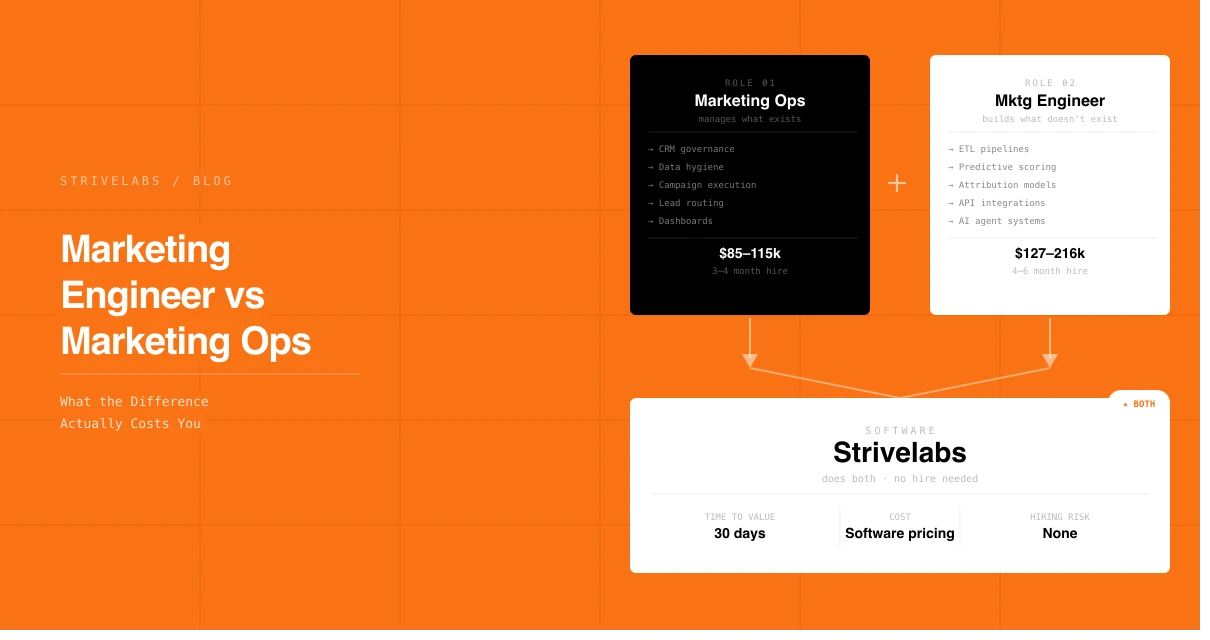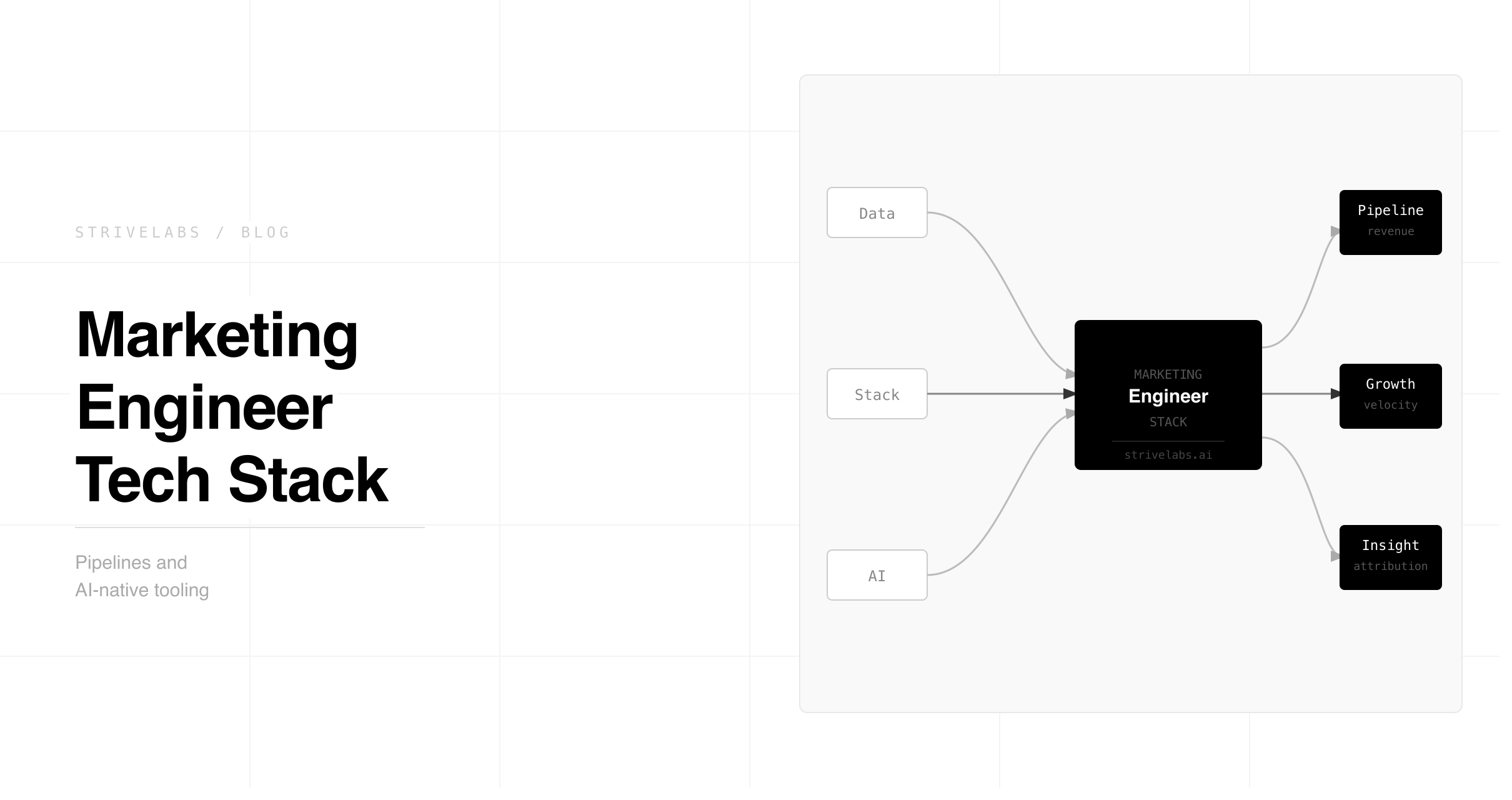
A marketing engineer is the person who turns your martech investment into a measurable pipeline, and in today's time and age, that job has never been harder or more important.
The martech landscape now sits at 15,505 products, up just 0.79% from last year after a 100x run since 2011. The number looks stable. The reality underneath it isn't. Around 1,488 new products were added while 1,367 were removed, signalling a market in fierce churn, not stasis. For Heads of Marketing, this means stack decisions carry real strategic risk. Pick the wrong tools and you're rebuilding in 18 months. Pick the right ones and your marketing function compounds.
The AI-powered marketing automation market is valued at $47 billion in 2026 and forecast to reach $81 billion by 2030. That growth isn't coming from adding more tools; it's coming from teams that have figured out how to connect the tools they already have into systems that run without constant human intervention. That's exactly what a marketing automation engineer or technical marketing engineer is hired to do.
This guide maps the full stack a digital marketing engineer builds. CRM, data warehouse, iPaaS, automation, AI agents, and analytics and also breaks down how each component connects to a business outcome your CFO will recognise. It also shows where most mid-market teams get stuck, and why Strivelabs was built to solve that specific problem.
The marketing engineer function, delivered as software.
See how Strivelabs gives mid-market teams the operational capacity without the hiring cost.
Explore Strivelabs →
At a Glance
-
A marketing engineer is a hybrid role blending marketing strategy, data systems, and engineering, the person responsible for making your stack produce revenue, not just activity.
-
With 15,505 martech tools now available and the market actively churning, tool choice and integration reliability are now strategic decisions, not operational ones.
-
Marketing automation delivers an average $5.44 ROI per $1 invested, but only when the underlying stack is properly connected and governed.
-
An effective marketing engineering stack is built on five integrated layers: an API-first CRM, a central data warehouse, an iPaaS integration layer, an orchestration engine, and an AI agent framework.
-
The success of a marketing engineer is measured by direct KPI impact: reduced CAC, faster experiment velocity, higher conversion rates, and closed-loop attribution.
-
Strivelabs delivers this entire function as software, giving mid-market teams marketing engineering capability without the headcount cost.
What is a Marketing Engineer?
A marketing engineer is the technical operator who designs, builds, and runs the systems that turn marketing strategy into automated, measurable growth.
The role splits into two common variants depending on where a company sits. A technical marketing engineer is typically product-facing and sitting close to the product and data teams, owning instrumentation, experiment infrastructure, and growth loops. A marketing automation engineer is systems-facing and owning the martech stack, campaign orchestration, lead flow automation, and CRM operations. In practice most mid-market teams need both capabilities from one person, which is exactly why the role is so hard to hire for.
The outcomes a marketing engineer delivers for a Head of Marketing are concrete: faster experiments (weeks not quarters), automated playbooks that run without manual intervention, and closed-loop attribution that connects spend to pipeline. Companies using marketing automation report 80% improvement in lead generation and a 451% increase in qualified leads. Those numbers don't come from buying a new tool, they come from having someone who knows how to wire the tools together.
Why Hiring a Marketing Engineer is Important in 2026?
2026 is a structural tipping point, not a trend. Three forces converged simultaneously: AI-native tooling became production-ready, martech consolidation made integration complexity unavoidable, and CFOs started demanding pipeline attribution instead of activity metrics. Heads of Marketing who don't have a marketing engineering capability, internal or otherwise, are now operating with a structural disadvantage.
The numbers make the case:
-
The martech landscape reached 15,505 tools in 2026, up from just 150 tools in 2011. Every tool in your stack is a potential integration failure without someone who owns the architecture.
-
The AI-powered marketing automation market hit $47 billion in 2026 and is forecast to reach $81 billion by 2030, the infrastructure investment is accelerating, not slowing.
-
Businesses generate approximately $5.44 for every $1 spent on marketing automation, but only when the automation is properly instrumented and connected to revenue data.
-
Marketing automation reduces marketing overhead by 12.2%, boosts sales productivity by 14.5%, and generates 50% more sales-ready leads at 33% lower cost through lead nurturing workflows.
-
Companies using automation report up to 77% higher conversion rates, the gap between teams with and without this capability is compounding every quarter.
-
CFOs now want ROI, not novelty. Teams are expected to move faster and deliver more without adding headcount or spend. A marketing engineer is how you do both simultaneously.
The business case for Strivelabs sits exactly here. If the ROI of a properly built marketing engineering function is clear, but the hiring cost and timeline to competency makes it inaccessible for most mid-market teams, that's the gap Strivelabs closes. You get the function, the stack, and the outcomes, without the 6-month hire.
Core Components of a Tech Stack
A marketing engineering stack isn't a collection of tools, it's an architecture. The difference is intentional data flow. Every component either produces data, transforms it, or acts on it. When those three functions are connected cleanly, marketing compounds. When they're not, you get tool sprawl, attribution gaps, and manual reporting that consumes the team.
There are five layers every digital marketing engineer evaluates before anything else.
CRM and CDP
The CRM is the operational record of your customer relationships. The CDP is the unified identity layer that stitches behavioural data across touchpoints. A marketing automation engineer expects both to behave like infrastructure — reliable, API-first, and query-able without engineering tickets.
What a marketing engineer needs from this layer:
-
Reliable identity resolution - a single customer record that survives across email, product, paid, and offline touchpoints. Without this, attribution is guesswork.
-
API-first access and real-time event streaming - the stack needs to read from and write to the CRM programmatically, not through manual CSV exports.
-
Audience export and reverse ETL capability - segments built in the warehouse need to activate in the CRM and ad platforms without latency.
Data Warehouse and ETL
The warehouse is the single source of truth for attribution, experimentation, and reporting. Without it, every team in the company is working from a different version of the data.
What a technical marketing engineer expects here:
-
Event schema governance - every marketing event (form fill, ad click, product action) has a consistent schema that doesn't break downstream dashboards when upstream tools change.
-
Scheduled ELT pipelines - data from every source loads on a defined cadence with clear SLAs. No silent failures.
-
Experiment-ready data models - cohort tables, conversion events, and attribution paths are pre-built so experiments can be analysed without custom SQL every time.
Integration Layer and iPaaS
iPaaS is one of the fastest-growing categories in the 2026 martech landscape, it's becoming the orchestration layer that connects everything. The reason is simple: every tool in a modern stack emits events, and without a reliable integration layer, those events either get lost or require custom code to process.
What this layer is responsible for:
-
Event streaming vs webhooks vs batch sync - knowing which pattern fits which use case. Real-time personalisation needs streaming. Nightly attribution rollups need a batch.
-
Error handling and replayability - failed syncs need automatic retries and full replay capability. Silent data loss is the most common cause of attribution gaps.
-
Schema transformation - data from different tools arrives in different shapes. The integration layer normalises it before it hits the warehouse.
Automation and Orchestration
This is where a marketing automation engineer spends most of their time — and where the biggest gap exists between what most teams have (email sequences) and what's actually possible (multi-channel, conditional, AI-triggered workflows).
-
Campaign orchestration - multi-step, multi-channel workflows that respond to behavioural signals rather than just time delays.
-
Conditional routing - lead flow logic that segments by firmographic, behavioural, and intent data simultaneously.
-
Trigger-based vs agent orchestration - trigger-based automation fires when a defined event occurs. Agent orchestration allows the system to plan and execute a sequence of actions based on a goal, not just a trigger.
Experimentation and Analytics
Speed of experimentation is the primary compounding advantage a marketing engineer creates. Teams that can run and analyse 10 experiments a month beat teams running 1, regardless of budget.
-
Feature flags and experiment governance - the ability to run controlled tests across channels without deploying new code for every variant.
-
Cohort analysis and lift measurement - understanding which segments responded to which treatment, not just aggregate conversion rates.
-
Warehouse-linked experiment data - experiment results connect back to revenue attribution so you know whether a 12% CTR lift translated to a pipeline impact.
AI Agents and Models
Global AI in marketing is on track to reach an estimated $41 billion in 2026, and the use cases a marketing engineer builds with AI agents are now production-ready, not experimental.
Common agent patterns:
-
Ad copy generation and testing - agents that generate variant copy, deploy it via API, monitor performance, and pause underperformers without human intervention.
-
Competitor and signal monitoring - agents that watch competitor pricing pages, job postings, and content updates, then surface relevant signals to the team on a defined cadence.
-
Content refreshers - agents that audit existing content for ranking decay, generate refresh recommendations, and queue updates for human review.
Guardrails every technical marketing engineer builds in:
-
Training data provenance - know what data trained the model producing outputs.
-
Validation loops - every agent output passes a quality check before activation.
-
Human-in-the-loop checkpoints - high-stakes actions (budget changes, audience suppression) require human approval before execution.
How to Choose an Automation Platform
Platform selection is where most mid-market teams make their most expensive mistake, buying for features instead of architecture. The right evaluation criteria aren't about what the platform can do in a demo. They're about what it lets you build over two years.
| Criteria | Enterprise Suite | Mid-Market Platform | Email-First Tool | Strivelabs |
|---|---|---|---|---|
| API coverage | Full | Partial | Limited | Full |
| Data model flexibility | High | Medium | Low | High |
| Implementation time | 6–12 months | 2–4 months | 2–4 weeks | Days |
| Internal eng required | Yes | Sometimes | No | No |
| AI agent support | Roadmap | Roadmap | No | Native |
| Best for | $50M+ revenue | $5M–$50M | Email-only plays | Mid-market teams without eng |
Integration Patterns and Data Pipelines
The four patterns every digital marketing engineer works with:
-
Event-first telemetry - every user action (page view, form fill, product event) emits a structured event to a central stream. This is the foundation of real-time personalisation and accurate attribution.
-
Batch ETL - scheduled data pulls from sources that don't support event streaming (ad platforms, legacy CRMs). Reliable for reporting; too slow for activation.
-
Reverse ETL - warehouse-computed segments and scores pushed back to operational tools (CRM, ad platforms, email). Closes the loop between analytics and activation.
-
Streaming CDP flows - real-time identity stitching and audience computation as events arrive, enabling personalisation at the moment of intent rather than the next morning.
Reliability concerns every marketing automation engineer plans for:
-
Idempotency - the same event processed twice should not create duplicate records downstream.
-
Backfills - when a pipeline breaks, you need to replay historical data without corrupting existing records.
-
Schema evolution - upstream tools change their data structure without warning. The pipeline needs to handle this gracefully.
AI Agents and Orchestration Tools
Agent orchestration is the next layer above automation. Where automation fires when a condition is met, an agent plans a sequence of actions to achieve a goal, and adjusts based on what it observes.
Common 2026 use cases for a marketing engineer building agent systems:
-
Signal monitoring - agents watching competitor activity, intent data spikes, and content decay signals, then routing to the right workflow.
-
Content generation pipelines - brief → generate → validate → publish pipelines that run on a schedule with human review gates at defined checkpoints.
-
Playbook execution - when a high-intent signal fires (pricing page visit + job posting for a relevant role), an agent sequences the right outreach across channels.
Selection criteria for agent frameworks:
-
Observability - can you see exactly what the agent decided and why? Without this, debugging failures is impossible.
-
Testability - can you run the agent against historical data before deploying it against live traffic?
-
Security and privacy controls - agents that touch customer data need role-scoped access and audit trails.
Pilot approach before broad rollout:
-
Pick one high-frequency, low-risk use case (content refresh monitoring is ideal).
-
Run in shadow mode, the agent makes recommendations, and the human approves all actions for 30 days.
-
Measure decision accuracy against your human baseline before enabling autonomous execution.
Measuring Impact and ROI
A marketing engineer's impact should show up in your board deck within 90 days, not just your internal dashboards.
Primary KPIs to track:
-
CAC reduction - automation and better attribution should surface inefficient spend within the first quarter.
-
Experiment velocity - number of experiments run and analysed per month. This is the leading indicator of compounding growth.
-
Conversion rate by funnel stage - where is the automated system outperforming manual execution?
-
Time-to-insight - how long from a campaign launching to having statistically valid results?
-
LTV:CAC ratio - the long-term measure of whether better targeting is producing better customers.
Attribution cadence:
-
Weekly operational review - pipeline by channel, experiment status, automation health.
-
Monthly strategic review - CAC trend, LTV cohort analysis, experiment learnings.
Governance checklist:
-
Data quality tests run on every pipeline, every day.
-
Clear ownership of every data source and transformation.
-
Post-mortem cadence for failed experiments - not just winners get reviewed.
Conclusion
A marketing engineer is not a nice-to-have in 2026. CFOs want ROI, not novelty. Teams are expected to move faster and deliver more without adding headcount or spend. The marketing engineer is the role that makes that possible, but for most mid-market teams, hiring one is either too slow or too expensive to be a realistic option.
That's exactly the gap Strivelabs was built to close. The function of a marketing engineer, stack architecture, automation orchestration, AI agent deployment, closed-loop attribution, delivered as software, at a fraction of the cost and timeline of a full-time hire.
Run a 90-day pilot. Benchmark your current stack against the architecture in this guide. Validate the ROI before committing to a full programme. The teams that move first on marketing engineering capability in 2026 will have a compounding advantage that gets harder to close every quarter.
$1M+ in pipeline generated by teams using Strivelabs.
See what you're missing in 14 minutes.
Book a demo →
Frequently Asked Questions (FAQs)
What does a marketing engineer actually do day-to-day?
A marketing engineer spends their time across three areas: maintaining and extending the martech stack (integrations, data pipelines, platform configuration), building and running automated workflows (lead nurture, campaign orchestration, reporting), and running growth experiments (A/B tests, funnel optimisation, attribution analysis). The split between those three shifts depending on company stage, earlier stage teams skew toward building; more mature teams skew toward experimentation and optimisation.
Do I need to hire a marketing engineer or can software replace the function?
For most mid-market teams, the honest answer is that hiring a full-time marketing engineer is either too slow (3–6 month hiring cycle) or too expensive (US salaries typically $90K–$130K+). Platforms like Strivelabs were built specifically to deliver the marketing engineering function, stack integration, automation orchestration, AI agents, as managed software, which is how mid-market teams access the capability without the headcount cost.
What's the difference between a marketing automation engineer and a technical marketing engineer?
A marketing automation engineer is primarily systems-focused, owning the martech stack, campaign workflows, and CRM operations. A technical marketing engineer is more product-facing and owning experiment infrastructure, growth loops, and data instrumentation. Most mid-market teams need both skill sets from one hire, which is the core reason the role commands a premium.
How long does it take to see ROI from a marketing engineering investment?
76% of companies see a positive return on investment within one year of implementing marketing automation. With a properly scoped 90-day pilot focused on one funnel and one experiment framework, most teams start seeing measurable CAC improvement and experiment velocity gains within the first quarter.
What martech stack should a marketing engineer build in 2026?
The core architecture is five layers: an API-first CRM/CDP, a central data warehouse, an iPaaS integration layer, an automation and orchestration engine, and an AI agent framework. The specific tools within each layer depend on your company size, existing contracts, and technical maturity, but the architecture pattern is consistent. This guide covers the full evaluation criteria for each layer.
Can Strivelabs replace a marketing engineer?
Strivelabs delivers the outcomes a marketing engineer produces, connected stack, automated workflows, AI agents, closed-loop attribution as a managed software platform. For mid-market teams that can't hire or don't want to manage the function internally, Strivelabs is the direct alternative. For teams that do have a marketing engineer, Strivelabs accelerates what they can build and reduces the infrastructure maintenance overhead.