Most B2B SaaS teams have marketing ops. Very few have a marketing engineer. Many confuse the two and hire the wrong one, then wonder why their stack still breaks and their pipeline attribution still doesn't work.
The distinction matters more in 2026 than it ever has. Marketing analytics manager salaries are projected to reach $117,750 in 2026, growing 3.7% year-over-year, and 78% of marketing leaders now pay a premium for candidates with specialised technical skills. The market is telling you something: technical marketing capability is scarce, expensive, and increasingly non-negotiable.
This post clarifies what each role actually does, where the confusion comes from, and why most mid-market teams end up needing both, or a software alternative that delivers the combined function without the hiring cost or timeline.
At a Glance
-
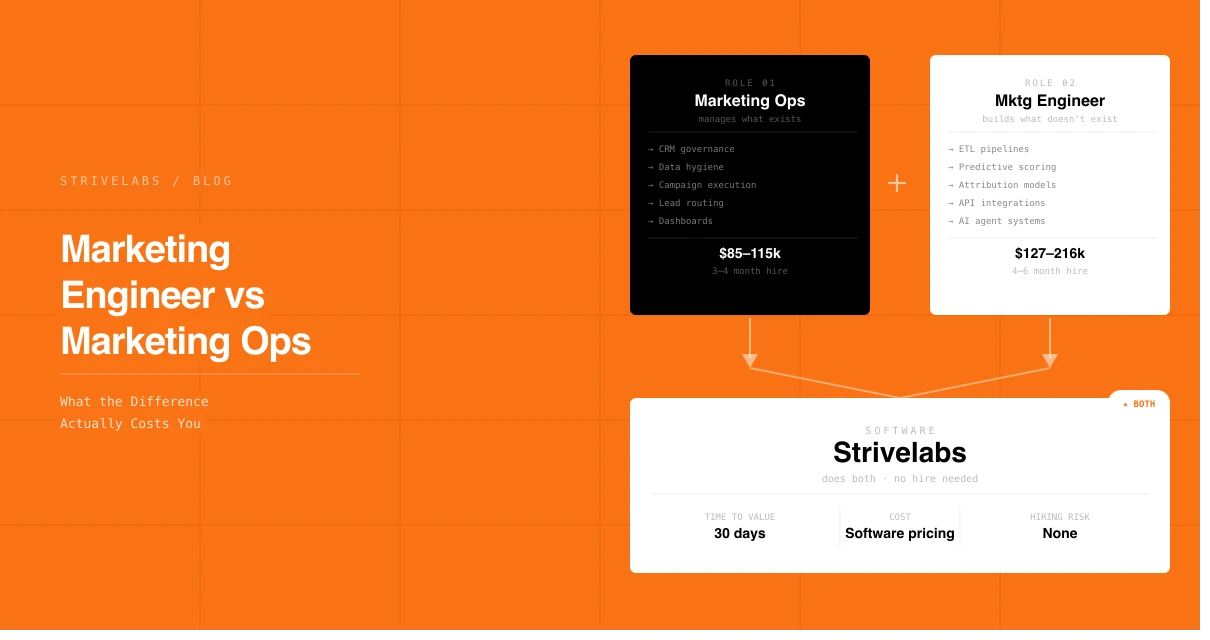
Marketing ops manages the systems you already have. A marketing engineer builds the systems you don't have yet. Hiring one when you need the other is the most common, and most expensive, mistake in B2B SaaS marketing team design.
-
Salaries for technical marketing roles are rising 1.5–3.7% year-over-year in 2026, with marketing analytics and digital strategy commanding the highest premiums. The cost of a mis-hire compounds when the role takes 3–6 months to recruit and another quarter to ramp.
-
The confusion between the two roles is not a job description problem. It's a data architecture problem, both roles live in the same tools, speak the same language, and get evaluated on overlapping metrics. The difference is what they build vs what they maintain.
-
Most mid-market B2B SaaS teams need both capabilities. Few can afford both hires. That's the gap Strivelabs was built to close.
Marketing engineer vs marketing ops
Marketing ops manages your platforms and handles the workflows. Meanwhile, marketing engineers build the predictive systems and automations that don't just sit there.
If you work in marketing ops, people judge you by how smoothly campaigns run and the accuracy of the data. You'll win when launches do not break and leadership can actually trust the dashboards. Engineers use a different yardstick. They focus on boosting conversion rates and cutting costs through smarter paths. The goal is to have a real impact on your pipeline.
It's best to hire for marketing ops if your tech stack is a mess. Go for a marketing engineer if you want new models to scale.
-
Marketing ops focuses on governing your platforms and maintaining data hygiene to improve lead quality, activation speed, and error rates.
-
Your marketing engineer will build the models and custom code that drive conversion lift and a higher return on automation spend.
The confusion has a real cost. When a team hires a marketing ops specialist expecting engineering output, custom automations, predictive scoring, ETL pipelines, they get a well-run CRM and a frustrated hire. When they hire a marketing engineer into an ops role, data governance, campaign QA, vendor management, they get expensive technical talent doing work that doesn't compound.
The checklist at the end of this post exists for this reason. Before opening a job req, know which problem you're actually solving.
Why people confuse the two roles
Confusion often stems from technical overlap. You might see both groups tinkering with the same APIs or arguing over event tags. If you don't define those boundaries, your hiring efforts will probably fail.
-
It is common for both to spend all day inside a CRM or tag manager. Since the interface is the same, the actual labor looks identical to an outsider.
-
People in both camps use words like tracking and workflows. That shared lingo makes it hard to tell if someone is building the engine or just driving the car.
-
In earlier years, an engineer built a tool and an operations person used it. Those old rules died out as software became more tangled.
-
A title like growth engineer often lacks a clear meaning. Without a sharp job description, you won't know if the person builds systems or manages the logic.
Messy data is what happens when nobody knows who owns the stack. Fixes take forever when the lines are blurred.
What marketing ops owns
Your marketing ops team builds the foundation that makes results predictable. Because of this, you can focus on testing ideas without stressing over data accuracy. The role is not just about software.
Daily work centers on tech governance and CRM hygiene. Runbooks turn your ideas into stable campaigns.
-
Tech governance includes managing vendor contracts and selecting primary systems for your data.
-
Better data hygiene relies on normalization to keep account mapping accurate across your different tools.
-
Campaign execution stays consistent when you set clear segmentation rules and reusable templates.
-
Active reporting management helps keep your dashboards fresh so you can catch failures early.
-
Compliance focuses on setting up the controls and audit trails you need for security.
The signal that you need marketing ops is simple: campaigns are breaking, data can't be trusted, and leadership doesn't believe the dashboards. That's an operations problem, not an engineering problem. Hiring an engineer to fix bad data governance is like hiring an architect to clean the building.
Leadership needs figures they can trust. That's why this role produces dashboards that don't crash. Good routing rules prevent leads from becoming lost opportunities.
While they use SQL and Salesforce, project management skills matter too. These pros build systems that last.
What a marketing engineer builds
A marketing engineer's focus is on the technical side of growth. Instead of just setting up a campaign, you'll see them writing the code that drives your automations.
-
Event-based systems react instantly to user actions to update profiles and start campaigns.
-
Scoring tools they develop use lead signals to find your top prospects.
-
Data moves from your own systems into a warehouse and back to your marketing tools through fast ETL pipelines.
-
When a standard tool doesn't have the right connection, these experts write custom APIs.
These assets change how your business performs. Automations speed up how fast you can act. Your conversion rate's likely to go up because of better predictive models. Clean data's the way to get accurate attribution.
You'll usually find these pros using Python and SQL. They'll use those languages to manage data alongside platforms like Airflow or Dagster. Success won't just come from strong coding and a knack for testing.
The signal that you need a marketing engineer is equally specific: your stack is stable, your data is clean, and you're leaving a pipeline on the table because you can't build the automated systems that would capture it. That's an engineering problem, not an operations problem.
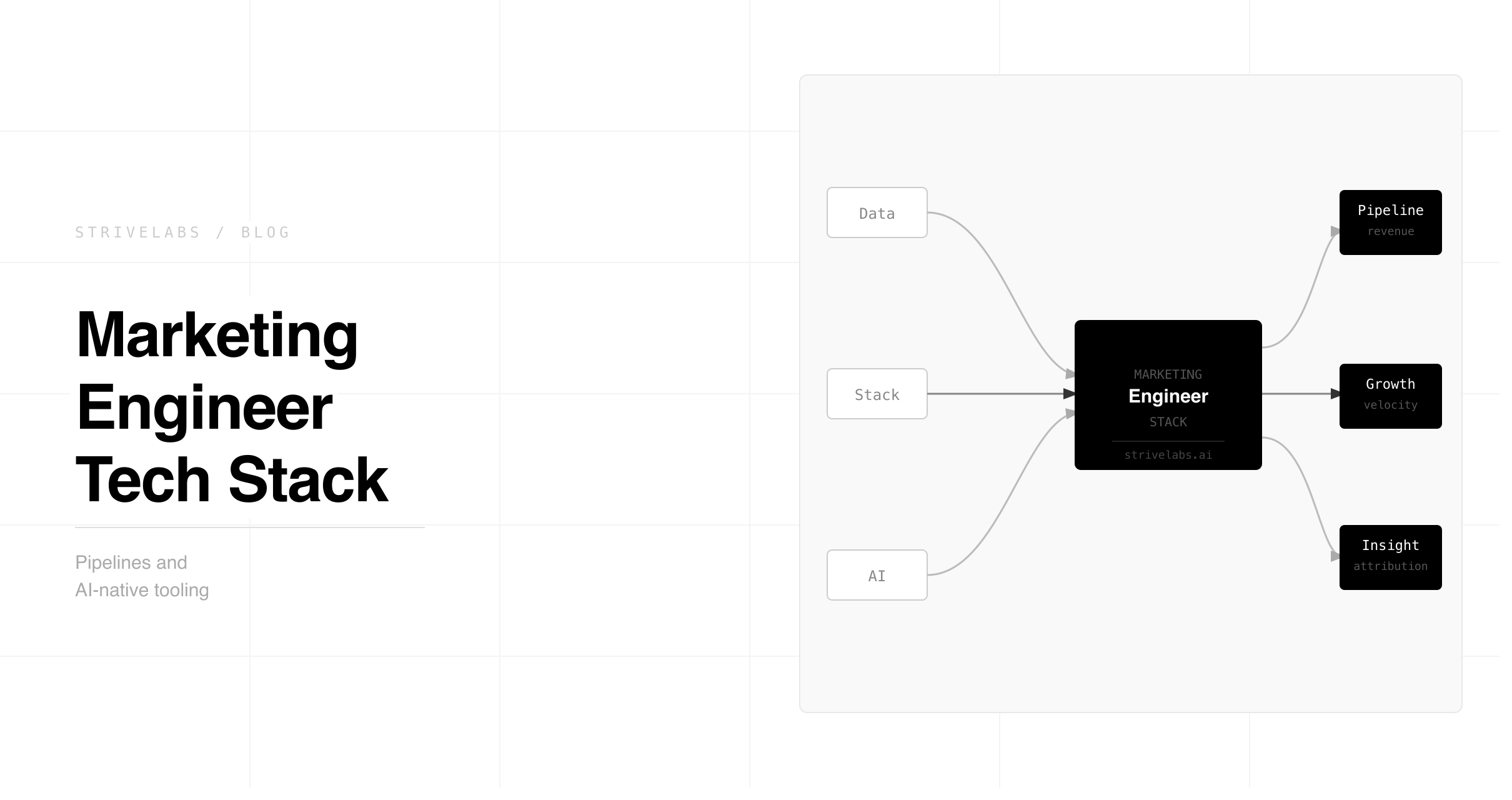
For a detailed map of what a marketing engineer builds and maintains, see the marketing engineer tech stack guide, it covers every layer from CRM and CDP through to AI agents and attribution.
Better decisions start with better infrastructure.
Most mid-market teams pick a channel and hope. Strivelabs gives you the data to know, and the infrastructure to act on it.
Book a Demo →
Where these roles overlap and where they differ
Data is the focus for both teams. Friction often starts when nobody knows who gets the final word on a project. Even with the same end goals, one side usually wants to keep things running while the other wants to build something fresh.
-
You might find both roles working on CRM tasks, tracking events, or setting up campaign automations.
-
Real differences appear when you look at who writes the actual code or handles the predictive math models.
A strong plan keeps the ops team in charge of quality and rules. Engineers handle the heavy lifting of writing production code. While they have to agree on how to label data, the ops group should probably sign off on changes that could break a stable workflow.
Processes and workflows
Ownership of a process usually comes down to whether the goal is stability or growth. Marketing ops folks typically manage the day-to-day tasks and make sure everything hits its marks. On the other hand, engineers focus on building custom code for new experiments.
-
The ops team sets the rules for who gets a campaign and checks the work for mistakes.
-
Pipelines and the custom links that trigger automatic emails are the main concern for engineers.
-
When a new idea is ready to go big, the engineer hands a finished version to the ops team to keep it running.
Skills and hiring profiles
Picking the right person for the job means knowing if you need someone to manage or someone to build.
-
Look for ops candidates who have great project management skills and know how to grow a playbook.
-
A good engineer will have a portfolio of code and can talk through how they use different APIs.
-
You might ask a potential ops hire to fix a messy workflow, but an engineer should be able to map out a deep technical solution.
KPIs and success metrics
Success doesn't look the same for everyone because the goals are so different. Using one scorecard for the whole department that tracks both reliability and fresh projects is a good way to stay balanced.
For the ops team, winning means data moves fast and the routing works every time. They watch for campaign errors and try to get rid of manual grunt work.
Engineers care about how much their new tools actually help sales. They track the value of the code they write and how quickly they can get a new system online.
Keep a shared list of health stats and new projects to bring these two worlds together. An automation is only a success if it stays stable for the ops team and makes money for the business.
| Area | Marketing Ops | Marketing Engineer |
|---|---|---|
| Core duties | Handle and supervise systems to keep campaigns steady | Create the tools and models that add new abilities |
| Deliverables | Work plans, data views, and quality control steps | Data flows, API links, and automated triggers |
| Skills | Design of processes, CRM tools, and managing projects | Writing code in Python and working with various APIs |
| KPIs | Speed of leads and the health of your data | Increases in sales and the value of new tech |
| Typical hire | Manager of operations or a lead routing expert | A data engineer or a professional coder |
| Who signs off | Ops for how things work, leaders for general rules | Engineers for the code and ops for the rollout |
Do you need both, one, or neither?
Does your team need more hands or better tools? Your decision hinges on the current backlog and how far your performance metrics have slipped lately. Figure out if the real hurdle is messy execution or if you simply lack the technical skills to move forward. If the crew spends all day fixing data mistakes or campaign glitches, hiring marketing ops first is usually the better call. But when the tech stack is stable and you need predictive scoring to scale, a marketing engineer offers more value. Software purchases can buy you time. Many tools fix repetitive problems, like content decay or keyword tracking, in less than three months. Adding a full-time staff member makes more sense if the solution requires unique models or highly specific integrations.
Which role fits your company size
Smaller companies usually prioritize keeping their basic systems alive. Larger groups often need engineers to build custom data paths.
-
Under 5 million dollars in annual revenue, most startups get by with a marketing ops generalist or a part-time hire to manage systems.
-
Growth stage companies with revenues up to 100 million dollars might bring on a full-time marketing ops manager and use contract marketing engineers for specific technical projects.
-
Enterprise organizations with over 100 million dollars in revenue typically need a senior ops team working with several dedicated marketing engineers to manage complex data flows.
The fastest way to decide:
Answer these three questions:
-
Can your team trust your CRM data and dashboards right now? If no, marketing ops first.
-
Is your pipeline limited by the absence of automations and predictive systems that don't exist yet? If yes, marketing engineer.
-
Can you afford a 3–6 month hiring cycle, a $90K–$130K salary, and a 90-day ramp before seeing output? If no, evaluate software alternatives first.
Most mid-market teams answer yes to question 2 and no to question 3. That's the gap Strivelabs closes.
Adopting a fractional method works well for businesses that need deep technical skills but don't want the cost of another full-time salary.
How AI is changing the marketing engineer role
Modern tools can handle code structures and basic data moves, which makes some engineering tasks much faster. Even so, a human must watch over the work to keep the underlying structure safe.
AI is not eliminating the marketing engineer role. It's shifting where the value sits. Code generation handles the integration scaffolding that used to take days. That shift means the scarce skill is no longer writing the code, it's knowing which systems to connect, which data model to build, and which automations will actually move the pipeline.
The marketing engineer of 2026 spends less time writing connectors and more time designing the architecture that AI agents run on. The role gets more strategic, not less relevant.
78% of marketing leaders pay a premium for specialised technical skills, and that premium is accelerating as AI tools raise the floor of what's possible without technical talent. The ceiling is also rising.
Quality control is the new priority. This shift makes the role more about oversight than just writing code.
A quick checklist to help you decide
Check these priorities to see if a new hire or a new tool is the better path for you.
-
If you are losing over 40 percent of marketing hours to data cleaning and firefighting, look for a marketing ops specialist.
-
Marketing engineers are the better pick if the roadmap requires custom automations or predictive scoring to hit a 10 percent revenue growth target.
-
Evaluate software first if a specific product can show results within 90 days for less money than a new salary.
-
Waiting on a hire makes sense until you can define specific outcomes and a clear return on investment for an engineering project.
-
Before starting large engineering projects, an ops function should be in place because privacy rules require strict management.
-
Speed is important, so try a software trial with a short-term contractor if you don't have enough internal staff.
How Strivelabs supports both marketing engineers and marketing ops
Strivelabs is the marketing engineer for your team, not a tool that supports one. It delivers the combined function of marketing ops and marketing engineering as managed software: stack integration, automation orchestration, AI agent deployment, attribution, and closed-loop reporting.
For mid-market B2B SaaS teams that need the output of both roles but can't justify two senior hires at $90K–$130K each with a 6-month combined recruitment timeline, Strivelabs is the direct alternative.
What Strivelabs runs for your team:
-
Data ingestion and identity resolution, the ops layer that keeps your CRM clean and your attribution intact
-
Automation and orchestration, the engineering layer that builds and runs the workflows your team currently does manually
-
AI agents, SEO, paid, content, experiments, and reporting, all running with human approval gates
-
Closed-loop attribution, connecting campaign spend to closed revenue without a dedicated data engineer
See how the marketing engineer function connects to every layer of your stack, and why the role is increasingly being delivered as software rather than headcount.
Conclusion
Choosing between a marketing engineer vs marketing ops role isn't just about picking sides because both roles help your data stay reliable. You'll notice that marketing operations usually handles governance. Still, a marketing engineer builds the custom code and models that actually boost your performance. If finding a hire doesn't happen quickly, software tools can fill that gap for a while.
If you aren't sure where the problem lies, run a 90 day pilot. This period usually clarifies if the issue is execution or technical power.
Check your metrics now. Decide between reliability or new builds, then hire or buy.
The marketing engineer function, delivered as software.
See how Strivelabs gives mid-market teams the operational capacity without the hiring cost.
Explore Strivelabs →
Frequently Asked Questions (FAQs)
What is the most common mistake when hiring for these roles?
Hiring a marketing engineer to fix an ops problem, or a marketing ops specialist to solve an engineering problem. The tell is in the backlog: if most open tickets are broken workflows, data quality issues, and campaign errors, that's an ops problem. If most open tickets are custom automations, predictive models, and pipeline gaps that require new systems, that's an engineering problem. Solving one with the other costs you time, money, and a frustrated hire.
What is the typical salary for a marketing engineer vs marketing ops in 2026?
Marketing and creative salaries are rising 1.5% on average in 2026, with technical roles commanding higher premiums, marketing analytics managers at $117,750 and digital strategists at $109,500. A marketing engineer with Python, API fluency, and data warehouse experience typically commands $110K–$140K in the US market. A senior marketing ops manager runs $85K–$115K. Combined, that's a $200K+ annual headcount investment before benefits, equity, and management overhead.
Can one person do both roles?
In the earliest stage of a company, under $5M ARR, yes, with tradeoffs. As the company scales, the roles diverge in two incompatible directions: ops demands systematic governance and process discipline, engineering demands deep technical focus and creative problem-solving. A person who is genuinely excellent at both is extraordinarily rare and extraordinarily expensive. Most companies are better served by a clear decision about which capability they need more urgently, then solving the other through software or contractors.
Does a marketing engineer report to the CMO or CTO?
Typically the CMO in B2B SaaS, with a dotted line to engineering or RevOps depending on company structure. The critical factor is that their primary stakeholder is marketing velocity, not infrastructure stability. Marketing engineers who report into IT or central engineering tend to deprioritise marketing initiatives in favour of company-wide engineering work. Keep them inside the marketing function.
When does it make sense to use software instead of hiring?
When three conditions are true simultaneously: you need the output faster than a 3–6 month hiring cycle allows, the function is well-defined enough that a platform can deliver it reliably, and the cost of the platform is meaningfully less than the fully-loaded cost of the hire. For most mid-market B2B SaaS teams, all three conditions apply to both the marketing ops and marketing engineer functions, which is exactly the problem Strivelabs is built to solve.