An AI marketing platform is no longer a competitive advantage as it's becoming the baseline. In 2026, 88% of marketers use AI tools daily, and the AI marketing industry has reached $47.32 billion. The teams not using these systems aren't just moving slower, they're operating with structurally higher costs and lower attribution clarity.
This guide is built for marketers who need to make a real platform decision and not read a vendor brochure. It covers how AI marketing platforms work, which features actually move the needle, how to evaluate vendors without getting burned, and how to run a 90-day pilot that proves ROI before you commit.
For mid-market teams who need the capability without the infrastructure cost, Strivelabs delivers the AI marketing function as managed software with stack integration, automation orchestration, and closed-loop attribution included.
At a Glance
Review these core ideas before reading the full post.
-
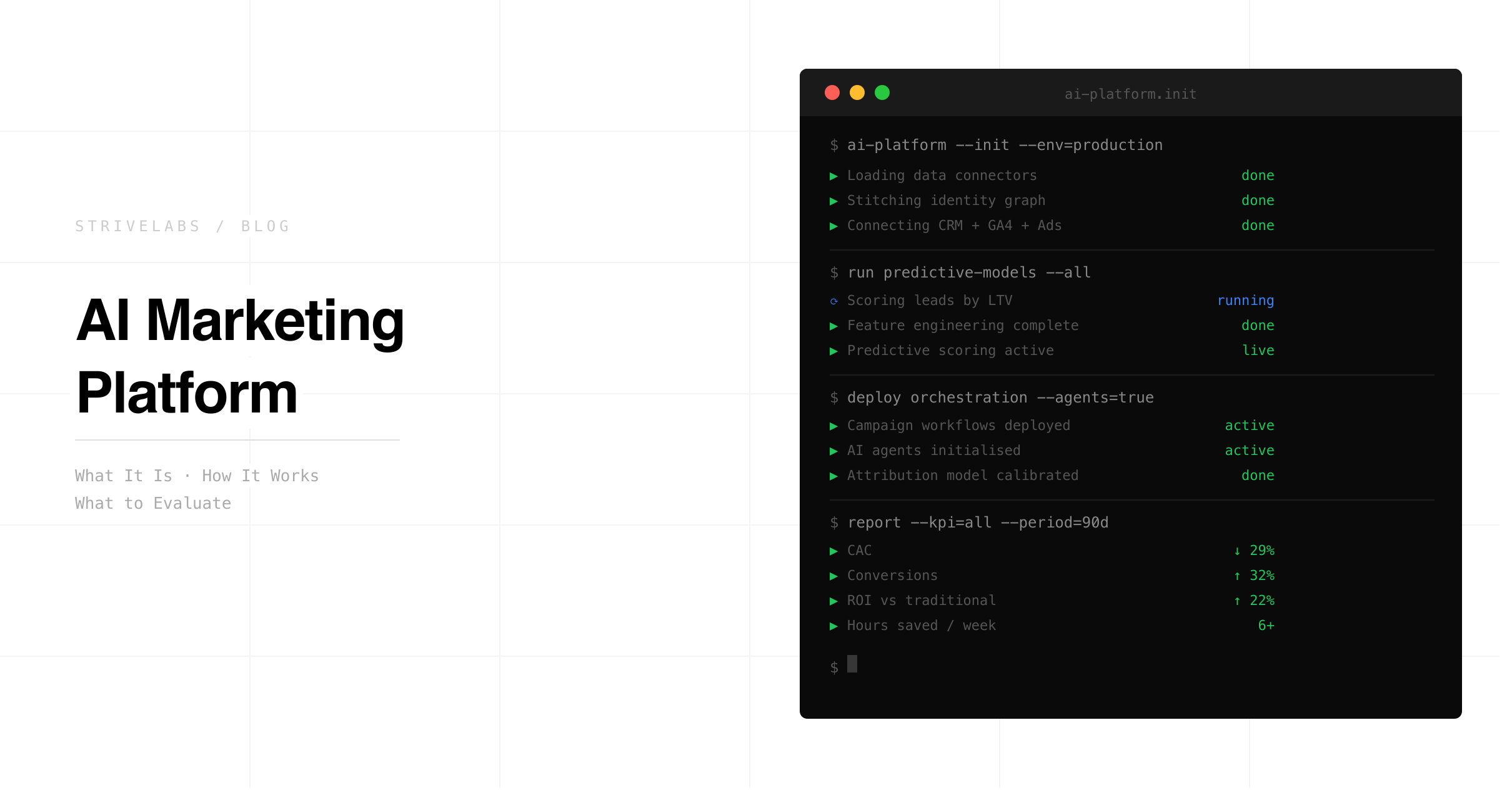
AI-driven campaigns deliver 22% better ROI, 32% more conversions, and 29% lower acquisition costs than traditional methods, but only when the underlying data is clean and the stack is properly connected.
-
95% of AI users report major cost and time savings, the productivity gains are real, but they require the right implementation sequence.
-
Marketing automation saves companies an average of 6+ hours per week on routine tasks, time that compounds into experiment velocity over quarters, not just sprints.
-
Success depends on first-party data quality, if your CRM and GA4 are messy, the platform will automate the wrong outcomes faster.
-
Strivelabs is built for the mid-market gap, the teams that need AI marketing infrastructure but can't justify the implementation cost and headcount of an enterprise suite.
What is an AI marketing platform?
An AI marketing platform is a digital brain that collects data to recognize behavioral patterns with predictive models. Once it identifies a trend, the system starts automated tasks so you don't have to click anything. This helps you expand your work without hiring more people. 71% of companies now use or have adopted marketing automation, with 49% specifically deploying it for personalisation. The shift isn't experimental, it's operational.
Core capabilities and where the platform usually sits in your stack
-
Software connectors grab data from your CRM, website analytics, and advertising accounts.
-
Identity resolution tech allows the system to link different user IDs together to give you a single view of every customer.
-
By using feature engineering, the software turns simple events into scores that predict if a person will buy something.
-
Messaging schedules are handled by specialized tools across your email and advertising channels.
-
Large language models write, copy and create different versions of ads to improve how content performs.
-
Performance is tracked with attribution tools that send alerts to the right people when things change.
Typical buyers and placement in the tech stack
-
People like growth directors or revenue managers are usually the ones who buy these platforms.
-
This software sits on top of your current data sources and turns that info into specific instructions for your marketing.
Deployment models you will encounter
-
One vendor handles all the hosting and upkeep in a standard SaaS model.
-
Some options come as part of a much larger marketing cloud suite.
-
Linking various tools together via API connections often costs more to set up, yet it offers much more flexibility for your specific tech stack and legacy systems than a standard suite.
In practice, it's a marketing engineer who architects and maintains this stack, the technical operator who connects your AI platform to revenue outcomes.
Is an AI digital marketing platform right for you? You get faster testing and clearer attribution. It's a smart move for teams with clear goals. Still, if your first-party data is messy, the results won't be good. Make sure your database is organized before you try a small pilot.
Where Strivelabs fits: Strivelabs is purpose-built for mid-market teams that need the AI marketing platform function without the enterprise implementation cost. It connects your existing stack of CRM, GA4, paid channels, and runs the orchestration layer as managed software.
Core features of AI marketing platforms
Manual chores do not have to eat up your schedule. If software handles the repetitive parts of a workflow, it frees up mental space for your strategy.
Hard data fuels these systems to guide your decisions. Because of this, it becomes possible to treat every customer like an individual. Scaling to millions of users does not mean you have to lose that personal touch.
Organisations investing in AI see sales ROI improve by 10–20% on average, with leading companies achieving 1.5x higher revenue growth over three years compared to peers. The table below maps the features that drive those outcomes.
| Feature | What it does | Business outcome | Why it matters |
|---|---|---|---|
| Data connectors and ingestion | It pulls data from a CRM, ad accounts, and call logs | All models run from one central source | This cuts down on manual file merging so you can find answers faster |
| Unified customer profiles | Connects the same user across a phone and a laptop | Personalization that feels relevant | It prevents the mistake of sending the same ad twice to one person |
| Predictive scoring | Models that estimate who will buy or leave | Efficiency in how teams and funds are used | Your money goes toward the leads that are most likely to convert |
| Orchestration engine | Actions that trigger based on what a user does | A consistent experience across every channel | Messages do not contradict each other during the buyer journey |
| Content generation | Systems that draft headlines and body copy | Faster iteration and more available assets | You do not need to wait for a creative team for every minor update |
| Creative testing and optimization | Automated runs to find the best version | Improved sales numbers through small tweaks | Decisions are made using statistics instead of a gut feeling |
| Reporting and attribution | Tracking how specific ads contribute to a sale | Total clarity on the return on investment | It is easy to prove why a specific strategy works |
Why each feature matters to a head of marketing
-
Connectors give hours back to your day by clearing out the mess of spreadsheets that hide where sales are actually coming from.
-
Avoid looking messy by using unified profiles to prevent sending two different offers to the same person.
-
Since predictive scoring identifies the best leads, you can squeeze a better return out of your ad spend without asking for more budget.
-
Building value with a specific audience becomes easier when an orchestration engine helps you cut through digital noise.
-
Fresh ideas hit the market fast with AI content tools and this removes the lag between a concept and a live advertisement.
Advanced features for enterprise buyers
-
Governance and clear logic help a company stay compliant with audits and internal policies.
-
If you manage massive spend, shifting budgets across platforms in real time lets you change bids or creative as the data moves.
-
Built in RAG ensures the AI understands specific products and uses the right brand voice consistently.
The marketing engineer function, delivered as software.
See how Strivelabs gives mid-market teams the operational capacity without the hiring cost.
Explore Strivelabs →
How an AI marketing platform works
Think of these systems as a network of pipes. They take raw, disorganized information and turn it into something that actually helps your business. To understand the process, you have to look at how data moves through specific stages. It is straightforward sometimes. Other times, it's not.
-
During the data ingestion stage, connectors grab your first-party details from CRM systems or social platforms.
-
By merging various IDs into a single profile representing a real person, matching logic helps with identity resolution.
-
Feature engineering is the step where raw events become specific traits the model can actually use.
-
While predictive systems score user behavior, the model inference process creates content that's ready for your customers.
-
Action routing uses APIs to push recommendations into your marketing channels, even if you don't have a developer.
-
If outcome data flows back through a feedback loop, the system can improve its retraining efforts over time.
Common AI techniques used and where they apply
-
NLP and embeddings are often used when a business needs to understand customer sentiment or write a copy from reviews.
-
Predictive models let you spot leads that are ready to convert or find users who might stop using your service.
-
Optimization algorithms make it easier to manage a budget or test different versions of a digital ad.
-
To keep marketing copy accurate, retrieval augmented generation (RAG) mixes product facts with a large language model.
Latency and inference trade-offs
-
Real time inference is typically necessary for tasks like live bidding or personalizing a website as a user browses.
-
Batch inference usually works best for massive content projects or lead scores that only need nightly updates.
Related Read: AI Marketing Platform vs Traditional Marketing: How to Decide
Benefits of AI marketing platforms for heads of marketing
Specific numbers show the real effect an AI marketing platform has on profit margins. It is possible to tie these gains to the metrics your leadership team watches most closely.
-
Tracking hours saved for each employee clarifies how much time you get back by cutting out manual tasks.
-
Tests happen faster.
-
Throughout the workday, you can watch A/B experiments across several campaigns simultaneously.
-
Profits from ads often climb after an AI powered marketing platform starts managing the optimization.
-
In most cases, conversion rates go up because people feel the messaging is tailored to them.
-
Income tracking is more accurate since fewer conversions go unassigned.
What the numbers look like in practice
The numbers are no longer directional, they're measurable. Marketing automation saves teams an average of 6+ hours per week on routine tasks. AI campaigns deliver 29% lower acquisition costs than conventional methods. AI personalisation increases conversion rates by up to 10% in e-commerce, while AI-powered product recommendations can increase average order value by up to 369%. Results depend on data quality, but the trajectory is consistent across company sizes and sectors.
How persona-specific actions translate into daily decisions
-
People running paid ads get automated alerts about old creative so they don't have to guess when to change their bids.
-
Content creators get a ping if a page rank slips, which helps them save traffic with quick updates.
-
If you work in product marketing, you can use tools that track what the competition is doing to help refine your pitch before a launch.
Data and integrations worth prioritizing
Focus first on information that clears up the most confusion in your modeling. You want to prioritize integrations that offer specific identity details, key conversion events, or clear signs of how ads are performing. Poor data simply results in poor predictions. It is generally understood that bad data leads to bad guesses, so starting with the cleanest inputs is a smart move.
High-value internal sources
-
CRM records track where leads come from and how they move through the sales pipeline.
-
Tools like GA4 help follow user sessions and the specific paths people take before buying.
-
Platforms like Meta or Google provide a way to see if the money you spend matches the results of different ads.
-
Text from calls or chat logs from apps like Zoom offer a deeper look into what customers think.
-
Software usage data shows exactly how people interact with a product to identify your most active users.
High-value external sources
-
Feeds for social listening and brand sentiment tools help you catch sudden changes in the market.
-
You can often find missing features or see how others are marketing themselves by checking review sites and competitor websites.
-
Looking at search engine results and what keywords are trending is a solid way to find new topics for your content.
-
Information from third-party intent providers can fill in the blanks when internal records fall short.
Why identity stitching and first-party data matter
Even a great model cannot fix a broken identity graph. When that starting point is messy, the system begins to learn patterns that are not actually there. Using accurate first-party data ensures that your marketing reaches the right audience. It keeps the numbers truthful. Reliable data hygiene is the grease that keeps the whole operation running smoothly. Without this foundation, the rest of your automation efforts are likely to struggle.
Which integrations to prioritize for a 90-day pilot
-
Connect your CRM with GA4 to create a basic system for tracking and measurement across your funnel.
-
Pick the ad platform where you spend the most and start testing different budgets and creative assets there to see what sticks.
-
Records from sales calls or meeting transcripts are useful for businesses that do not close every deal through a website transaction.
| Integration | Type | Expected impact | Implementation effort |
|---|---|---|---|
| CRM like HubSpot or Salesforce | Internal | High impact for attribution and LTV | Medium |
| GA4 | Internal | High impact on funnel and behavior | Medium |
| Google Ads and Meta | Internal | High impact for automated budgets | Low-Medium |
| Call transcripts | Internal | Medium impact on lead quality | Medium |
| Social listening | External | Medium impact for trends and sentiment | Medium |
| Competitor and review sites | External | Medium impact on product insight | Low |
For a deeper breakdown of how these layers connect CRM, warehouse, iPaaS, and AI agents, see our guide to the marketing engineer tech stack.
Measuring ROI and performance
How can you tell if the system's doing its job? Success often hangs on how fast the platform operates. You will need to see if the tool makes smarter choices than a person would. Because these automated calls move the needle on your primary metrics, the speed of your data matters quite a bit.
Look at these specific indicators to judge your ROI. That is the best path to clarity.
KPIs to include in your evaluation framework
-
Model logic stays sound when you're tracking specific precision and recall scores for prediction accuracy.
-
You will calculate the percentage of lift by checking conversion rate impact against your control groups.
-
A tool that's managing active campaigns should show you how the cost per acquisition shifts in real time.
-
Tracking cohort data from before and after personalization helps you see the actual lifetime value uplift.
-
Teams need to monitor the time to insight by measuring the gap between raw data collection and a finished plan.
Benchmarks to target: AI campaigns typically deliver 32% more conversions and 29% lower CAC than conventional methods. Use these as your pilot baseline, if you're not trending toward these numbers by week eight, the data quality issue is usually the culprit, not the platform.
Reporting cadence and templates
-
Operational reports sent weekly use automated alerts to give tasks to your media specialists.
-
Leadership teams look at monthly strategic reports to review high level performance before shifting the product roadmap.
-
Keeping an experiment log ensures your staff doesn't waste time repeating the same tests or mistakes.
Sample weekly reporting template
-
List the top three urgent alerts and name the specific person who's responsible for the next steps.
-
Give a quick summary of how current spending and ROAS have shifted since you last checked.
-
Progress reports for active tests should highlight which results look like obvious wins for the brand.
-
You've got to verify data integrity to spot errors in how identities match across different software.
Attribution approaches when platforms modify campaign delivery
-
Use randomized holdout groups to isolate the actual value the platform adds through an experiment first mindset.
-
Do not just trust a black box model. Instead, use incrementality testing to measure the real lift your campaigns create.
-
You'll verify if the underlying math is reliable by mixing modeled attribution with physical experiments.
| Dashboard area | Key metrics to display |
|---|---|
| High level performance | Total spend and revenue plus ROAS and CPA |
| Attribution summary | Modeled data compared to experiment lift |
| Actionable alerts | Live suggestions for marketing departments |
| Data integrity | Connector status and identity match percentage |
How to choose the right AI marketing platform
It rarely makes sense to sign a multi-year contract before a tool proves its worth. Most companies treat software selection like a technical audit rather than a casual purchase. Success hinges on a weighted scoring system that looks at how the tool works, how the team uses it, and how safe the data stays. A brief test run usually clarifies things after you crunch those numbers. You want to see that the vendor manages your files correctly while actually helping you reach a wider audience.
Ways to approach the evaluation
-
Scrutinizing capability fit involves mapping out current tasks against future scaling needs. A lot of your focus should land on how the system connects to existing stacks and manages content.
-
Operational fit is measured by the total engineering hours required to keep the engine running. It is a mistake to pick a tool that requires more daily maintenance than your current team can realistically handle.
-
Security requirements are non-negotiable for most modern businesses. Every vendor has to comply with internal rules about where data sits and how it is shielded from unauthorized access.
-
A simple scorecard helps track technical specs, setup hurdles, and total costs. Weights should be applied to your highest priorities so the final number actually means something.
Vendor capabilities checklist
Confirm that the system has the mandatory features first. Only after that should you look for extras that might make the setup easier over time.
-
The system must have built-in connectors for your CRM, GA4, and the specific ad networks used daily.
-
Essential safety features like single sign-on and varied access levels for different staff members are required.
-
Trust is built when a platform offers audit logs that explain why certain predictions were made.
-
An API is necessary so the software can talk to other marketing tools without someone doing manual data entry.
-
Service level agreements have to guarantee high uptime and quick data processing speeds.
-
Helpful additions might include tools for testing creative assets or templates that make defining an audience faster.
Questions to ask about implementation fit
Check how the vendor actually operates instead of just reading their sales brochures. Use the following questions to grade their answers.
-
You should ask how the system pulls data from your CRM and analytics. You'll need a timeline for when results start appearing. It is also important to know how much data mapping is required before the information is usable.
-
Pinpoint which staff members are needed for the rollout. Requesting a breakdown of hours for engineers, analysts, and product managers during the setup phase helps with planning.
-
Support during the transition is a major factor. Reliable vendors usually offer training, manuals, and runbooks to help the team learn the new software.
-
The plan for when automation fails needs to be clear. You should know how quickly the system can be deactivated or rolled back if performance drops.
Drafting an internal document helps track whether your data is actually ready for a migration. This paper should outline setup complexity and needs a formal sign-off from the project lead.
Security and compliance review
Safety and privacy are the most important hurdles during the buying process. You need to see proof of their safety measures rather than just taking their word for it.
-
Residency rules define exactly where your information lives. You should confirm the specific regions being used and check how the vendor handles cross-border transfers to stay within the law.
-
Data has to be encrypted whether it is sitting in a database or moving across a network. This means checking key management so only the right people have access.
-
Every login or change to a setting must be captured by logging systems and access controls. These records need to be tamper-proof to ensure there is a clear trail for auditors.
-
Vendors must have a plan to send a notification within a specific number of hours if a security incident happens. This timeframe should be locked into the contract.
-
Privacy policies need to detail how the vendor follows GDPR and honors customer choices regarding data use. This is a primary way to keep trust with your users.
-
Certain sectors require additional layers of scrutiny. The tool must align with standards like HIPAA or COPPA if the work involves finance, healthcare, or schools.
Integration and rollout roadmap
To get results, you need a rollout that moves through three distinct phases. A pilot usually kicks things off. Once that works, validation occurs before the project moves to full scale. Tracking is much easier when you start with a small test. After the numbers prove the concept is solid, the program can grow while you establish operational rules.
High-level roadmap summary
-
The pilot phase lasts 60 to 90 days and focuses mostly on verifying your data connections.
-
Expect validation to take between 90 and 180 days as you add more channels to make sure the returns hold up over time.
-
Scaling to full capacity takes 6 to 12 months since the system starts handling routine choices while you shift the main workload.
What to include in each phase
-
Selecting just one channel for your pilot allows you to see if predictive scoring actually turns leads into qualified opportunities.
-
During the validation stage, you can bring in more customer types and train staff while keeping data standards high.
-
Scaling covers the whole production workflow, so you'll need a team to monitor model health and automate budgets across different areas.
Gantt-style milestones you should track
-
You will map out data and plug in those connectors during the first two weeks of the project.
-
From week 3 to week 6, the team focuses on connecting user IDs, setting baseline figures, and testing early model versions.
-
Live tests happen during weeks 7 through 12, which helps with adjustments and creating the first returns report.
-
Add more channels during months 4 to 6 as you show final results to leadership.
-
The work becomes a permanent fixture after month 6, and you should assign specific people to manage the system.
Pilot plan
Small tests verify that a tool works before you commit a large budget to the project.
Pilot timeline and core objectives
-
Planning for a 60 to 90 day window means you'll need weekly check-ins to watch the progress.
-
Complete at least one test that improves a primary metric while checking that data flows as expected.
-
Success depends on the data match rate staying above 85 percent and costs showing a real shift.
Owner responsibilities
-
The marketing lead picks the goals and stays accountable for the final performance numbers.
-
Data engineers build the connections and also watch out for messy or corrupted information.
-
A dedicated analyst takes care of the math for tests and checks model accuracy.
-
Support and onboarding help come from the vendor success manager if you run into trouble on the platform.
Scale and change management
Teams need a clear plan to work together as the system expands across departments.
-
A new playbook explains exactly when to turn things on or how to fix common errors.
-
Content and paid ads teams should go through training to see how their daily tasks will shift.
-
Expansion stays stable if you add just one customer group or a single channel at a time.
-
Reviewing big changes in the models or automation methods is the job of a specific committee.
Maintaining models and data
You need to observe the system constantly to keep the math accurate and reliable.
-
Match IDs often to keep the rate high and prevent bad data from entering the system.
-
Retrain models on a fixed schedule so performance doesn't drift over time.
-
It is necessary to name specific owners for the math, the models, and the data pipes.
-
Look at the business value every three months by comparing it against technical results.
Common pitfalls and how to avoid them
Projects often fail because of messy data, lack of responsibility, or false vendor claims. You see it happen all the time.
Common technical pitfalls
-
Focus on deterministic keys and logic that keeps working if your identity resolution starts to fail.
-
If data is poor, it ruins model accuracy, so use validation steps to keep low quality records out of your system.
-
Demand a firm schedule from the vendor and include it in testing if core systems aren't connected yet.
-
Use high speed paths for immediate actions during real time personalization and let other data process later to manage lag.
-
Refresh systems built on old facts with current data regularly. This keeps performance high.
Organizational challenges
-
Fix leadership gaps by picking one person to run the pilot and using a RACI chart for data ownership.
-
While staff might resist change, you can help them hit goals by showing quick wins and offering guidance.
-
Make sure the vendor runs a live demo with measurable results before you sign a contract to avoid impossible goals.
-
Agree on conversion definitions and cohort tracking early. Does that align with your plan?
When vendors overpromise
Look out for warning signs that show a review is needed.
-
Ask for exportable files and readable logs to check model functions if a provider blocks data access.
-
Messy metrics lead to confusion, which is why you need a plan explaining success if a baseline does not exist.
-
Since vague contracts are risky, you should secure written promises for specific uptime and technical help instead.
-
Tell the provider to use your actual data for demos. Expect this to take two weeks.
Next steps and resources
Getting everyone on the same page is a requirement before the pilot begins.
30/60/90 day checklist
-
Month one focuses on landing executive buy-in and appointing a specific project lead, so don't overlook these tasks.
-
During the second month, teams handle identity stitching and kick off early model runs even if the technology isn't flawless yet.
-
The third month involves running live experiments before the team reviews the results to plan the future of the program.
Practical resources to prepare
-
One-page vendor scorecards help teams evaluate various features alongside possible risks.
-
Regular reporting templates keep stakeholders updated on a weekly or monthly basis.
-
Small teams often use a basic playbook to document core hypotheses and necessary sample sizes.
Suggested internal stakeholders and roles
-
Senior growth leads typically act as pilot owners to manage the group and finalize big decisions.
-
A data engineer maintains high standards of data hygiene by managing the necessary connectors.
-
To ensure quality, the analyst monitors the models and executes the actual experiments.
-
Channel staff see better outcomes when they include persona data in their daily routines.
Conclusion
Because messy data fades when your AI marketing platform creates standard workflows for outreach, your measurement finally stops being a shot in the dark. Your success does not hinge on one model, so keep operations strict and your data clean.
Run a short pilot. Expansion isn't wise until you've proven the impact. Quality data turns minor wins into real gains for your ROAS and customer lifetime value.
Better decisions start with better infrastructure.
Most mid-market teams pick a channel and hope. Strivelabs gives you the data to know, and the infrastructure to act on it.
Book a Demo →
Frequently Asked Questions (FAQs)
What does an AI marketing platform actually do that my current tools don't?
Most marketing automation tools execute rules you define, if X happens, do Y. An AI marketing platform learns from outcomes and adjusts autonomously. It identifies which leads are most likely to convert, reallocates budget toward performing channels without human intervention, generates and tests creative variants, and closes the attribution loop between spend and revenue. The gap isn't features; it's whether the system gets smarter over time or stays static.
How much does an AI marketing platform cost for a mid-market team?
Enterprise suites typically run $3,000–$15,000/month plus implementation costs of $50,000–$150,000 and 6–12 months to deploy. Mid-market platforms range from $500–$3,000/month with shorter implementation timelines. The real cost question is total cost of ownership, subscription fee plus internal engineering hours plus ongoing model maintenance. Strivelabs is designed to eliminate the internal engineering cost entirely, making enterprise-grade AI marketing infrastructure accessible at mid-market pricing.
What data do I need before starting an AI marketing platform pilot?
At minimum: a CRM with at least 12 months of lead and customer data, GA4 properly configured with conversion events, and at least one ad platform with 90+ days of campaign history. The data doesn't need to be perfect, but your identity resolution needs to be clean enough to link the same customer across at least two touchpoints. A 85%+ CRM-to-GA4 match rate is a healthy baseline to target before launch.
How long before an AI marketing platform shows measurable ROI?
95% of AI users report major cost and time savings, but the timeline depends on pilot scope. Time savings from automation typically show within the first 30 days. CAC improvements usually surface between days 30–60 as the model accumulates enough signal. Conversion lift and LTV impact are 90-day metrics. Set your pilot at 60–90 days minimum and measure against a defined control group, otherwise the ROI case won't survive a CFO review.
Can a mid-market team without a data engineer run an AI marketing platform?
Yes, if the platform is designed for it. Enterprise suites require dedicated data engineers for implementation and maintenance. Strivelabs is built specifically so mid-market teams without in-house engineering can access full AI marketing infrastructure. The integration layer, model maintenance, and orchestration are managed on your behalf, your team configures the strategy, Strivelabs handles the technical execution.