82% of B2B SaaS teams now use AI marketing tools, the highest adoption rate of any sector. Most buy the wrong platform for their motion, discover the integration gaps six months in, and end up with an expensive dashboard nobody trusts. This guide covers what actually matters for B2B SaaS evaluation; capabilities, a weighted vendor scorecard, and a 60-day pilot with clear pass/fail gates. No generic feature checklists.
At a Glance
Reviewing this guide helps before starting.
-
An AI marketing platform works by bringing intelligence and data into one place to clear out messy silos.
-
Because B2B SaaS sales cycles move at a glacial pace, software won't work if it can't talk to your CRM about specific buyer touchpoints.
-
Scorecards and 60 day trials help you test options, but don't skip verifying SOC 2 or GDPR audits to keep data safe.
-
Revenue reports and automated persona actions matter more than vanity stats or scattered tools.
What is an AI marketing platform?
Defining this technology starts with looking at how it differs from a single tool. Think of an ai marketing platform as a central hub. It gathers your own data alongside outside signals to create a clearer picture of your market. Daily tasks get easier when these insights flow into the workflow, which allows for much better decision making. It's how you track results with more accuracy.
-
CRM details and product events get pulled into one identity graph to make attribution easier.
-
Models spot buyer intent or drops in content performance to provide constant updates.
-
The system organizes audience segments and notifies team members automatically when it is time to act.
Why does deep integration matter for B2B SaaS? Buying cycles often take months, so you need attribution that follows every touchpoint. A scoring system that does not include product usage leaves the data incomplete. Proving influence is nearly impossible then.
Be careful with vendor promises by keeping these common issues in mind.
-
Check if the models use your own first-party data or just rely on generic information.
-
Data sync timing varies, so look closely since real-time claims often hide lag.
-
Engineering help is usually required because connecting deep CRM systems isn't a simple task.
How do B2B SaaS buyers differ?
Purchasing software for a business isn't like personal shopping. You'll find that various factors shift the way you judge a provider, particularly when your internal goals are on the line.
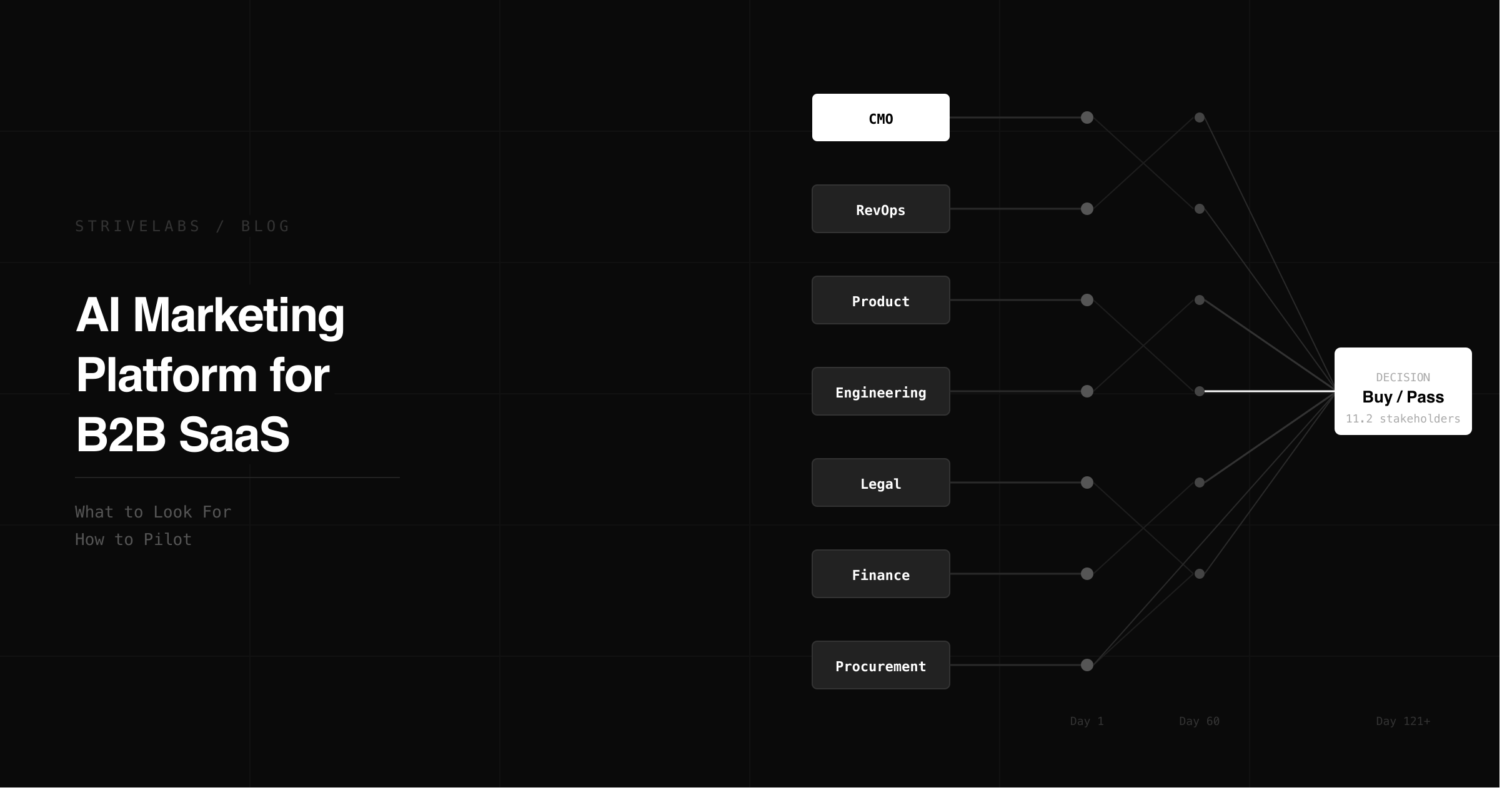
Buying committees now average 11.2 stakeholders for deals over $50K, up from 9.7 in 2024, with sales cycles running 121 days for mid-market and 218 days for enterprise. A platform that can't attribute across that full cycle is operating blind for the majority of your pipeline.
-
Examine buyer profiles and the specific traits that drive procurement decisions.
-
Providers often use an ideal customer profile to demonstrate their fit for your industry.
-
Since sales cycles in this market are long, revenue attribution must cover several months.
-
Technical owners usually step in once revenue operations starts the scoping process.
-
Your requirements'll change depending on whether you choose a product led or sales led approach.
-
Usage signals and the speed of user activation are the main focus for product led models.
-
Sales led motions tend to prioritize CRM depth and pipeline reporting.
-
Buyer priorities typically follow a very specific sequence.
-
Data storage rules and security standards like SOC 2 usually take precedence.
-
If the software doesn't sync with your CRM or analytics, the deal's probably dead.
-
You'll need a model that tracks various touchpoints to show how the platform actually helped.
-
Customer calls and real data are the best ways to verify what the software can do.
-
Pilot success criteria often shift as buyer behaviors change.
-
Procurement teams often demand audit rights and clear rollback clauses in the contract.
-
While sales led trials focus on speed, product led versions look at user retention.
-
Success often comes down to linking user identities and seeing if the team's actually using the tool.
| Need / Buyer Type | PLG (Product led) | Sales led | Enterprise procurement |
|---|---|---|---|
| Priority signal | Product events and activation funnels | CRM stages or opportunity touches | Security, compliance, and SLAs |
| Pilot success metric | Activation or retention lift | Pipeline influence and lead conversion | Data residency, SOC 2, and contract clarity |
| Required integration | Mixpanel, Amplitude, or in-app SDKs | Salesforce or HubSpot deep sync | Legal, security, and procurement forms |
| Typical stakeholder | Product and growth | Revenue operations and sales | Legal, security, and procurement |
Better decisions start with better infrastructure.
Most mid-market teams pick a channel and hope. Strivelabs gives you the data to know, and the infrastructure to act on it.
Book a Demo →
Core capabilities B2B SaaS teams need
Small steps are usually best. You should link technical tools to how a company makes money. This approach centers on the actual result a tool provides instead of just ticking a box for a specific feature.
Setting up identity resolution and CRM syncing is a great place to start. Since these pieces make measurement possible, the way you bring in product usage is important early in the process. Depending on who you sell to, one might be more important than the other. You can always add automated agents later.
Signal based lead scoring
Finding accounts that are ready for a sales talk is easier when you combine product data with engagement signals. This strategy looks at how people use your software or interact with campaigns to score specific contacts. If product data is missing, moving leads into a sales-ready status becomes much more precise.
-
Model inputs often involve product events and recent actions like demo views combined with conversion history.
-
Sales teams frequently find better leads and speed up their handoffs because SDRs do not waste time on dead ends.
-
This is one of the core functions a marketing engineer builds into the stack, the signal layer that connects product usage to sales readiness.
Integrating product usage data
The way customers use your software can be a massive help for scoring and personalization. Any platform you pick has to handle event streams while fitting into your current setup.
-
You should track things like login frequency and signs that a user might quit.
-
Check if the tool connects with Segment or if it allows for direct event ingestion through an SDK.
-
Ask the vendor how they handle large data volumes or the way they backfill historical records.
Multi-touch attribution
Because B2B sales cycles often last months, multi-touch attribution is a good way to see what drives revenue. You need a setup that offers different models for your marketing mix. These systems give credit across the whole funnel for deals that take 60 to 180 days to finish.
-
Models vary between linear rules and more complex math like Markov or Shapley.
-
Look at how the software manages metadata and if you can change the lookback windows.
-
The model must report on both people and the whole account so finance sees the same story as marketing.
-
For a full breakdown of attribution models and how to choose the right one for your sales cycle, see the marketing attribution guide
CRM sync and workflows
Syncing your CRM in both directions is a requirement for teams today. The platform needs to push data into the tools your reps use while pulling back their actions to close the measurement loop. If you do not have a solid connection, you will spend your time exporting files by hand.
-
Bidirectional sync should include leads and opportunities to keep data moving between Salesforce or HubSpot and your other tools.
-
Fields for campaign IDs and deal values need to be part of the setup while you also need a plan for when data conflicts happen.
How to evaluate data and integration depth
Before signing a contract, look past a vendor's claims about tool support. It is usually best to audit their connectors yourself. By asking for mapping documents and a telemetry sample from after the ingestion process, you'll get a clearer picture of the technical reality. It's also smart to request a sample ingestion plan alongside an estimate of engineering hours for backfills. Doing this shows you the actual workload and prevents scope creep from ruining the project later.
First-party data readiness
A simple checklist often helps determine if the data is actually ready for predictive use cases.
-
To establish a single customer ID, you'll need to use consistent matching keys like email addresses or account IDs across every platform.
-
Maintaining event hygiene is much easier when you use stable schemas and distinct names to avoid duplicate event types.
-
Timing accuracy typically relies on using UTC for all events and applying server-side stamps for key actions.
-
Because models usually require at least 180 days of historical data, you'll find that having a backfill feature is often non-negotiable.
Duplicate leads or missing account IDs often serve as early warnings. If product analytics rely too heavily on sampling, the fidelity needed for modeling often vanishes. In most cases, this results in data that nobody can trust and makes the entire implementation process far more difficult than it needs to be.
Identity and resolution
Stitching identities together is a part of measurement that people often neglect. You'll need to understand the specific logic and the thresholds the vendor uses.
-
Stitching methods vary from deterministic keys such as CRM IDs to probabilistic signals from devices or cookies.
-
It's helpful to ask about the distribution of confidence scores and how the software handles merges when confidence is low.
-
Requesting to see a live contact that exists in multiple systems during a demo allows you to watch the tool resolve those identities in real time.
Product analytics connections
Product analytics are central to modern SaaS reporting. The platform has to map key events while keeping raw payloads. Many tools claim to support Mixpanel or Amplitude, but you'll want to verify which specific fields they actually need.
-
Standard integrations you'll want to look for include Snowplow, Segment, Mixpanel, Amplitude, or direct SDK ingestion.
-
The platform has to manage data mapping for specific event names and properties like user IDs or plan tiers.
-
Because sampled analytics often introduce bias, you'll need to check how the vendor handles those specific issues.
Ad platform and tag coverage
Paid channels remain a major driver for the sales pipeline. Validating connectors and checking metric parity with ad platforms ensures that your attribution and budget actions stay accurate.
-
Your stack likely requires connectors for LinkedIn Ads, Google Ads, Meta Ads, and any programmatic platforms you're using.
-
Comparing clicks, spend, and total conversions helps you reconcile reporting between the vendor and your ad account.
-
Finding a tool with configurable attribution windows and latency settings is helpful when you're dealing with long sales cycles.
Attribution for long sales cycles
Tracking how marketing affects the bottom line over several months requires a few different tactics. Sales paths are rarely straight. Since no single tool can show you everything, you'll need to combine data methods that align with your specific internal reporting. It is a good idea to test your models with real world experiments. This stops one single channel from grabbing all the credit, which often happens in attribution. Accurate reporting stays possible even for deals that take six months to close.
Multi touch modelling
These systems spread value across every single point where a buyer meets your brand.
-
While linear or time-decay setups offer clear attribution rules, Markov chains rely on probability to judge complex interactions.
-
Checking simple rules is easy, but they often miss the heavy lifting performed by content at the very start of the journey.
Assisted conversion tracking
Early interactions tend to disappear when newer clicks arrive. Your ai marketing platform has to keep that first point of contact visible while still gathering data from the end of the funnel. For businesses with six month cycles, this is important.
-
Record every timestamp and campaign ID inside a timeframe that actually reflects your buying cycle.
-
If you find software that secures the first touch, your sales and finance teams will finally be looking at the same numbers.
Experimentation and holdouts
At times, the only way to find the truth is to stop running certain ads.
-
Set up a control group of accounts that never see a specific set of ads to see how they compare against the group that does.
-
Because these tests run for months, you are going to need a very large dataset to get clear results.
-
Statistical models help fill in the blanks when your account volume is too low for standard testing. Smaller teams don't always have the resources for this.
Preserving originating touchpoints
Keeping that first interaction data safe as it moves through various software tools is a necessity. You should tag the original source right away and lock the field.
-
Give every single lead or account record a permanent ID that links back to the very first interaction.
-
Firm data governance ensures that CRM updates or new form submissions do not wipe out the original source info.
AI agent capabilities for B2B SaaS marketing
It doesn't help anyone to have an AI agent inside a platform if it won't give you clear tasks or reduce the grunt work. If you work in paid media, content, or product growth, you need tools that push your workflow forward. You should look for features that catch shifts in your ideal customer profile before the rest of the market notices. These tools send alerts to the right person and suggest exactly what to do next.
ICP signal monitoring
Your growth and sales teams can work faster when agents watch account activity and point out real changes. If you manage high-volume accounts, this kind of automated oversight is where you will see the most benefit.
-
Good monitoring software identifies things like sudden jumps in product usage, visits to pricing pages, or new demo requests.
-
You will find that interest signals often show up through increased feature adoption, intent-based chat language, or general spikes in user activity. This type of automation is a great fit for teams that have hundreds of accounts to track at the same time.
Competitor and win-loss tracking
Watching your rivals automatically helps you do more than just adjust your market position. It gives your sales reps the data they need to beat tough objections when they are on a call. You will find that short summaries usually perform better than long, boring reports.
-
Typical results include things like new pricing models, fresh feature launches, or the specific reasons why a deal was won or lost.
-
Changes in how a rival positions themselves should go straight to your sales intelligence units so they can fix their battlecards and coaching materials.
-
You can connect these signals by linking them to CRM records whenever someone mentions a competitor during a meeting or a discovery session.
Content ops for category creation
You gain a huge speed advantage when agents track search rankings and build briefs for your specific ideal customer profile. Turning those automated alerts into briefs that are ready to use will save you hours of research. It helps you stay ahead of competitors who move much slower.
-
You can expect these tools to provide warnings about content that is losing traffic, gaps in current topics, and briefs with advice for specific personas.
-
The most efficient way to work is by sending these briefs to your content leads, filling out outlines automatically, and then watching how it affects your pipeline.
Experiment velocity for PLG funnels
You can test new ideas much faster when agents suggest hypotheses and group your target audiences automatically. To see if these tests are actually working, you should watch your activation data very closely.
-
Changes in activation rates for treated cohorts show you how many users reached a specific goal after you updated the product.
-
Checking for retention gaps at the 7, 30, and 90-day marks helps you figure out if your changes keep people around for the long haul.
-
You can track how users adopt new features and see the final conversion from a trial to a paid plan to understand the real effect on your revenue.
Reporting and pipeline visibility
Often, data needs to lead directly to revenue. Any tools you've picked should offer attribution and RevOps dashboards that sync with CRM and finance logs. This keeps the numbers you present to the CFO from appearing like soft marketing metrics. When every department looks at the same figures, trust in the data's going to grow. Match your reporting to the sales cycle and the specific metrics the board cares about.
Marketing sourced versus influenced
It's important to have clarity on definitions when you speak with sales and finance teams.
-
Marketing'll get credit for sourced revenue if the initial touchpoint or the actual origin of a deal happens specifically because of a particular campaign.
-
You'll count revenue as influenced when marketing provides a middle touchpoint that speeds up a deal or increases the odds of closing compared to a scenario with no marketing contact.
MQL to SQL conversion by channel
Why monitor the funnel at the channel level? This approach'll show you which specific paths turn leads into buyers. These funnels track the journey from a visit to a lead, then through the MQL and SQL stages, and finally to a closed deal. Shifting an MQL to the sales stage doesn't take much more than specific data.
-
The CRM's got to keep MQL definitions and scoring fields consistent so the data stays accurate and reliable for everyone.
-
Handoffs'll need timestamps so you can track the exact speed of lead progression and spot where things tend to slow down.
-
They've got to hold onto campaign IDs and UTM tags throughout the entire customer path to preserve the original history.
Did You Know?
LinkedIn delivers 121% blended B2B ROAS per Dreamdata's 2026 benchmark; the only major paid platform with positive aggregate B2B ROAS in 2026. Channel-level MQL to SQL tracking is what tells you whether that ROAS is translating into a pipeline or just activity.
Experiment lift tied to pipeline
Most finance leaders look for the actual cash impact of your marketing tests.
-
You're able to change lift percentages into pipeline forecasts by applying your average deal size and past conversion rates from the last few quarters.
-
Your reporting windows shouldn't be shorter than the real length of the sales cycle to ensure that revenue forecasts'll stay on track for the year.
Executive dashboards and alerts
Leadership dashboards don't need to be long. They've got to stay short and give a clear next step. If you send an alert, make sure it reaches the person who can fix the problem.
-
RevOps groups typically check views for sourced revenue and the ROI of each channel to monitor performance and general pipeline health.
-
Create alerts for when pipeline speed drops or when your best ads start to lose their punch and stop bringing in new leads.
Governance, security and compliance
Governance usually dictates whether a deal moves forward or stalls out. You shouldn't treat security or compliance as a last-minute check. Most procurement departments ask for certifications and DPAs before you start a pilot. If the vendor's answers seem blurry, don't settle. Ask for formal paperwork right away.
SOC 2 and security
Any vendor that says they are ready for the enterprise needs to back it up. This list helps you figure out if they're mature enough. It is easier to verify this now than to hit a wall during an audit.
-
Ask for a SOC 2 Type II report or a Type I that shows a path to the next phase.
-
Check that encryption is active for your data both in storage and while it travels over the network.
-
MFA is a requirement for admin logins, and the platform relies on permissions tied to specific roles.
-
They must have a written plan for incidents and a history of telling users about breaches without delay.
Data privacy and GDPR
If your company sells to the EU, the contract must include specific language. General privacy mentions won't cut it.
-
Make sure every subprocessor is named inside a signed DPA.
-
The contract needs to state clear rules for data minimization and set windows for notifications.
Data residency and isolation
Big enterprise clients care where their data sits. Confirming these settings while you are in the trial phase is a smart move.
-
You can ask for data to stay in a specific region or request encryption keys your team manages.
-
Look into backup storage locations to ensure your information never leaves the chosen region.
Vendor risk and SLAs
Check for legal safety and reliability by looking at these points. It won't take much time, but it saves you from surprises.
-
The SLA should define how much uptime is guaranteed and how fast you can export your data.
-
Confirm the vendor has cyber insurance and a set process to wipe data when the contract ends.
Vendor evaluation framework and scorecard
Picking an ai marketing platform is easier with a formal framework. A scorecard works well, especially with non negotiable security checks. Score points on tool connections, attribution depth, and total costs. If you weigh these technical stats against what real users say, you won't get distracted by a flashy demo.
Weighted criteria and weights
-
Looking at these percentages helps you map out the whole review process.
-
Connecting with your CRM or ad tools usually accounts for a quarter of the score.
-
The way the system handles multi touch attribution accuracy often gets 20 percent.
-
Compliance with SOC 2 or specific data residency rules typically takes up about 15 percent.
-
You should allocate 15 percent for automated workflows and data that syncs both ways.
-
The accuracy of alerts and how they get to your team represents 10 percent.
-
Support during onboarding and clear pricing models should fill the last 10 percent.
Why does this specific breakdown work? Because the depth of the connection and the attribution data reveal the real effect on your pipeline, these areas get the most attention. Most pilots fail when these specific parts do not hold up under pressure.
Pilot and commercial terms
-
Ask for a sandbox environment to test goals while you push for a better price.
-
Ensure your contract limits the billable hours for setup and includes a 60 day out.
Case studies and references
-
You should talk to a current user in a related field to look at their data.
-
Find out how quickly they saw a profit and if the software actually works as advertised.
Total cost and ROI model
-
Your budget needs to account for both the subscription and the hours your tech team spends on it.
-
Proving value to the finance team is much easier when you show better leads and lower costs.
How to run a short pilot
Focus on one ICP, a single channel, and one revenue hypothesis instead of casting a wide net. This tight focus gives you clear answers. It keeps the project from getting stuck. You will avoid wasting months on a strategy that was too broad to measure.
First month setup and checks
You have to get the technical foundation right during these first four weeks. If your starting metrics are wrong, the rest of the experiment won't matter.
-
Data mapping and identity testing create a foundation while you organize audiences and set up UTM tracking.
-
Engineers need to check how product events are pulled in and try to include at least 90 to 180 days of historical data.
-
By day thirty, you should have a working identity graph and reports showing your starting conversion rates.
Second month tests and iterations
Month two is about trying things out. Can the software actually move the needle on your pipeline?
-
Trying out new ads or focusing on high intent groups helps show if the model works.
-
Meet with RevOps every two weeks to tweak audience filters.
-
Tracking how fast deals move through the funnel helps you see if the tool pays for itself.
What success looks like at day sixty
You need clear markers to decide if you should keep the software.
-
Success often looks like accurate data and a team that actually uses the system alerts.
-
Failure might look like broken identity matching or zero movement after two solid tests.
-
Fixing problems usually involves narrowing your focus or asking the vendor for technical support.
Common pilot pitfalls to avoid
Keep the project on track by dodging these mistakes.
-
Clean up your event tracking before the models start so you don't end up with messy data.
-
Decide on your win conditions before the clock starts ticking.
-
Get RevOps involved early so they do not ignore the tool during the trial.
Conclusion
Long sales cycles expose every crack in your data, attribution, and activation. B2B SaaS teams need measurement and integration that don't fail at a platform level. Proving marketing influence is impossible if your software does not pull product signals or sync with your CRM. You should start with a pilot.
Focusing on one problem with a simple scorecard shows if the data is ready within sixty days. The trial either moves the pipeline or shows why things failed. It gives you the proof RevOps and procurement needed for a defensible purchase.
The marketing engineer function, delivered as software.
See how Strivelabs gives mid-market teams the operational capacity without the hiring cost.
Explore Strivelabs →
Frequently Asked Questions (FAQs)
How much does an AI marketing platform typically cost
What you pay for these systems depends on the specific knobs you need to turn. Basic content tools usually cost between $50 and $500 every month. If you move into larger enterprise marketing and analytics platforms with deep integrations, costs often start in the low thousands. For a full rollout, the monthly bill could reach $5,000 to $15,000 once the onboarding process concludes. It's common to see a price jump at this stage because technical requirements are higher for large teams.
What is the difference between an AI marketing platform and various AI point tools
Specific jobs like writing copy or providing SEO tips usually fall to point tools. A true ai marketing platform is different because it pulls together internal and external data from various sources. It'll chew through data signals around the clock. This lets you track actual revenue results instead of disconnected metrics.
Can a small B2B SaaS business benefit from an AI marketing platform
Smaller teams can find value, but full scale platforms generally suit mid market or enterprise companies better. These larger organizations have the high data volume and long sales cycles that justify the price tag. If a team's small, it might see a faster return by sticking with targeted tools. Wait until data maturity scales or internal resources expand. Complex systems often outweigh the benefits for a startup with limited leads.
What happens if our first party data is messy or incomplete
Bad data is usually why these projects fail. If identity tracking's broken or product events don't have timestamps, models won't work correctly. Most companies need to start with a focused cleanup project. To run predictive use cases effectively, you first have to fix event hygiene and UTM rules. Getting results without clean records is difficult.
Are the AI models in these platforms a complete black box
How a vendor builds their system changes the experience. While some companies use secret models, look for explainability during a search. Check the logic to see how software handles data. Lead scoring logic is a key detail. If a provider can't show how their system makes a recommendation, that's a major risk for revenue decisions and budget. You'll need to know if the software is biased or using outdated logic for your sales pipeline. This helps you avoid wasting money on the wrong lead segments.