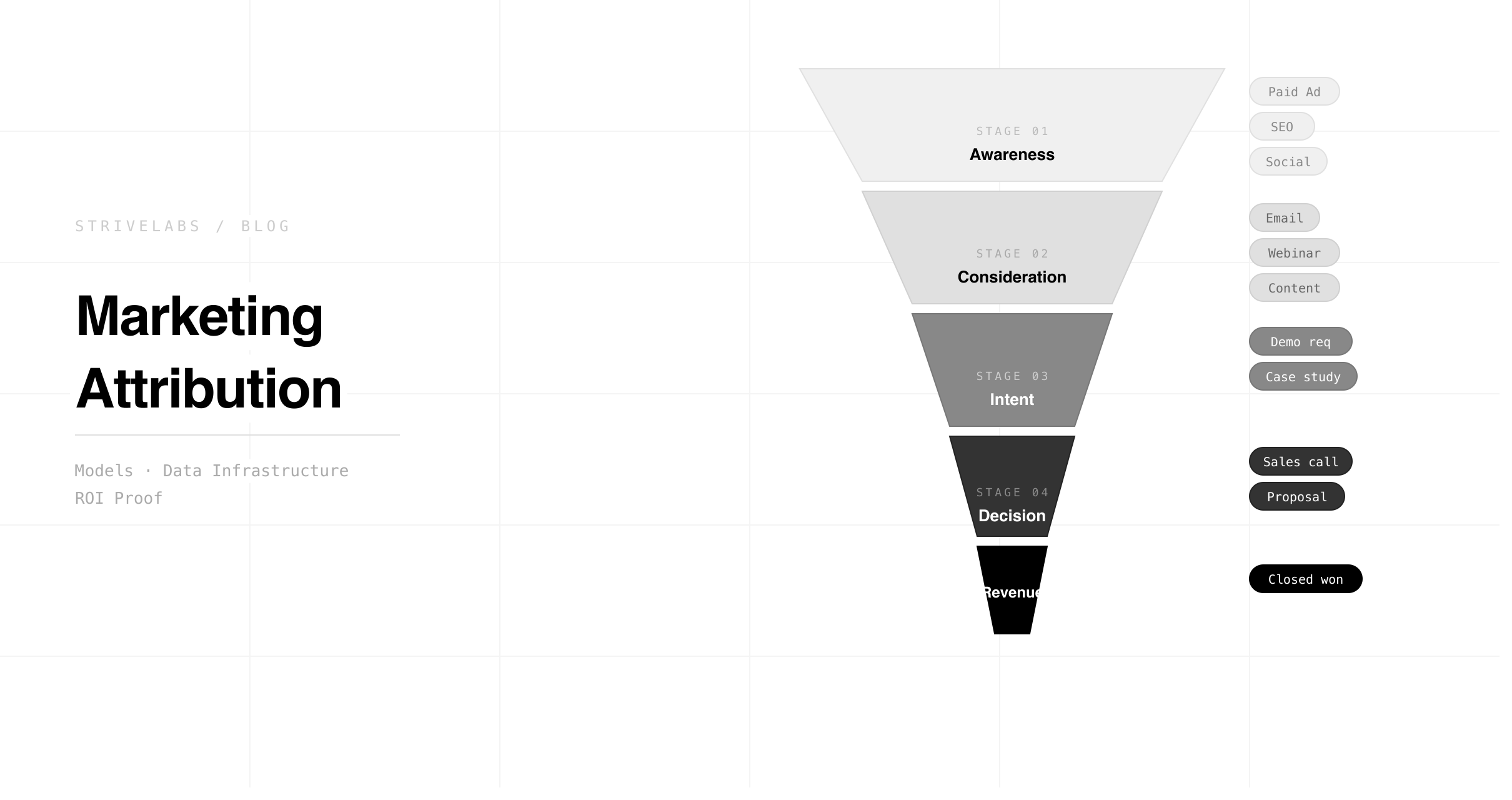
Only 21% of B2B marketers are confident in their attribution. The other 79% are making budget decisions on incomplete data; optimising for the wrong channels, underselling top-of-funnel investment, and presenting CFOs with numbers nobody fully trusts. This guide fixes that. Marketing attribution identifies the specific activities that generate revenue. By mapping touchpoints to sales, you ensure the budget is not wasted on things that don't work.
Multi-touch attribution improves ROI by 15–30% for teams that implement it correctly. ABM-led programs with proper attribution generate 2.6x more pipeline per marketing dollar than broad-reach demand gen. The gap between teams that can prove attribution and those that can't is compounding every quarter.
Look through the marketing attribution models and the checklist for your data stack below.
At a Glance
-
Marketing attribution involves connecting specific ads to final sales so you can see which campaigns generate real money.
-
Sales cycles in B2B aren't usually a straight line. Focusing only on one click can lead to bad spending choices because it ignores real buyer behavior.
-
To get B2B marketing attribution right, you need multi touch attribution and a closed loop attribution plan to match ad data with your CRM entries.
-
Accurate reports won't happen without high quality data. Use standard UTM parameters and track individual users across several channels to keep your numbers honest.
What is marketing attribution?
Marketing attribution tracks which touchpoints earn credit for a sale. Since you've got these numbers, messy campaign results become signals you don't ignore.
-
Linking campaigns to ROI lets you move your budget where it's working best.
-
You'll see rule-based marketing attribution models and data-driven choices. A clean data stack means your math's right.
Why attribution fails for most teams
You likely start with good intentions. You want to know which campaigns drive growth. But small gaps and lazy methods often ruin attribution before you look at the data. These common mistakes show up in specific ways.
-
Data silos cause friction. Your marketing and sales systems don't talk, so touchpoints never connect. This makes revenue attribution guesswork rather than measurement.
-
Messy UTM practices. If you do not tag campaigns consistently, traffic ends up in random categories that hide performance.
-
Broken CRM connections. Leads fail to link back to marketing because your lead source capture is weak.
-
A shortage of specialized skills. 42 percent of teams have a skills gap, which leads to models picked for ease.
-
Problems with user tracking. Roughly 41 percent of organizations struggle to follow anonymous to known journeys across different devices.
-
Not enough analytics help. Around 40 percent of teams lack the time for tasks like identity stitching or deduplication.
The biggest mistake is picking a model before you fix your data quality. Choosing a single touch approach, like first or last click, usually gives too much credit to the top or bottom of your funnel. You might waste money on flashy tactics while ignoring channels that help close deals.
Marketing attribution models
Choosing a model involves weighing simple rules against heavy math. You must decide if one interaction or several should get the credit. Usually, the quality of your data and the length of your sales cycle will point you toward the right answer. Simple is often better.
First-touch attribution
This model hands the whole prize to the very first interaction. Because it tracks the start, you see how well top-of-funnel campaigns bring in new people.
-
Setup is fast and awareness reports are easy to follow for most teams.
-
You may find it overvalues early ads and ignores what actually triggered the conversion.
Last-touch attribution
The final click right before someone converts gets the full reward. Marketers focused on direct response use this because they care about the moment of the sale.
-
Simple methods like this are fine for short sales cycles that don't involve much research.
-
It skips every touchpoint that happened before the end, which makes it less useful for complex B2B deals.
Linear attribution
When you assume every step in the journey is worth the same, this model fits. You split the credit up evenly across every recorded interaction.
-
It provides a more balanced outlook than single-touch models if you use many channels.
-
Tracking every step perfectly is a requirement here, yet you still cannot see which specific touches actually drove results.
Time-decay attribution
This system gives more credit to later interactions because they happened closer to the conversion. It focuses heavily on the consideration phase of the funnel.
-
Stakeholders can usually follow the logic since it values recent actions more than old ones.
-
Early brand awareness moments might get almost no credit depending on the half-life settings you choose.
Position-based attribution
Models like U-shaped or W-shaped versions highlight the heaviest parts of the journey. They weight the first touch and lead creation more while sharing the rest of the credit with other steps.
-
B2B journeys that target specific milestones work well with this because the model tracks awareness and conversion.
-
A common setup gives 40 percent of the credit to both the start and the finish of the journey.
Algorithmic data-driven models
These systems use machine learning to compare paths that convert against those that do not. They aim to find the real lift each touchpoint provides.
-
To make this work, you need plenty of data and a way to connect users across different sessions.
-
Use this approach if you can track events reliably over a long period.
-
These models show how different channels work together in a complex system.
-
Results can be hard to explain to management because the math happens out of sight.
The right choice depends on your specific goals.
| Model | Accuracy | Data needs | Best use case | Typical bias |
|---|---|---|---|---|
| First-touch | Low | Minimal | Awareness reporting | Overvalues the top of the funnel |
| Last-touch | Low | Minimal | Short funnels | Overvalues late contacts |
| Linear | Medium | Full paths | Multi-channel reporting | Waters down high-value touches |
| Time-decay | Medium | Timestamps | Consideration funnels | Undervalues early awareness |
| Position-based (U/W) | Medium-High | Milestones | B2B journeys | Dependent on milestone rules |
| Algorithmic and DDA | High | Heavy volume | Complex funnels | Hard to explain |
Better decisions start with better infrastructure.
Most mid-market teams pick a channel and hope. Strivelabs gives you the data to know, and the infrastructure to act on it.
Book a Demo →
Multi-touch attribution for B2B marketing
Multi-touch attribution spreads credit across every step of a buyer journey. This approach allows marketers to put more budget into the touchpoints that really help a conversion happen. It's common to focus only on the last click. But that fails to show what actually creates growth. Because B2B marketing involves groups of buyers and long timelines, single-touch data usually feels incomplete. Setting up closed-loop attribution often means you have to rethink how data identity and governance are handled.
Why multi-touch attribution matters in B2B
Closing a B2B deal doesn't happen after just one click. Stakeholders often spend months interacting with several campaigns. These interactions build up over time. If you focus only on that final touch, your plan might miss the early actions that first filled the pipeline.
-
Buying committees often have several decision makers who each require messages tailored to their specific roles.
-
Sometimes educational channels only prove their worth after a prospect sees them on several occasions.
-
Monitoring assist signals like account activity or demo requests is often a high priority.
-
Events and content usually function together with sales outreach instead of staying in separate categories. This setup is common in enterprise tech.
How to handle long sales cycles in marketing attribution
Longer cycles require credit windows that keep early influence visible as weeks pass.
-
Lookback periods should align with your typical sales cycle, which means a 30 to 180 day window is common for B2B even if a one week window works for simpler sales.
-
Giving specific credit to milestones like when an opportunity begins prevents those early interactions from getting lost.
-
Server side tracking and identity stitching help connect anonymous visits to specific accounts and still follow privacy rules. This is often the best approach for global firms.
Did You Know?
The average B2B buyer journey in 2026 involves 88 touchpoints and 10 stakeholders. Buying committees now average 11.2 people for deals over $50K, with sales cycles running 121 days for mid-market and 218 days for enterprise. Last-touch attribution doesn't just give you an incomplete picture in this environment, it actively misleads budget decisions.
How closed-loop attribution works in practice
This method connects marketing touches to revenue inside CRM records to offer a clearer look at what works. You end up with campaign data that helps you make better choices.
-
If you don't connect your CRM to web analytics and marketing automation platforms, attribution data stays siloed.
-
Teams usually link data sets using UTM parameters, email addresses, and specific timestamps.
-
Pay attention to outcome signals, particularly when deal stages change or the date an opportunity officially starts.
The Dark Funnel Problem — Why 38% of Your Pipeline Looks Like It Came From Nowhere
Most B2B attribution systems track what they can see. The problem is that a significant portion of your pipeline was influenced by things they cannot, a prospect reading your LinkedIn post without clicking, a buying committee member sharing your case study in a private Slack channel, a podcast mentioning your ICP heard on their commute. None of these generate a UTM parameter. None show up in GA4.
The dark funnel gap averages 38% of the B2B pipeline. For most teams, that revenue gets credited to direct traffic, the last sales email, or nowhere at all. Budget decisions get made on 62% of the picture.
What lives in the dark funnel:
-
Dark social - content shared in private Slack groups, WhatsApp, forwarded emails - arrives as direct traffic with no source
-
Organic research without conversion - multiple blog visits before a branded search six weeks later
-
Word of mouth - the most powerful B2B channel and the least measurable
-
Sales-assisted touchpoints outside your marketing stack entirely
This is exactly the gap closed loop marketing is designed to address; connecting the observable touchpoints into a revenue record even when the full journey isn't visible.
The data infrastructure you need
Marketing attribution works like plumbing. You cannot just pick a model and expect it to function. First, a pipeline must be in place to capture touchpoints, clean up the data, and connect identities before the results go to the users.
Internal data sources
Start with the systems already in your stack. Get them to provide clean exports.
-
Gather data from platforms like Google Ads or LinkedIn and pair it with CRM records for deals. It is usually helpful to include MQL timelines from your automation software too. GA4 records and phone logs are also worth including if you have them.
-
Everything relies on using the same UTM names in every campaign. Timestamps have to match across different systems. You also need rules that delete duplicate events so reports don't get cluttered. This keeps the final numbers reliable.
| Example row | Source | Key fields to capture |
|---|---|---|
| Paid search | Google Ads | campaign_id, creative_id, click_ts, gclid, cost |
External and observational data
Outside signals give you context. They explain why performance changes when you can't see the clicks. This is especially true for brand awareness.
-
Look at search trends to spot demand or use social tools to see how much people talk about the brand. Tracking what competitors are doing helps you understand why the market is moving.
-
Those extra details let you double check the numbers you see inside ad platforms. Clicks do not tell the whole story, so these signals help you find trends in specific groups that data might miss.
-
External data can fix the bias found in standard platform reports. This works best for teams that want a complete view of their performance.
Identity and stitching
Connecting the dots between users is often the hardest part. The strategy you choose has to match your technical skills and privacy rules.
-
In most cases, teams use lead IDs for exact matching or rely on probability for people who have not logged in yet. Combining both methods is a smart way to figure out who is who as time goes on.
-
If you need to move fast, a CDP is a good choice. But if you want to use SQL and keep the data in your own hands, a warehouse is the better path.
-
A CDP is faster to set up but is often more expensive. If you have engineers who can handle SQL and keep the connections running, the warehouse gives you much more control.
Warehouse and tooling
The warehouse is where the truth lives. Decide which tasks belong to marketing and which stay with the data team. This keeps roles clear.
-
Most setups use connectors to bring in data and a clean schema for specific events. You finish the process by adding a layer for SQL or machine learning models.
-
Marketers should be the ones deciding on UTM rules and campaign details. The heavy lifting of connecting systems and checking for errors usually falls to the engineering team.
-
Marketing Mix Modeling and clean rooms help when privacy laws make it hard to track people individually. They offer a view from the top.
-
When you send attribution data back to your ad accounts, you can start bidding on profit instead of just clicks. This shift makes every dollar spent on ads work harder because the system optimizes for actual revenue.
How to choose a model and tool
Selecting the right model and software depends mostly on your funnel stage and data maturity. You also have to consider what the finance team needs for their reports. Before committing, run small tests to check your assumptions. Using a basic framework makes it easier to compare the pros and cons. The system doesn't have to be complex to work well.
A practical framework for choosing the right marketing attribution model
Begin by making a checklist of your requirements. Once that is done, you can move on to short experiments.
-
Use a checklist to see how your sales cycle and channel count align with different model types. Short cycles might work with basic setups, but longer journeys with many steps often need position-based or algorithmic logic.
-
It is helpful to run two models at the same time. You could compare last-click results with a position-based version to see if the channel recommendations change.
-
To measure the real lift of one specific channel, you might need a holdout test. This involves keeping the media mix the same for a control group to see what happens without that spend.
-
The most effective marketing attribution model is one that leaders can understand quickly. It still needs to provide enough data for tough budget decisions during planning sessions.
How to evaluate marketing attribution software
Technical requirements are only one part of choosing software. Internal politics often play a role too. When you sit down for a demo, make sure to ask very pointed questions about the mechanics.
-
Ensure your checklist includes items for data connectors and identity stitching. The system must be able to follow your specific business rules without requiring manual workarounds every day.
-
Mid-market B2B marketing attribution usually requires a connection between a CRM like Salesforce or HubSpot and platforms like GA4. Adding call tracking and automation tools to the mix is another good move.
-
During a demo, ask the vendor how they deal with duplicate records. You should also find out if you can change lookback windows easily. It's just as vital to understand the model logic as it is to know what data goes to finance.
-
Look for marketing attribution software that lets you switch models without calling a developer. Being able to make small updates on your own saves a lot of time for the entire marketing team.
How to present marketing attribution to the CFO
CFOs need reliable numbers and logical explanations. Frame your attribution system as something that supports the way finance already tracks performance.
-
Campaign revenue and the cost of each closed-won deal are metrics that usually satisfy a finance lead. Including confidence bands for these numbers makes your estimates look much more credible to the executive team.
-
You need to be very clear about lookback windows. Explain exactly how the system handles assists to keep the narrative simple and avoid confusion during budget reviews.
-
Sometimes data gaps happen. If they do, prepare a simple note explaining why they affect your results and when you expect to fix them so the team stays informed.
| Tool capability | Why it matters | Minimum expectation |
|---|---|---|
| Data connectors | Closing the loop is impossible without the right connectors | Standard connectors for your CRM, analytics, and ads |
| Identity stitching | This process links customer touches to actual revenue | Support for deterministic matching and custom rules |
| Model flexibility | Different businesses have unique needs | Rule-based and data-driven options are both necessary |
| Finance exports | This helps with revenue reconciliation | Exportable views for the finance team |
| Reporting & alerts | These trigger timely actions | Dashboards for revenue and automated notifications |
If you're evaluating platforms specifically for B2B SaaS, the AI marketing platform evaluation guide covers the vendor scorecard and pilot framework in detail.
How strivelabs closes the attribution loop
Strivelabs is more than software. This system is a marketing engineer for the company. By combining internal and external data, it cleans up signals to turn raw info into specific tasks for different personas. These pilots move quickly. You can show real value without spending $50,000 on a tool or finding a data engineer.
-
Unifying data brings together ad, web, CRM, and chat history for identity stitching. Multi touch attribution models run on their own to suggest actions tailored to targets rather than generic audiences.
-
Because setup is fast, mid market B2B firms usually complete a closed loop attribution pilot within 30 to 60 days. Ready-made schemas mean the process takes less time than building from scratch.
-
Results change based on your job. Paid search managers see budget advice while writers get alerts about search rankings. Product marketers can monitor win loss records or see how competitors don't match up.
-
Getting started requires ad and CRM access, UTM standards, and won deal samples. Expect a report in under two months.
Conclusion
Choosing an attribution model isn't the only step. You will need clean data and a clear plan for tracking identity.
Without shared definitions, the numbers just won't make sense. Pick a model that matches your sales cycle. Try a closed loop pilot to see how it performs against holdout groups. Show your CFO a dashboard with revenue per campaign and an estimate of data confidence. Fast tests help you learn before your budget grows.
The marketing engineer function, delivered as software.
See how Strivelabs gives mid-market teams the operational capacity without the hiring cost.
Explore Strivelabs →
Frequently Asked Questions (FAQs)
What is the difference between multi-touch attribution and marketing mix modeling
Multi touch attribution tracks specific actions like clicks or email opens so you can change campaign tactics quickly. Marketing mix modeling looks at broad historical data to help you plan annual budgets. It doesn't follow a single person through their journey. Instead, it looks at the big picture to see how various channels perform over a long time. Executives often use this data to determine where the next million dollars should go.
How does attribution work without third-party cookies
With cookies going away, focus on first party data and server side tracking. Use hashed identifiers to keep your data accurate. This helps you bridge gaps where direct tracking is difficult and is a necessary shift for any modern marketing team today.
What does a 7-day attribution window mean
This setting assigns credit to marketing touchpoints that happen in the week before a conversion. While it works for small purchases, the long cycles in B2B marketing make a seven day window feel too tight. You'll probably miss the early research phase that happened a month ago. High ticket items often require months of nurturing before a lead finally signs a contract.
What is the most common mistake when implementing attribution
Choosing a model before you clean your data is a mistake that happens often. If your UTM taxonomy is messy or your tracking scripts are broken, the results will not be reliable. Building a solid technical foundation is the only way to get a clear view of customer identity.