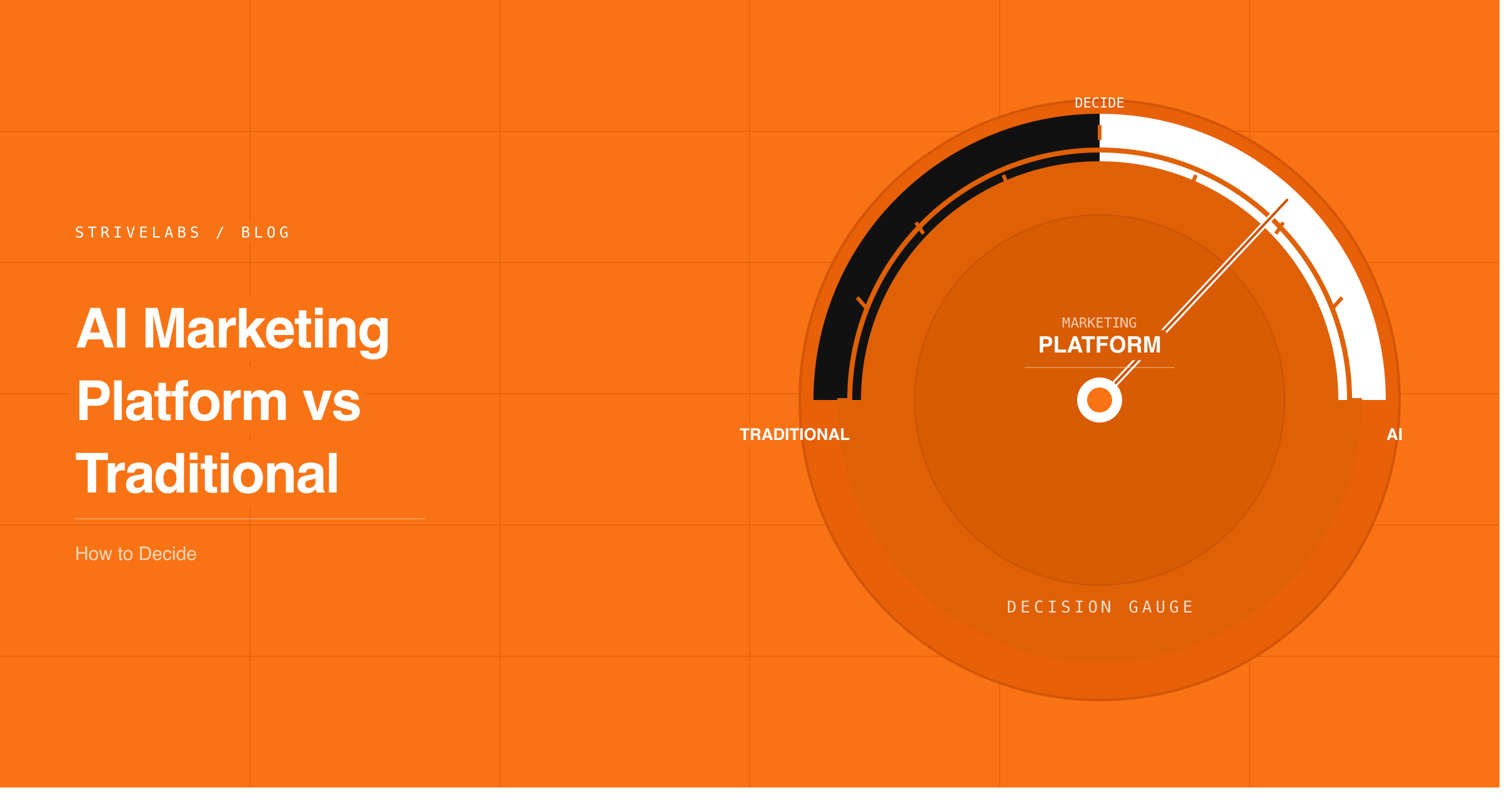
Marketing leaders in 2026 must compare an AI marketing platform against traditional marketing. Decisions about budget allocation aren't abstract ideas. They are financial realities.
Instead of waiting months for performance data, you'll often see value from modern tools within weeks. This guide looks at both approaches and includes ROI benchmarks for a pilot. Use the checklists to vet different vendors. Strivelabs sits at the centre of this decision, giving mid-market teams the AI marketing infrastructure to run the comparison themselves, without building it from scratch. You can also grab reporting templates for a POC. After running a quick test with the media-mix list, show the results to the C-suite.
At a Glance
It's helpful to see the big picture before you look at details.
-
You can use an AI marketing platform to manage your workflows and adjust ad spend using live data.
-
Instant metrics set these systems apart from traditional marketing that builds trust over years.
-
Experts today expect digital channels to grab roughly 72 to 73 percent of ad spending in a trillion dollar market.
-
Your strategy works best if you combine AI precision with the local reach of traditional marketing.
What is an AI marketing platform?
An AI marketing platform is a central command post. It gathers performance metrics and chat logs to offer clear instructions for spending your money or finding new customers. Speed is the main result when data meets action. Manual tasks are still an option, or you can just let the software handle it.
A few core parts make these systems work.
-
Machine learning and predictive analytics look at lifetime value and suggest where to move your money.
-
The software builds SEO plans or reviews phone logs using language processing and text creation.
-
Data orchestration brings Google Ads, CRM data, GA4, and social media feeds together in one place.
-
Changing ad images or adjusting what you bid happens with a single tap.
Big companies want ads that fix themselves and paths tailored to each buyer. Numbers for 2025 and 2026 show that adoption doesn't slow down. Ask for hard budget data when testing a new tool.
What is traditional marketing?
Traditional marketing involves physical ads and broad tactics that stay offline. Setup takes longer. Even so, they usually work when your audience values trust or simply doesn't use the web.
Which offline channels offer the most benefits for your brand?
-
Television and radio commercials allow you to tell stories to massive audiences.
-
By using billboards or direct mail, you can saturate a specific town with paper flyers.
-
You might build relationships through hands-on demos at local trade shows.
-
Many companies still use telemarketing for direct phone outreach.
Physical ads often feel more reliable. Local placements help when data is thin, but measuring traditional marketing is not a fast process.
How do AI platforms differ from traditional marketing?
Marketing leaders usually split their budgets between a few specific buckets. The trick is balancing new tech with the kind of broad reach that has been around for decades.
Audience targeting and reach
Modern tools give you the power to carve out tiny groups of people or find new leads based on who is already buying. It lets you show specific ads to specific users without losing the scale of a big campaign. Old school placements work differently. They cast a wide net over a city or a time slot. If you want everyone in town to know your name, that is still the way to go.
-
Microsegmentation finds people ready to buy, which often leads to better conversion numbers.
-
Standard channels usually win out when you need street visibility or want to reach folks who aren't online much.
-
Consider an app launch where profit is the priority. An AI marketing platform is usually the right call, while radio or billboards better suit a local grand opening.
Measurement and attribution
Digital systems churn out data the second things happen. You can see which ad led to a purchase even if the buyer never clicked a link. Trying to track an offline ad is a lot harder. You end up relying on surveys or proxies that arrive weeks after the money is spent. It is like waiting for the mail to find out if your business is growing.
-
Things like impressions and customer acquisition costs are easy to track on a live dashboard.
-
Reach estimates and surveys take a long time to get back from traditional media outlets.
-
A gap exists because you can kill a bad digital campaign in a few days, but offline data takes much longer to surface.
-
You can use digital ads to see how much a local radio spot actually boosted your sales.
Speed and agility
How fast can you swap a photo or change what you're willing to pay for a click? On the web, it takes a few hours. That speed lets you run small tests without risking the whole budget. This is exactly the operational edge a marketing engineer builds into your stack, which tests, measures, and iterates without waiting on manual processes. Traditional media works on a different clock. Long lead times and high production costs mean you're stuck once the print ad hits the street.
-
The digital world runs on fast tests and bid changes that can happen at any hour.
-
It usually takes weeks or even months to take a traditional ad from a concept to a finished product.
-
Speed is key for growth since it stops you from wasting money on ideas that don't land.
Cost structure and scale
Digital systems mostly run on auctions and fees that scale with your usage. There are setup costs, but the price to reach one person usually gets lower as you spend more. Traditional buys use flat rates. You pay the same for production and placement whether the ad works or not.
-
Traditional pricing is usually locked in, but modern setups charge for software access and the ads themselves.
-
A traditional buy gives you a budget you can predict, but auctions are often more efficient for finding specific buyers.
-
Good programs get cheaper as they grow because the system learns from the data you feed it.
| Capability | AI marketing platform | Traditional marketing |
|---|---|---|
| Targeting | Micro-groups, lookalikes, and live changes | Broad reach based on location or time |
| Measurement | Multi-touch tracking and quick profit models | Delayed surveys and general estimates |
| Speed | Updates occur in hours | Weeks or months to start a campaign |
| Cost structure | Auctions and platform fees | Fixed prices and high production costs |
KPI and ROI comparison for 2026
How's your strategy working? It's worth checking these two specific sets of numbers.
-
Keep an eye on how fast you pivot versus conversion efficiency. While an AI marketing platform lowers your CPA fast, traditional marketing builds brand recognition that pays off in lifetime value later.
-
Plan for 2025 and 2026 by looking at the global market. Digital ads make up 73 percent of global spending. Since the market's over a trillion dollars, budgets naturally move to digital.
Collecting KPIs helps you see how these methods stack up.
-
Track total ad views and what that reach costs you.
-
Watch your cost per acquisition and how often visitors buy.
-
See how fast your team tests new creative alongside assisted conversions.
-
Don't ignore brand awareness data or customer consideration.
Use this template for your reporting.
| Time period | Channel | Spend | Impressions/Reach | Conversions | CPA | Conversion rate | Estimated LTV impact |
|---|---|---|---|---|---|---|---|
| Q1 2026 | AI-driven paid social | $XX,XXX | X,XXX,XXX | XXX | $XX | X.X% | $X,XXX |
| Q1 2026 | OOH + radio | $XX,XXX | Estimated GRPs | XXX (proxy) | $XX (proxy) | N/A | $X,XXX |
Add your brand numbers above. Comparing CPA against your speed of change over three months gives a sharp view. Make sure labels show if data's from 2025 or 2026.
A bar chart makes these gaps clear. It's helpful to map CPM and conversion rates for both your AI marketing platform and traditional marketing work.
When to choose AI over traditional channels
Managers deciding where to place a test budget can start with this framework. Look at how the audience acts. Check for legal roadblocks, too. Most tests show a clear signal in four to eight weeks, although it does take some patience.
Audience fit checklist
Determine if your customers like digital messages or if they really need to see you in person. Use these questions to find out.
-
Is it possible to track your customers online using data you already own?
-
Models that track lifetime value are usually helpful for certain expensive customer groups.
-
Think about whether a local launch needs billboards or events to work.
-
Patterns in how people buy things often point to those who will come back again.
-
Older groups might still choose traditional marketing over a specific mobile app.
-
Sometimes you just need to put a sample in their hands to close a deal.
Budget and media mix rules
Your testing plan depends on what you want to achieve and the speed you need. Keeping a small budget is usually the right move during the consideration stage. Try this split for two months.
-
Move 60% of the cash into search or social ads so you can get data fast.
-
A 25% slice can go toward radio spots or events paired with online follow up ads.
-
The last 15% covers the cost of creating the ads and checking brand health.
You will use digital channels as your main testing tool. Try spending on a few different things to see if people really know your brand better. If one spot gets you better results after 30 days, don't wait to move your money there.
Brand and long-term goals
Think about the steps that follow that initial purchase.
-
When you need to look credible, traditional marketing often builds trust with a broad crowd.
-
Lead capture happens fast with digital tools, which can drop your total costs.
-
Launching something new usually takes a two part plan where physical ads get attention while digital ones finish the sale and capture the lead information.
Related Read: The Marketing Engineer Tech Stack in 2026 - Pipelines and AI-native Tooling
The marketing engineer function, delivered as software.
See how Strivelabs gives mid-market teams the operational capacity without the hiring cost.
Explore Strivelabs →
How to evaluate AI marketing platforms
Most marketing teams evaluate new vendors using a process that mirrors traditional procurement routines. Can the AI marketing platform talk to your existing software? To be useful, it needs to provide advice that helps you move faster. Test the fit using the following five categories.
Data and integrations
Data should move as fast as your market does. Confirm if the vendor handles the specific data volume your company generates on a daily basis.
-
Verify that the system connects to Meta, Google Ads, GA4, and HubSpot without custom code.
-
Syncing might happen every few seconds, though some tools only refresh once every twenty-four hours.
-
Ask the vendor how their software merges duplicate customer profiles.
-
Connect one ad account to a CRM list for two weeks to see if numbers match.
Actionable insights and alerting
Why settle for raw data? Your staff needs tasks they can finish immediately rather than a messy list of figures. Unorganized figures do not help anyone.
-
A specific suggestion is usually more valuable than a huge spreadsheet of unorganized numbers.
-
Check for simple toggles in the interface to change a bid or swap an image.
-
Notifications can trigger if a budget hits a limit or if SEO rankings drop.
-
Watch for low conversion rates on landing pages during your trial. This approach is often best for teams running high-volume campaigns.
Measurement and reporting
Attribution data belongs in one spot. This stops the headache of building manual reports every week, which usually eats up your team's time. Look for a system that organizes everything without needing constant human intervention.
-
Use dashboards with prebuilt layouts that show which ads caused a sale.
-
Can the software send scheduled email updates or flag unusual traffic spikes?
-
Link your budget to first-click and last-click sales during a fourteen-day test. Users often save ten hours this way. This allows them to focus on strategy instead.
Security and compliance
Because privacy laws are strict, you cannot ignore data rules during a software test. This is especially true when handling customer identities across different global regions.
-
Look at internal controls for permissions and see how quickly customer info can be deleted.
-
Find out if data stays in one country or if the system encrypts it during transit.
-
Providing privacy impact summaries helps the legal department work faster. A standard check takes five days.
Pricing and total cost
Don't ignore hidden labor costs. Subscription fees are only part of the story, and the time your team spends on setup is a real expense.
-
Make sure you can easily find the monthly subscription costs, connection fees, and support charges.
-
Estimate the total hours your staff will spend getting the software to work.
-
Track the license fee and maintenance hours in a spreadsheet. Managers save five hours a week just by using a clear tracker like this.
Pilot contracts typically last two or three months with a price that won't change. You might set a goal to lower the cost of acquiring a customer. If the platform does not hit those marks, the contract should let you walk away.
Implementation and team impact
Adding an AI marketing platform to your department alters daily workflows because it's changing task ownership and demands fresh expertise. A phased introduction works best when you've set clear guidelines and can show efficiency wins.
What defines success? You'll find the answer in your data. Watch your campaign instrumentation closely.
New positions often appear during this transition, like data integrators or platform owners. Training for staff won't take forever but typically lasts four to eight weeks, while reaching full adoption could take three months. You're ready once your campaigns use first-party data and you've established one source of truth for conversions.
-
The pilot phase lasts up to eight weeks and focuses on linking your main accounts to test proof of concept metrics.
-
Between week eight and twenty-four, scaling happens by adding more connectors and shifting sixty percent of the budget to automated actions.
-
Embedding the system takes six to twelve months as alerts become a standard part of the daily routine.
Invite the Head of Marketing, media leads, CRM owner, and data engineers to the table. Look for results like time saved on manual bidding or a lower CPA.
Real-world benchmark case studies and templates
Grab these templates when you need to plot your own category tests. You will find that moving data from the tables into a personal workbook makes comparing your results much simpler. Often, this is the fastest way to see which tactics really hit your goals.
An AI-driven campaign example
Imagine a paid social push that you manage through an AI marketing platform. You should watch specific KPIs and handle technical tracking so the software gets the correct data. Before you start, check that your CRM connection is solid.
Campaign summary and measurement plan
-
Your goal is to secure trial users who have a lifetime value of more than 300 dollars.
-
You can find new leads by mixing paid social ads with programmatic placements and retargeting.
-
Data will reach the platform after you finish setting up server-side tracking and your CRM matchback feeds.
Campaign Metrics Checklist
| Metric | Target |
|---|---|
| Campaign spend | $50,000 |
| Impressions | 2,000,000 |
| Clicks | 40,000 |
| Conversions | 1,000 |
| CPA | $50 |
| Conversion rate | 2.5% |
| 90-day LTV uplift | $X |
Keep a close eye on your cost per acquisition so you stay under budget. Most people see conversions begin within the first two weeks. A real lift in value usually shows up after about ninety days. But if the data looks flat, do not panic yet.
A traditional campaign example
Out-of-home ads and radio spots remain classic choices if you want broad brand awareness. You will find that calculating ROI is difficult because direct tracking is not always an option. In many cases, these old-school methods give you a perspective that digital clicks just cannot provide.
Campaign mechanics and tracking approach
-
You will focus on building awareness across three major cities for a period of two months.
-
Your ads will appear on billboards near transit hubs and in radio spots during the morning commute.
-
Success comes from checking foot traffic, watching coupon use, and running surveys before and after the campaign.
Practical tracking and measurement bullets
-
Use short promo codes or specific landing pages to see which listeners are actually taking action.
-
Carry out a brand awareness survey before your start date and do it again once the campaign ends.
-
You can also spot success by looking for spikes in local web traffic or visits to your physical stores.
A hybrid campaign example
Hybrid strategies work by putting digital ads on top of a more conventional launch. Using this approach helps you grab extra demand and check if your digital spend truly helps your bottom line. An A/B test is the most reliable path if you want to isolate your results. It gives you the evidence you need to scale up or pull back.
Hybrid A/B test plan
-
Group A acts as your control and only sees the standard ads in the cities you choose.
-
Group B gets those same ads but adds digital retargeting and specific creative assets.
-
You will measure the extra sales from retargeting and look for any changes in your total costs.
Sample A/B test bullets
-
Try to split your audience by zip code and keep twenty percent of that population as a control group.
-
You should start both versions at the same time and check the performance lift at 60 and 90 days.
-
Your test group will probably show more sales and better customer value over the long haul.
| Benchmark table (editable) | AI-driven campaign | Traditional campaign | Hybrid campaign |
|---|---|---|---|
| Sample spend | $50,000 | $50,000 | $75,000 |
| Estimated impressions | 2,000,000 | Estimated GRPs | 2,500,000 |
| Conversions (measured) | 1,000 | 300 (proxy) | 1,400 |
| CPA | $50 | $167 | $54 |
| Time to insight | 7 to 14 days | 30 to 60 days | 14 to 30 days |
How Strivelabs helps you make better marketing decisions
Strivelabs pulls together internal stats and broader market trends into a single view. The tool suggests actions for specific positions. Advice arrives ready for paid, content, or product groups. It works. Data alone doesn't give all the answers, so the software sends custom alerts that suggest the next move.
During a proof of concept, you'll want to focus on the exact numbers and situations that a marketer actually cares about.
-
Link your GA4 account and CRM data to things like call transcripts, Reddit posts, or competitor websites.
-
Pay attention to the goals a leader prioritizes, like reallocating funds to save ROAS or hitting refresh on content when decay alerts appear.
Questions like these help you understand how the system fits into your daily routine.
-
Check how much time is needed to sync major accounts and what the service level agreements specifically promise.
-
Is it possible to tweak alerts so they work for a content manager as well as a paid search expert?
-
Trials lasting sixty or ninety days are often necessary to see if the tool truly brings down the CPA.
-
Clarify what the support looks like once the team begins the full rollout.
If you don't want to wait, use a checklist to test the platform against your own KPIs for two months because waiting isn't always an option.
Conclusion
Deciding between an AI marketing platform and traditional channels is not usually a binary choice.
Success depends on your target audience and specific goals. AI tools might show ROI faster, but traditional marketing still builds local awareness well. If you test these today, you'll want to watch your CPA and conversion rates closely. Tracking brand lift for 60 to 90 days helps too.
Have you considered mixing these methods? Small pilots often show the best results.
Strivelabs organizes data for specific personas. This keeps you from spending all your time on reports so you're free to focus on the work that matters.
Better decisions start with better infrastructure.
Most mid-market teams pick a channel and hope. Strivelabs gives you the data to know, and the infrastructure to act on it.
Book a Demo →
Frequently Asked Questions (FAQs)
Will AI marketing completely replace traditional marketing?
Total replacement is not likely to happen. Traditional methods still work well when you want to build trust or a local presence, but AI brings precision and scale to the table. Most brands don't see the most reliable results without a hybrid strategy. It's mostly about finding a balance that fits your specific audience.
How does a mid-market team without a data engineer run this comparison?
Most mid-market teams don't have the infrastructure to run a clean AI vs traditional comparison — they lack unified attribution across channels. Platforms like Strivelabs solve this by connecting your existing stack and surfacing the comparison data automatically, without requiring a dedicated data engineer.
What's a realistic budget split when testing AI vs traditional channels for the first time?
A practical starting point is 60% into digital AI-driven channels (paid social, search) where data returns fast, 25% into one traditional channel with a measurable proxy (promo code, dedicated landing page), and 15% into creative and measurement infrastructure. Run it for 60 days before making permanent allocation decisions.
How much can AI reduce marketing costs compared to traditional methods?
Real savings are often possible. Many companies report that acquisition costs drop by 30 to 40 percent once they start using AI for targeting and bidding. For most businesses, individual results depend on how mature your data is and the specific tools you select. You won't see these drops without good data.
What is the 3-3-3 rule in marketing?
This guideline suggests you grab a person's attention within 3 seconds. You should share 3 main messages. Use 3 different touchpoints. The approach works well for designing short ads or campaigns that involve multiple steps and require a simple message.