Around 34% of enterprise marketing teams now run at least one autonomous agent in production, more than double the 14% reported just six months ago. The teams not moving are not standing still, they're falling behind on experiment velocity, content output, and campaign response time simultaneously.
Agentic marketing is not automation with a smarter interface. It's a fundamentally different operating model, one where software plans, executes, and learns from campaigns with minimal human intervention. 94% of teams use AI, but only 23.3% have integrated autonomous agents capable of making their own decisions. The gap between those two numbers is where the competitive advantage lives.
This guide covers what agentic marketing is, how it differs from standard automation, what it looks like in practice, and how to start a pilot in under 30 days.
At a Glance
Consider these core concepts first.
- Software that thinks for itself maps out plans in agentic marketing. These programs don't follow a fixed script. They're much more than basic automation.
- You will likely see your daily tasks change. Spend less time on chores and more on big ideas.
- Because everything happens so fast, teams can run dozens of weekly tests.
- The agentic AI market is growing at a 43.84% CAGR; from $5.25 billion in 2024 to $199.05 billion by 2034. This is not an emerging trend, it's a structural shift in how marketing operates.
- 93% of leaders believe teams that successfully scale AI agents in the next 12 months will gain a lasting edge over competitors.
- 80% of marketers say they would use an AI agent for audience building — and 72% are already comfortable using agentic AI to summarise data.
- You must still define the goals. It's also necessary to check the results and sign off on everything.
What agentic marketing means
At its core, agentic marketing relies on autonomous AI to function. These tools run campaigns. Because these systems manage the manual labor, you don't have to oversee every small move. The average number of distinct agents per enterprise marketing team is now 2.8, up from 1.1 just six months ago. The most common use cases: SEO content briefs and outlines (58% of agent users), campaign performance monitoring, and budget reallocation recommendations.
- Standard automation follows a script, but agentic AI looks at the objective to evaluate goals and try different tactics.
- By some estimates, this tech might handle two thirds of all marketing work. Speed gains of 10 to 15 times are often possible.
- You'll escape boring chores when agentic marketing is in place. This shift lets you focus on high level strategy and growth tests.
Why marketing is ready for agentic AI
The pieces are already on the board. Right now, you probably feel a strong push to move faster.
- Your data is prepared because CRM signals and first-party facts let agents track performance instantly.
- Since cloud companies now include agentic features in basic software, you don't need a massive engineering project to begin.
- Small teams see administrative walls crumble when agentic workflows take over the setup grind.
- Using these systems helps you fix issues like content burnout or missing a sudden trend.
Better decisions start with better infrastructure.
Most mid-market teams pick a channel and hope. Strivelabs gives you the data to know, and the infrastructure to act on it.
Book a Demo →
Agentic marketing in practice
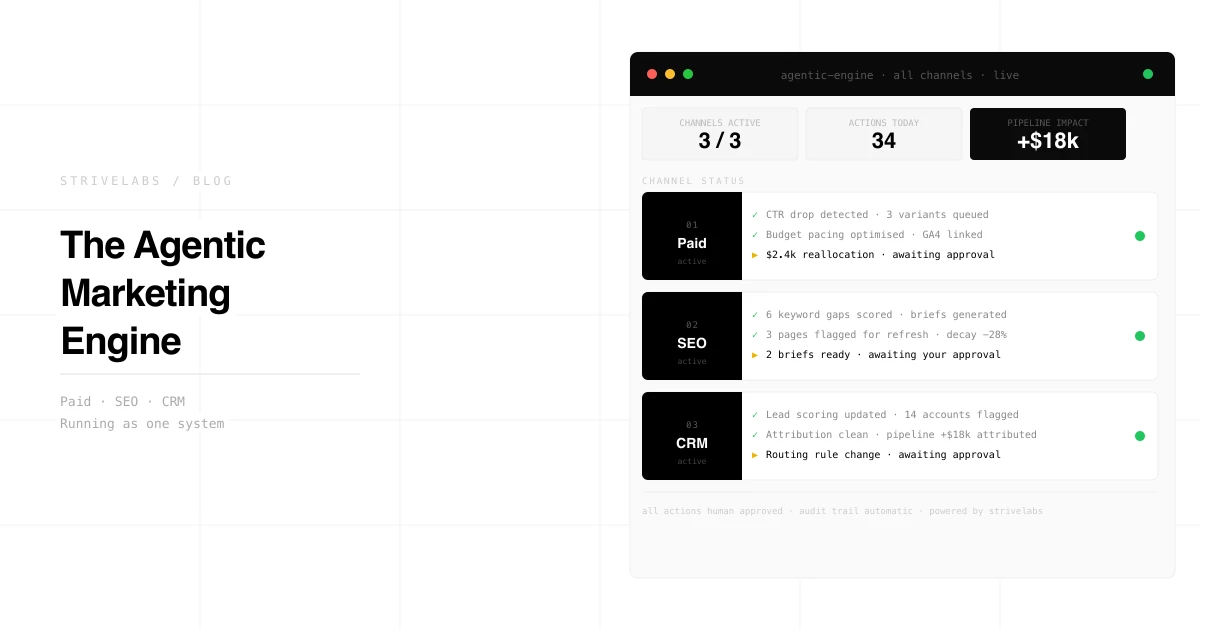
Humans maintain oversight while these systems operate. Instead of just showing you a graph, agentic marketing tools suggest specific experiments for quick sign-off.
A concrete paid ad recovery example
Imagine a situation where your click through rate drops unexpectedly. To prevent budget drain, an agent triggers a recovery sequence immediately. This work runs quietly while your attention stays elsewhere.
- As soon as the system spots a dip, it scans your historical data to pitch three unique tests meant to fix the problem.
- You set spending limits after reviewing the new copy to ensure the campaign stays within your brand guidelines.
- Projections show the likely gains for each version, and you will notice that the time spent making choices shrinks from days to a few hours.
Who decides with a human in the loop
These platforms function strictly inside the guardrails you establish. You retain full control over every major choice.
- While you set the primary goals, the software manages the repetitive tasks of executing small experiments.
- You can require manual approval for any changes to your creative assets but let the system handle boring, daily chores so you don't have to.
- Outcomes often depend on how clearly you define your targets or if you have a solid backup plan for handling errors.
What agentic marketing is not
It is a mistake to think these tools replace your strategic thinking or logic.
- These aren't just basic bots, because they finish multi-step projects rather than just typing out replies to questions.
- Unlike standard AI generators, these agents analyze current performance and tweak their approach on the fly.
- Check that a vendor's tool has manual check-ins and offers quick access to your numbers before you commit to it.
- Only 16% of RevOps professionals trust their data accuracy — and that single issue is the biggest blocker to automation maturity. Agentic marketing doesn't fix bad data. It executes on whatever signals you feed it, faster and at higher volume than any human team.
- Before deploying an agent for any use case, you need three things in place: a CRM with consistent lead source fields and deal stage tracking, event-level tracking with unique IDs in GA4 or your product analytics, and a single source of truth for attribution that connects campaign spend to closed revenue.
- Without these three, an agentic system produces confident wrong answers at scale. With them, it compounds every good signal your team generates into pipeline impact.
- This is exactly where the marketing engineer tech stack matters — the data infrastructure an agent runs on determines the quality of every decision it makes autonomously.
Operational changes and the metrics that matter
Agentic workflows shift how teams operate. Instead of manual oversight, systems that function on their own handle measurement.
- Experimentation speed often climbs from monthly checks to dozens of weekly tests because agents manage setup, variants, and analysis.
- Real-time dashboards show automated ideas, so you don't wait for static reports.
- Since routine chores take less time, a person spends more hours on strategy or adjusting safety limits.
- Track asset throughput, test volume, lead to opportunity velocity, time to insight, and budget reallocation speed.
How Strivelabs enables agentic marketing
Strivelabs is not an AI tool you configure. It's the marketing engineer for your team — the full agentic marketing function delivered as managed software.
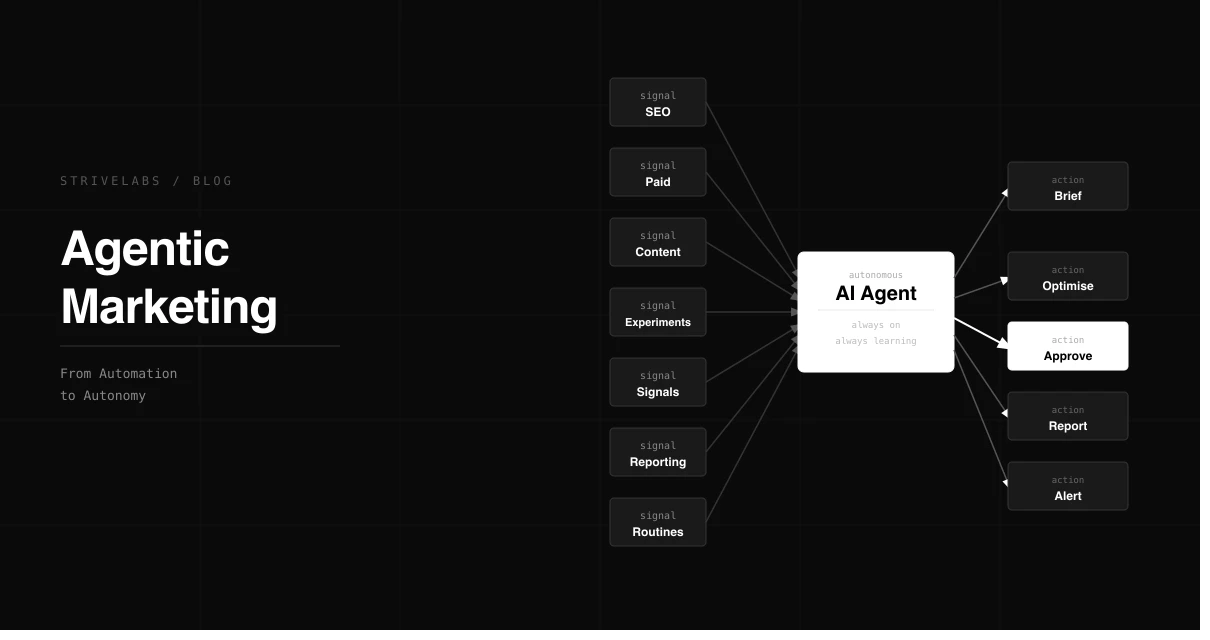
Connect your CRM, paid platforms, Search Console, and GA4. Strivelabs runs the agent workflows across every marketing function without requiring internal engineering to build or maintain them:
- SEO and content — topic discovery, brief generation, full drafts, ranking decay alerts queued for human review
- Paid media — spend optimisation, creative diagnosis, budget reallocation with approval gates before anything touches your accounts
- Experiments — hypothesis generation, audience segmentation, pipeline impact measurement. Everstage runs 4x more experiments per quarter using Strivelabs.
- Reporting — automated reports from paid, SEO, CRM, and pipeline in one view. No more manual spreadsheets.
- Routines — recurring agent workflows on a defined schedule, routed to the right person with a specific playbook attached.
Every action requires your approval before execution. The agent proposes. You decide. The audit trail is automatic.
See how AI marketing agents work in practice, and how human-in-the-loop approvals keep every action inside your guardrails.
The following table compares manual and Strivelabs agentic workflow outcomes.
| Standard Automation | Agentic Marketing | |
|---|---|---|
| Trigger | Fixed rule — if X then Y | Goal-based — achieve outcome Z |
| Response to change | Follows script regardless | Adapts based on observed results |
| Human input required | Setup and every exception | Goal-setting and approval gates |
| Experiment velocity | 1–2 per month | 10+ per sprint |
| Attribution | Action-level | Pipeline-level |
Paid marketers receive creative fatigue alerts. You'll see content teams monitoring which posts fade. Product marketers track why deals win.
Conclusion
By adopting agentic marketing, you'll move your team from repetitive tasks to setting strategy and guardrails. Small teams building these systems run more tests and don't get beat by larger groups stuck on manual work.
Launch your pilot. Track your weekly tests and do not forget to keep the brand safe.
The marketing engineer function, delivered as software.
See how Strivelabs gives mid-market teams the operational capacity without the hiring cost.
Explore Strivelabs →
Frequently Asked Questions (FAQs)
What is the difference between agentic marketing and marketing automation?
Marketing automation executes fixed rules — if a lead fills a form, send an email sequence. Agentic marketing works toward a defined goal and adjusts its approach based on observed outcomes. An automation tool does what you programmed. An agentic system figures out what needs to be done, does it, and learns from the result. 34% of enterprise marketing teams now run production agents — the shift from automation to agency is already underway.
How does a human marketer maintain control over an AI agent?
Control stays with you. Set specific goals and brand guardrails. Decide whether you want to sign off on every move or just high-stakes marketing moves. These agents stay within your walls and alert you if limits are hit.
Will agentic AI replace strategic marketing roles?
Not at all. Machines handle dull chores, but they lack human intuition for strategy. This change clears your calendar. It lets you focus on creative vision and deep decisions software cannot replicate today for you.
What is a practical first step to test agentic marketing?
Focus on a tight task first. Try refreshing old posts or reaching out to cold leads. Once CRM data is linked, run a pilot. Judge results by counting experiments your team finishes in one week of work.
What KPIs should I track for agentic marketing?
Experiment velocity (tests per sprint), time to insight (signal fires to human action), budget reallocation speed (hours from underperformance signal to budget shift), agent recommendation acceptance rate (below 60% signals data quality or threshold misconfiguration), and pipeline impact per agent workflow. Vanity metrics — impressions, clicks, open rates — are outputs. These five are the inputs that predict whether agentic marketing is compounding or just executing.
How does human oversight work in agentic marketing?
You set the goals and the guardrails. The agent operates within them and surfaces recommendations with a confidence score attached. High-stakes actions — budget shifts above a defined threshold, audience suppression, pricing changes — require human approval before execution. Low-stakes actions — content refresh recommendations, performance alerts — route to the right team member with a specific playbook. See the full human-in-the-loop approval framework for how to design the tiers.