You already know what agentic marketing is. This post is about what it looks like when it actually runs, specifically, what the engine does to your Google Ads account, your Search Console data, your HubSpot pipeline, and your weekly report before you open your laptop on Monday morning.
Most B2B SaaS marketing teams have the data. Google Ads performance by ad group. Search Console impressions by keyword. HubSpot pipeline by stage. GA4 sessions by landing page. None of it automatically tells anyone what to do next. A marketer has to check each source, diagnose what changed, decide what to do about it, build the action, and queue it for execution. The average SaaS company uses 91 marketing tools in 2026, and almost none of them talk to each other without a human in the middle.
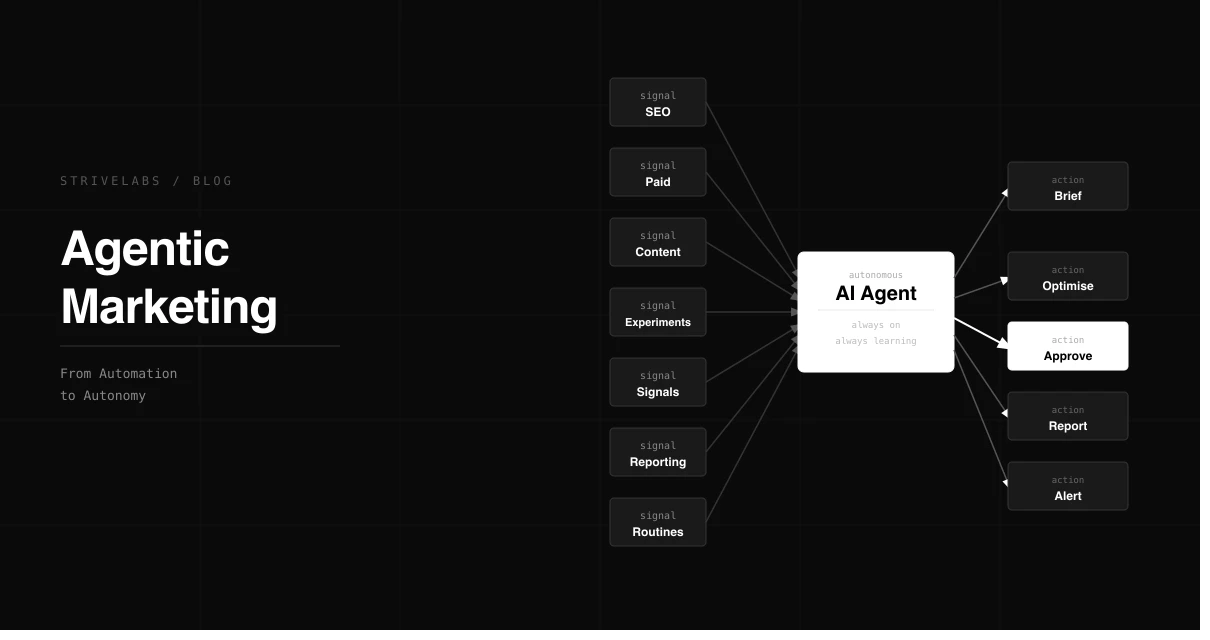
The Agentic Marketing Engine removes the human from the middle of that process. Not from the decision. From the data-pulling, diagnosing, and action-building that happens before the decision. The engine senses data continuously across every connected source. It generates recommended actions with its reasoning. It waits for approval. The marketer reviews, adjusts if needed, and approves. The engine executes.
This post covers how that runs specifically, across paid media, SEO and CRM, with the exact inputs, outputs and approval points at each stage.
At a Glance
-
The Agentic Marketing Engine connects to internal data, Google Ads, HubSpot, GA4, Search Console, and external signals, LinkedIn, G2, Reddit, competitor sites, and routes persona-specific actions to paid, content and product marketers.
-
Human approval is required before every action executes. The engine proposes. The marketer decides.
-
The engine does not replace the marketer's judgment. It replaces the four manual steps, data pull, diagnosis, action building, queue, that happen before the judgment call.
-
Setup takes under five minutes per integration via OAuth. No engineering required.
What the Agentic Marketing Engine Actually Is — and What It Is Not
Before covering how it runs, one distinction matters.
The existing agentic marketing blog covers what agentic marketing is as a concept. This post covers what Strivelabs' engine does mechanically, the specific data it reads, the specific actions it generates, the specific approval points where the marketer steps in.
The engine is not a dashboard. A dashboard shows you data when you open it. The engine reads data whether you open it or not, continuously, across every connected source.
The engine is not a copilot. A copilot waits for the marketer to ask a question. The engine generates recommended actions from what it detects in the data, without being prompted.
The engine is not autonomous. Every action it recommends requires the marketer's explicit approval before it executes. The human-in-the-loop principle is not a safety disclaimer, it is the operating model. The engine is fast at detection and action-building. The marketer is better at judgment. The approval gate is where those capabilities meet.
What Data the Agentic Marketing Engine Reads and Why Each Source Matters
The engine connects to two types of data sources. Internal, your own systems. External, the market around you.
Internal sources
Google Ads
Campaign performance, ad group spend, keyword quality scores, CTR by creative, conversion events from GA4. The engine reads this to detect performance shifts before the marketer's weekly review. A CTR drop that started Monday is visible to the engine by Tuesday morning. Without the engine it surfaces on Friday.
HubSpot CRM
Deal stage changes, contact activity, lead scores, product usage events synced from your product. The engine reads this to connect pipeline signals to marketing actions. When a contact moves to Opportunity, the engine detects it and queues an audience suppression recommendation for the paid campaigns targeting that contact.
GA4
Landing page performance, session duration, traffic source, conversion path. The engine reads this alongside Search Console to diagnose why a page is losing traffic, whether the issue is a ranking drop, a CTR drop, or a conversion rate drop. Each root cause needs a different fix.
Search Console
Impressions, clicks, average position, query-level data. The engine reads this daily to detect content decay signals, pages losing impressions on high-intent queries before the traffic drop becomes visible in GA4.
External sources
Ad engagement signals, competitor activity, content performance data from your own campaigns and from market signals.
G2 and Reddit
Competitor sentiment, buyer objections, product positioning gaps. The engine reads these to surface competitive intelligence for the product marketing persona without manual monitoring.
Competitor websites and PR feeds
Positioning changes, feature launches, pricing updates. The engine alerts the product marketer when a competitor makes a meaningful change, before the sales team finds out from a lost deal.
Better decisions start with better infrastructure.
Most mid-market teams pick a channel and hope. Strivelabs gives you the data to know, and the infrastructure to act on it.
Book a Demo →
How the Agentic Marketing Engine Runs Paid Media
What it reads
Campaign KPIs across Google Ads and LinkedIn, spend, CTR, conversion rate, CPC, quality score. Creative performance by ad ID. Landing page conversion rate from GA4. Audience overlap and frequency data.
What it detects
CTR drops on high-spend ad groups. Creative fatigue, when an ad's CTR is declining as the audience has seen it too many times. Budget inefficiency, spend concentrated on keywords or audiences with declining conversion rates. Audience overlap between campaigns cannibalising each other's performance.
What it generates
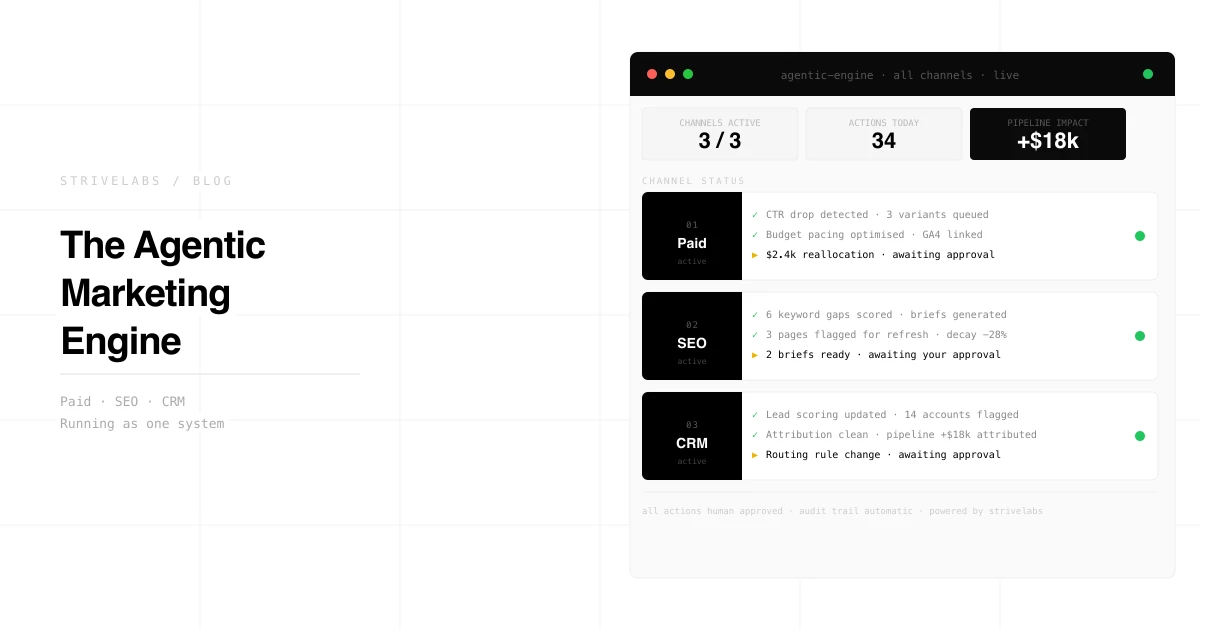
A prioritised list of recommended actions with reasoning attached. "Ad group X has seen a 23% CTR drop over seven days. Three possible causes: creative fatigue (confidence 68%), increased competitor bidding on this keyword (confidence 22%), landing page performance drop (confidence 10%). Recommended action: swap creative to variant B which tested 14% higher CTR in the previous cycle. Budget reallocation: move £800 from ad group X to ad group Y which is converting at 2.4x the rate."
What the marketer approves
The marketer reads the diagnosis and the recommended action. They agree, adjust the budget figure, or reject the recommendation with a note. If approved, the engine executes the change via the Google Ads API. Nothing touches the ad account without sign-off.
The AI Agents for Paid Media post covers this in full detail, the specific Monday morning scenario, the channel-by-channel breakdown, the before/after table.
How the Agentic Marketing Engine Runs SEO
What it reads
Search Console impressions and clicks by query and page. GA4 landing page metrics, sessions, bounce rate, conversion rate, session duration. SERP feature changes, whether the page previously held a featured snippet or People Also Ask position and no longer does.
What it detects
Content decay, pages losing impressions on high-intent queries over a 90-day rolling window. Click-through rate drops while position holds, a competitor improved their title tag and is stealing clicks before the page drops in ranking. Intent shift, the SERP composition changed and the page no longer matches what searchers expect to find.
What it generates
A content refresh brief built from the specific signals that caused the decay, not from a template. The brief includes the primary keyword with current intent mapping, the competitor content now outranking the page, the specific sections to update, and internal linking recommendations. The brief is ready for a writer to take action immediately.
What the marketer approves
The brief before it goes to a writer. The draft before it is published. The AI Agents for SEO post covers the full six-stage workflow from GSC signal to published post.
How the Agentic Marketing Engine Runs CRM
What it reads
HubSpot deal stages, contact activity, lead scores, product usage events, email engagement, time since last marketing touch.
What it detects
Pipeline stage changes that should trigger marketing adjustments. Engagement gaps, contacts going dark for 14+ days with no email open, site visit or ad click. High-activation product signals, trial users hitting milestones that indicate buying intent. Win/loss patterns, which marketing touchpoints appear consistently in won deals vs lost deals.
What it generates
Pipeline stage change, recommended audience suppression on awareness campaigns + notification of last marketing touch to sales rep. Engagement gap, re-engagement sequence recommendation with suggested subject line variants. Product milestone, upgrade-focused ad creative recommendation for that contact's audience segment. Win pattern, updated targeting recommendation based on which ICP attributes correlate with closed-won deals.
What the marketer approves
Every CRM-triggered marketing action before it executes.
How the Engine Connects All Three — the Attribution Loop
This is what separates the Agentic Marketing Engine from running three separate channel agents.
Paid data alone shows clicks and spend. SEO data alone shows traffic and rankings. CRM data alone shows pipeline and deals. None of them, in isolation, answers the question that matters most: which marketing actions are generating revenue.
The engine connects all three. When a deal closes in HubSpot, the engine traces the full attribution path, which paid ads the contact clicked, which content they read, which search queries brought them to the site, how many times they visited the pricing page. That attribution data feeds back into the Sense stage for future targeting decisions.
This is closed loop marketing running automatically, not as a Friday reporting exercise but as a continuous feedback mechanism that improves every subsequent campaign recommendation. The Marketing Attribution post covers how to build this attribution model correctly for a B2B SaaS sales cycle.
Top-quartile SaaS marketing teams attribute 41% of the qualified pipeline to organic search, content and AEO. Getting to that number requires attribution infrastructure that connects every channel back to the pipeline. The engine builds and maintains that infrastructure continuously, not in quarterly attribution reports.
What a Week Looks Like When the Engine Is Running
Monday morning — before the marketer opens their laptop:
- 3 paid media anomalies flagged with diagnoses and recommended actions
- 2 content decay alerts with refresh briefs ready for writer assignment
- 1 HubSpot pipeline stage change detected, awareness ad suppression queued for approval
- Weekly performance report built across all channels, ready for review not for building
Tuesday and Wednesday: The marketer reviews Monday's action queue. Approves the budget reallocation. Adjusts the content brief before sending to the writer. Reviews and approves the audience suppression. Spends the rest of the time on the work that requires judgment, strategy, positioning, stakeholder alignment.
Thursday: The engine has run three more cycles since Monday. Two new anomalies detected. One experiment from last week has enough data to generate a learning, the engine surfaces the result with a recommended next action based on what it learned.
Friday: No manual reporting. No spreadsheet exports. No dashboard builds. The week's performance is already in the engine's output. The marketer reviews the summary, approves two actions for next week, and logs off.
That is not a hypothetical. Everstage runs 4x more experiments per quarter using Strivelabs. Spendflo 3x'd published content. Obbserv saved days of manual work every month.
What the Engine Does Not Do — Three Things That Stay With the Marketer
Brand voice and positioning decisions. The engine drafts copy. It does not know your brand voice nuances, your competitive positioning sensitivities, or the language your sales team has spent months calibrating. The marketer reads every draft before it reaches a buyer.
Strategic priority calls. The engine prioritises performance data and pipeline attribution. It does not know that you are repositioning the product, that a particular channel is strategically important regardless of short-term performance, or that the next six weeks are focused on a specific ICP segment for business reasons the data does not capture.
Stakeholder alignment. Sales, finance, product, the conversations that drive cross-functional strategy require human judgment, relationship intelligence and organisational context the engine does not have. It surfaces the data that makes those conversations better. It does not have them.
The human-in-the-loop model defines these boundaries precisely. Every marketing engineer function the engine delivers, attribution, automation, experimentation, stays within those boundaries.
How Strivelabs Delivers the Agentic Marketing Engine
Strivelabs connects to Google Ads, LinkedIn Ads, Meta Ads, HubSpot, Search Console and GA4 via OAuth. Under five minutes per integration. No engineering required.
Once connected the engine begins the Sense stage immediately. Within the first day it surfaces the first prioritised action list. Within the first week paid media optimisations are visible. Within 2-4 weeks content experiments show traffic impact. Within one full sales cycle the attribution loop connecting content and paid actions to closed deals becomes visible in HubSpot.
Three personas receive specific outputs:
Paid Marketers receive budget reallocation recommendations, creative fatigue alerts, keyword actions and weekly reports across Google Ads, LinkedIn and Meta.
Content Marketers receive content decay alerts, refresh briefs, ranking notifications and topic discovery from Search Console and GA4.
Product Marketers receive competitor alerts from G2, Reddit and competitor sites, win/loss patterns from HubSpot and Zoom call transcripts, and positioning recommendations from what is resonating in the market right now.
Every output routes to the right persona. Every action waits for approval. Every execution is logged in the audit trail.
The marketing engineer function, delivered as software.
See how Strivelabs gives mid-market teams the operational capacity without the hiring cost.
Explore Strivelabs →
Frequently Asked Questions (FAQs)
What is the Agentic Marketing Engine?
The Agentic Marketing Engine is Strivelabs' four-stage system, Sense, Decide, Act, Learn, that reads data continuously from paid, SEO and CRM sources, generates persona-specific recommended actions, executes with human approval, and measures outcomes to improve the next cycle. It is the operational infrastructure layer that turns marketing data into marketing actions without manual intervention at every step.
How is it different from the agentic marketing concept?
Agentic marketing is the category, AI systems that pursue goals autonomously. The Agentic Marketing Engine is Strivelabs' specific named implementation of that concept, the four stages, the specific data sources, the specific approval model, the specific persona routing. The concept explains what agentic marketing is. The engine explains how Strivelabs runs it.
Does the engine act on ad accounts without approval?
No. Every action the engine recommends, budget reallocation, audience update, ad pause, content brief, requires the marketer's explicit approval before it executes. The engine proposes with reasoning. The marketer decides. The engine executes. No action touches a live account without sign-off.
What is the minimum data required to start?
Three sources are sufficient for the first week: Google Ads or LinkedIn for paid signals, Search Console for SEO signals, and HubSpot for pipeline signals. GA4 connects alongside Search Console to complete the SEO picture. The engine produces its first prioritised action list within 24 hours of connection.
How long does it take to see results?
Most teams see the first paid media optimisation recommendations within the first day. Content decay alerts appear within the first week as the engine builds a baseline of your Search Console data. Attribution loop visibility, connecting marketing actions to closed deals in HubSpot, typically becomes clear within one full sales cycle, usually 60-90 days.