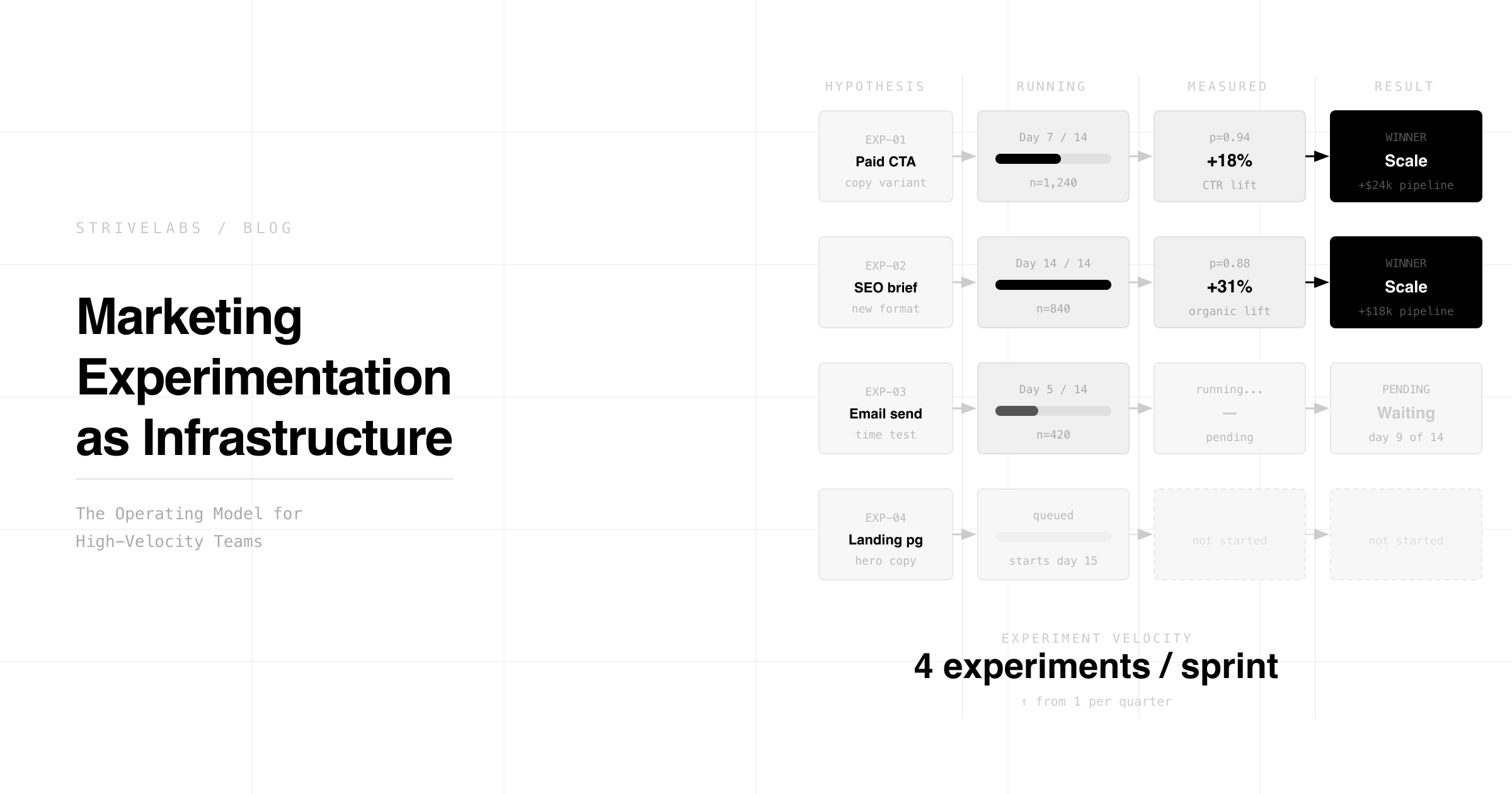
Most marketing teams run experiments the same way they file expense reports; reluctantly, occasionally, and only when someone asks. The result is a random collection of A/B tests that produce no compounding knowledge and change no budget decisions.
Companies with a single source of truth report 44% higher revenue growth versus 8% for those without one, and that gap is driven almost entirely by the quality and speed of their experimentation. When Twitter moved from one test every two weeks to ten tests per week, it grew rapidly — and that experiment velocity is widely credited as a primary driver.
This guide covers the four components of experiment infrastructure, how to measure what actually matters, governance that doesn't slow you down, and a 12-week roadmap to get there without hiring a data scientist.
At a Glance
Think about these fundamental principles as you design your approach.
-
Treat marketing experimentation as a unified growth engine because isolated A/B tests don't often produce lasting results.
-
Speed matters. Usually, experiment velocity leads to more success than focusing on specific data points alone.
-
You should build a marketing experimentation framework that includes data ingestion, randomization tools, measurement, and orchestration workflows.
-
Stop tracking vanity metrics that ignore business health. It's better to focus on pipeline growth and actual revenue.
-
Although a quarterly plan is necessary for high-velocity experimentation, you don't need to hire a full-time data scientist right away.
What is Marketing experimentation?
Marketing experimentation often relies on hypothesis testing. By running controlled trials across different channels, brands can identify better ways to acquire or retain customers. You don't need to rely on instincts since the data handles the explanation.
Experiment velocity, which measures the speed of your testing cycle, is a metric that carries real weight.
Gaining speed without hiring extra staff involves ranking ideas by impact and effort. Budget shifts feel much safer when hard numbers back them up.
-
This process converts assumptions into facts by using repeatable tests.
-
Treating velocity as a leading indicator creates more chances to win because the learning cycle happens faster.
-
A standard setup usually includes data collection, randomization tools, measurement systems, and workflow management.
Why are most marketing teams testing without learning?
Starting with a plan is fine. But piling up charts won't save a strategy that's already broken. If your operating model fails to connect these trials to actual revenue, you'll hit measurement hurdles that stop your progress. Internal friction often slows everything down.
-
Siloed tests often happen when departments launch projects alone, which leads to messy data and overlapping audiences.
-
You fall into a trap with vague metrics if you focus on surface clicks rather than tracking the actual sales pipeline.
-
Learning often stops when cycles take months to complete because the team doesn't have a clear timeline.
-
It is difficult to identify what truly drives growth when you rely on tracking errors like vanity numbers.
-
Because of internal friction and slow approvals, people often struggle to follow a consistent testing schedule.
-
Experiments stay in limbo when too many stakeholders get involved and delay decisions.
| Common Mistake | High-Velocity Best Practice |
|---|---|
| Isolated tests and messy audiences | Manage traffic through a central board while using strict sampling |
| Tracking clicks or views | Look for incremental revenue gains and set up guardrail metrics |
| Slow 12 week cycles | Run 14 day sprints for small changes or geo-tests for major shifts |
| Weak randomization | Use engine-level bucketing to make sure your data stays accurate |
| No learning agenda | Score ideas using the ICE method to keep goals aligned with the business |
These errors drag down your experiment velocity and ruin the upside of growth experimentation. The same fragmentation that breaks experimentation breaks closed loop marketing, when data is siloed, neither system can produce reliable results. 87% of marketers implement AI in their processes, yet most still rely on historical behaviour patterns to guide decisions, optimising for past performance rather than what actually drives outcomes. Experimentation infrastructure is the fix, not more AI tools.
Better decisions start with better infrastructure.
Most mid-market teams pick a channel and hope. Strivelabs gives you the data to know, and the infrastructure to act on it.
Book a Demo →
Test vs Experiment: Knowing the difference changes your budget decisions
People often use these two words interchangeably when talking about growth. While a test is usually a fast way to grab a quick signal, it is not the same as a formal experiment. True experiments rely on a hypothesis to find real causal links. These guidelines should help you decide which path to take today.
-
Small tests work best when you want to review creative assets or swap out old ad copy. Because these checks are cheap, the risk to your budget is not high. A fast answer comes without much fuss.
-
Proving cause and effect within a specific conversion path requires a full experiment. You cannot skip the control group in these setups.
-
When a simple test shows a steady lift, it is probably time to upgrade. This shift usually happens once the potential business impact reaches a serious level. The extra work pays off then.
-
Most daily choices rely on signals from a test, but experiment results are what actually change how you spend your total budget.
The four components of experiment infrastructure
Experiments need four layers to function together. This setup removes obstacles and ensures you can trust your numbers. When your infrastructure is solid, your experiment velocity marketing tends to grow without extra effort.
You should start by collecting every customer interaction through data ingestion. If your inputs are messy, you will end up guessing at results. Next, the engine sorts users into groups across your channels. This component manages changes on both the backend and frontend to keep your samples pure. A measurement layer then calculates the lift. This part of the marketing experimentation framework verifies the math and links your tests to revenue in your CRM.
Your workflows will stay steady when your guides are clear. You cannot turn a hypothesis into a decision if you do not rank your ideas or handle handoffs the right way.
Every layer offers its own set of benefits.
-
Data ingestion saves you time because it provides clean signals that connect directly to your sales data.
-
Your engine keeps the link between cause and effect clear even when you run several tests at once.
-
Measurement helps you spot negative side effects early so you can scale your winning ideas with confidence.
-
Orchestration creates a process you can repeat to make sure your speed does not drop while you grow.
Data ingestion and lineage
Pick a handful of sources and track just enough data to see which test caused a specific result. Monitoring data that does not exist is a waste of your time.
-
You should include your CRM, ad platforms, product events, and transaction logs.
-
Key signals usually involve user timestamps, session IDs, and the revenue you link to closed deals.
-
Telemetry needs require you to create unique event names and specific tags for every test ID.
Randomization and experiment engine
You must have proper randomization. The system needs to stay consistent so you can run multiple tests at the same time safely.
-
Sticky assignments and deterministic bucketing help you make sure every user sees the same experience every time.
-
Server flags handle your backend changes while client variants manage the user interface.
-
You need a plan to ramp up traffic slowly or stop a test if errors start to appear.
Measurement and analytics layer
This is the layer where your tests show their worth. You should define who is responsible for what and automate your math where possible.
-
A dedicated team tracks your lift, checks the statistics, and keeps an eye on safety metrics.
-
You see the real impact on your growth when your test IDs link to actual sales opportunities.
-
Your process should include creating records that show the hypothesis, the results, and what you plan to do next.
Orchestration and workflows
Without rules, your testing will get messy. You need to write down the exact steps for how a test goes from a thought to a finished project.
-
This includes the way you gather ideas, how you rank them, and the method for marking them as finished.
-
You can maintain a steady pace by launching your tests through regular cycles.
-
Safety checks and specific rules help you decide when a test is ready for you to launch it.
How to instrument your stack for high-velocity experimentation
High-velocity testing fails without solid instrumentation. When you've made current tasks measurable, future experiments move faster.
Connect internal data sources
First-party systems provide the most accurate picture. Bad integrations'll just break your flow.
-
Link your CRM and ad platforms to your billing and analytics data.
-
Keeping a clean data schema depends on how you track unique IDs and specific conversion events.
-
While you might sync ads in real-time, check CRM records daily since performance doesn't stay the same.
Ingest external market signals
These signals help you decide which test to run next. Don't treat this data as absolute truth; think of it as context. It is better to verify these cues before you act.
-
Pulling data from search trends or social listening helps you see what your audience wants right now.
-
Use these cues to spot competitor moves or to help your team prep for content tests.
-
If you suspect sampling bias, check those findings against your own internal numbers.
Route insights to marketer personas
Data isn't useful if nobody acts on it.
-
Tell the paid team when ads get old, or ping writers if organic traffic drops for no reason.
-
Weekly reports are fine, but Slack's better for quick updates when you find something urgent.
-
Put every new hypothesis on the board so your team can make a final call.
Connecting experiments to pipeline: How to measure what actually moved revenue
Speed-to-learning beats speed-to-scale in B2B growth marketing. Scaling without confirming ideas leads to wasted time, money and effort. The measurement layer is what separates teams that compound from teams that churn through tactics. Determining the net impact on a pipeline usually depends on holdouts and incrementality designs. It is a technical hurdle to connect experiment IDs to CRM opportunities, yet the process turns raw data into actual revenue forecasts.
This works.
Some marketers look at surface metrics, but this method results in financial reality. If you look at specific methods and reporting fields, you can build an accurate picture of the bottom line.
McKinsey's State of AI found that companies embedding AI into marketing workflows report 10–20% sales ROI improvement, but only when experiments are tied to revenue outcomes, not just activity metrics.
Measuring incrementality and lift
-
Geographical experiments or randomized holdouts show what actually drives growth within your target markets.
-
Mapping incremental conversions to pipeline value ensures the system doesn't count a single lead twice.
-
Most teams establish minimum sample sizes and run times before a test begins to keep the data clean.
Guardrail metrics and sample sizes
-
Keeping an eye on funnel drop off rates and CAC movement ensures you don't hurt the brand during the testing phase.
-
Before you launch, run a power analysis to help decide on the minimum effect thresholds you need.
-
Stakeholders find it easier to trust final numbers when you include confidence intervals in the report.
Linking experiments to revenue
-
Adding experiment tags to your leads allows for tracking how those individuals turn into revenue by the end of the sales cycle.
-
Try running weekly joins between your logs and CRM data to see the number of extra deals that actually closed.
-
A results template for every experiment should show the expected pipeline impact and the projected LTV.
Governance and the 12-week roadmap
Running your marketing experimentation faster is easiest when your governance is light enough to stay out of the way but strong enough to stop disasters. Expensive errors often pause the learning cycle. If you map out specific roles early, the program has a much clearer path toward a successful launch.
Decision rights and roles
Clear roles help a team make choices faster.
-
You need to name a test owner and a data steward to work with the growth lead and your legal team.
-
These guidelines help your staff see the difference between a minor tweak to the interface and a high stakes revenue test.
-
A single page RACI chart is usually enough to stop bottlenecks and keep everyone focused on their own work.
Experiment review and safety gates
-
Before your campaign goes live, you should check every message for legal issues and confirm that your privacy steps are solid.
-
If your funnel metrics suddenly tank, you can use limits set in advance to kill the experiment then and there.
-
Every trial needs an audit trail that lists the starting hypothesis, the scripts, and the final results for your records so you can look back later.
A quarterly roadmap for launching marketing experiments
Building a 12 week plan creates real momentum and focus for the strategy.
-
In the first month, you should focus on getting your tools ready and linking data events so you can push out those first pilots.
-
Your second month is mostly for ranking different hypotheses and checking that the tracking is not actually broken.
-
By the third month, you can shift your budget toward the winning versions as your team writes down their new playbooks.
You should watch your total test count and the percentage of results that actually help you make business choices for the company.
How to run experiment infrastructure without a data scientist
Success comes from using the skills the team already has and finding the right tools.
-
You can use a managed platform that plugs into your current analytics and advertising accounts without any extra work.
-
Using consistent templates for your data allows your team to understand the numbers without an expert in the room.
-
For those moments when incrementality needs a closer look, you should not be afraid to bring in an outside partner for a quick project.
-
Strivelabs is the marketing engineer for your team; experiment infrastructure, attribution, and pipeline reporting delivered as software without the internal build cost
Conclusion
Growth'll follow speed. If you increase how often you run causal experiments, you'll learn faster and stop wasting cash on duds. Your experiment velocity is a predictor for where growth is going. Stagnant results often happen because companies don't test enough. With a winner, you can shift the budget there immediately.
Focus on the foundation first.
According to the HubSpot State of Marketing, teams that run 5+ experiments per month are 3x more likely to report revenue growth than teams running fewer than two, the compounding advantage of velocity over volume.
The marketing engineer function, delivered as software.
See how Strivelabs gives mid-market teams the operational capacity without the hiring cost.
Explore Strivelabs →
Frequently Asked Questions (FAQs)
What are growth experiments?
These are structured tests built around a specific guess to find out if certain tweaks move the needle on business performance. By using control groups, your team can pinpoint how much revenue actually comes from those changes. The main goal is to identify methods that you can use again. It is a way to stop guessing and start knowing.
What are the main types of marketing experiments?
Standard methods range from simple A/B tests for comparing two options to multivariate setups that track several variables simultaneously. Many marketers also turn to incrementality tests. These use holdout groups to measure the actual lift a campaign provides instead of just tallying every single conversion. This helps you see if a campaign truly changed behavior. It provides a clearer picture of value.
How should you prioritize which marketing experiments to run first?
A framework like ICE clarifies the best path by measuring impact, confidence, and ease. In most cases, it is best to focus on ideas that promise a real business shift and have a sturdy hypothesis. This helps you figure things out much faster. Choosing these tasks first ensures you use your resources where they matter most.
What is a critical mistake to avoid when setting up an experiment?
Many teams make the error of ignoring proper control groups or skipping randomization. If you don't have a valid control, you can't be sure your changes caused the outcome. Chasing random noise is easy, but it won't lead to actual growth. It is important to get the foundation right before looking at results. You need to trust your data.
How much data is needed for a reliable marketing experiment?
Accuracy depends on reaching a sample size that is large enough to show a noticeable difference in performance. This specific number changes often because baseline conversion rates are rarely static. Run a power calculation before starting to ensure your results hold up. It is the best way to avoid calling a winner too early when the data is not ready.
Can you run effective marketing experiments without a data scientist?
It is possible to handle this without outside help. Current software and data tracking tools make the process simpler for everyone. While a consultant might be helpful for complex incrementality, your internal staff can still create hypotheses. Most routine testing simply does not require a specialist. You have the tools to do it yourself. This gives your team more control over the roadmap.
How Strivelabs turns experimentation into a managed capability
Strivelabs is built for teams that want experiment infrastructure without the engineering overhead. Connect your CRM, paid platforms, and product analytics — Strivelabs handles experiment design, audience segmentation, measurement, and results routing to the right team member.
Everstage runs 4x more experiments per quarter since deploying Strivelabs. The entire system — from hypothesis to pipeline impact report — runs without a dedicated data scientist or a six-figure analytics build.
For teams that have already built the marketing engineer tech stack, Strivelabs is the orchestration layer that makes it run at velocity.