Most teams discover content decay the same way. A post that was reliably generating demo requests disappears from the first page. By the time someone notices, usually because a sales rep asks why a specific lead source dried up, the post has been losing ground for weeks. The pipeline impact started before the traffic alert.
73% of B2B websites experienced significant traffic loss between 2024 and 2025. The teams absorbing that loss the fastest are the ones running reactive content operations — refreshing posts after traffic drops rather than before. A content refresh strategy that waits for a signal from GA4 is already three weeks behind the problem.
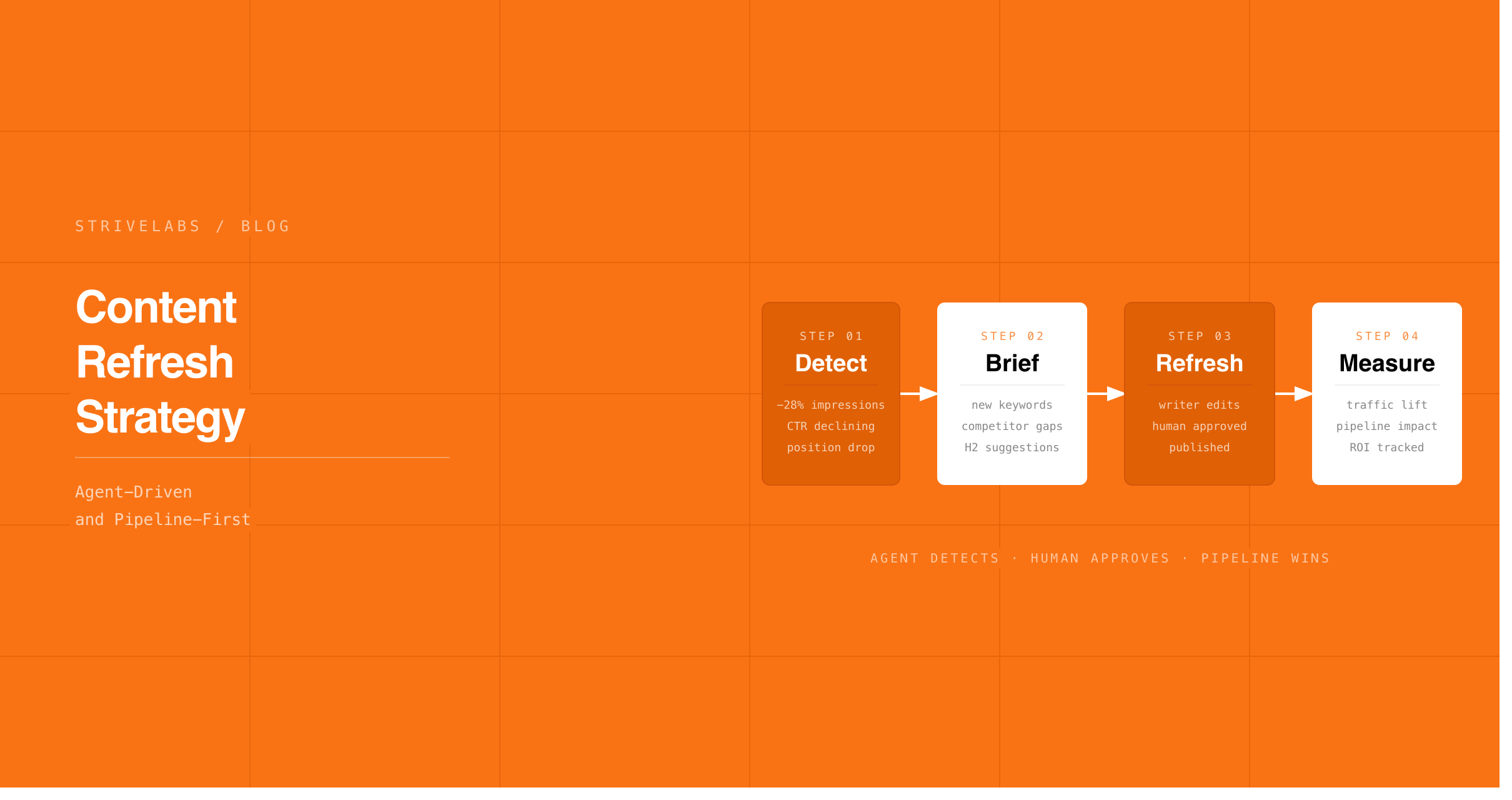
This post covers how an agent-driven content refresh workflow works, specifically how the Strivelabs SEO agent monitors Search Console and GA4 daily, detects decay before traffic drops materially, connects that decay to HubSpot pipeline attribution, and generates refresh briefs prioritised by revenue impact rather than traffic volume. Every update requires marketer approval before it goes live.
At a Glance
-
Content decay is a pipeline problem before it is a traffic problem. A post losing impressions on a high-intent keyword is losing attributed touchpoints from active deals, often weeks before the traffic drop shows up in GA4.
-
Position-one results are seeing a 58% drop in CTR when Google AI Overviews appear for the same query. Content that is not refreshed to match current SERP intent loses not just ranking but visibility across both traditional and AI search simultaneously.
-
The right prioritisation question is not "which post is losing the most traffic" but "which post was attributed to the most pipeline before it started declining." These are rarely the same post.
-
The Strivelabs SEO agent detects decay signals daily, falling impressions, CTR drops, SERP feature losses, and connects them to HubSpot deal attribution before generating refresh briefs. The marketer reviews and approves every brief before a writer touches it.
-
Refreshing content is 5x cheaper than writing new content and consistently delivers faster ranking recovery because the URL already holds authority.
Why Your Content Refresh Strategy Is Always Reactive
The problem is not that teams ignore content decay. It is that the detection method is too slow to prevent damage.
A post starts losing impressions on a high-intent query on a Monday. The marketer checks Search Console on Friday, a good week. They flag it. They write a brief over the following week. A writer picks it up the week after that. The refresh goes live three to four weeks after the original signal.
In a 90-day B2B SaaS sales cycle, four weeks is not a small delay. A buyer who found that post during week one of their research is now in week five. If the post dropped off page one in week two and was not refreshed until week five, that buyer found a competitor's post instead. The pipeline touchpoint did not disappear from the buyer's journey, it got replaced.
The structural problem with manual content refresh workflows:
Manual Search Console checks happen weekly at best, which means signals that fired on Monday surface on Friday, already four days into compounding. Writers receive briefs built from templates rather than from the specific signals that caused the decay, which means the refresh addresses the wrong root cause half the time. Prioritisation is based on traffic volume, which means the highest-traffic declining posts get refreshed first, not the posts with the highest pipeline attribution. These are rarely the same list.
An agentic content refresh strategy solves the structural problem. Not by making the manual process faster, but by replacing the detection, diagnosis and prioritisation stages with a continuous automated system while keeping every publishing decision with the marketer.
What Content Decay Actually Costs in Pipeline Terms
Traffic metrics make content decay look like an SEO problem. Pipeline metrics make it look like a revenue problem. The distinction matters for every budget conversation and every prioritisation decision.
Gartner predicts organic search traffic to websites will decrease by 50% or more by 2028 as generative AI search scales, which means the pipeline value of every high-performing post is more concentrated and more at risk than it has ever been. A post losing ground is not losing abstract traffic. It is losing attributed touchpoints from buyers in active research phases.
Here is how to quantify a specific post's pipeline risk:
| Metric | Value | Notes |
|---|---|---|
| Monthly organic sessions | 1,000 | Baseline before decay started |
| Traffic drop | 20% | Sessions declining over 90 days |
| Sessions lost | 200 | 1,000 × 20% |
| Page-to-MQL conversion rate | 2% | Historical performance for this page |
| MQLs lost | 4 | 200 × 2% |
| Lead-to-deal conversion rate | 25% | Sales closing rate for these MQLs |
| Estimated deals at risk | 1 | 4 × 25% |
| Average contract value | $40,000 | ACV for this pipeline segment |
| Pipeline at risk | $40,000 | 1 × $40,000 |
This calculation requires three data sources connected: Search Console impressions and CTR by page, GA4 conversion events mapped to MQLs, and HubSpot deal attribution showing which pages appeared as touchpoints in closed deals. When these three are connected in the same system, which is exactly what the closed loop marketing architecture enables, the prioritisation becomes a revenue decision rather than an SEO decision.
A Content Refresh Strategy That Runs Without You Triggering It
The difference between a reactive refresh strategy and a proactive one is not effort. It is a detection infrastructure.
Reactive: the marketer notices the traffic drop → investigates → decides to refresh → writes the brief → finds a writer → waits for the draft → publishes → monitors.
Proactive with the Strivelabs SEO agent: the agent detects the decay signal before traffic drops materially → diagnoses the root cause → connects the signal to HubSpot pipeline attribution → generates the refresh brief → routes it to the marketer for review and approval → writer receives a complete brief → publishes.
The marketer's involvement does not decrease. It shifts. Instead of doing the detection, diagnosis and brief-writing manually, the marketer reviews the agent's diagnosis, adjusts the brief if needed, and approves. The decision stays with the marketer. The data assembly and brief generation happen automatically.
This is the human-in-the-loop model applied to content operations. The agent is faster at detection and pattern recognition. The marketer is better at brand voice, strategic priority and competitive judgment. The approval gate is where those two capabilities meet.
Better decisions start with better infrastructure.
Most mid-market teams pick a channel and hope. Strivelabs gives you the data to know, and the infrastructure to act on it.
Book a Demo →
How the Agent Detects Which Posts Need Refreshing — and Why
The Strivelabs SEO agent reads Search Console and GA4 data daily. Not in weekly exports. Continuously.
Five specific decay signals the agent monitors:
Impressions falling on high-intent queries
In Search Console, filtered by commercial intent terms, "best," "vs," "pricing," "alternative," "how to." If impressions for these queries are falling on a specific page over a 90-day rolling window, the page is in decay on the terms that drive the pipeline. Not informational traffic. Pipeline-generating traffic.
Click-through rate dropping while position holds
A competitor improved their title tag or meta description and is now stealing clicks before the page drops in ranking. This is a 2-4 week warning signal. The page has not dropped yet. It will. Acting here is cheaper than acting after the ranking drop.
Session duration falling on organic referral traffic
Visitors arriving from search and leaving quickly means the content no longer matches what they expected to find. The keyword intent has shifted. The post was written for what people searched 12 months ago, not what they search now.
SERP feature loss
The page previously held a featured snippet or People Also Ask position and no longer does. When a search query triggers Google's AI Overview, organic clicks to the websites drop 57%, the ranking does not move but the clicks stop coming. A SERP feature loss is not a minor shift. It is a structural click loss.
Assisted conversion rate dropping in HubSpot
This is the signal most teams never see. When a page's assisted conversion rate, the number of deals where this page appeared as a touchpoint, starts falling, the page is losing pipeline impact whether or not overall traffic has moved. This requires Search Console data connected to HubSpot deal records. Inside Strivelabs, that connection is automatic.
When two or more of these signals fire on the same page, particularly when assisted conversion rate is falling alongside impressions, that page goes to the top of the refresh queue regardless of its position in the content calendar.
From Decay Signal to Writer-Ready Brief — What the Agent Does in Minutes
When the agent detects a decay signal it does not just flag it. It investigates.
Stage 1 — Diagnosis
The agent runs four checks on the decaying page: has a competitor published more comprehensive content on the same keyword in the last 60 days? Has the SERP composition changed, informational to commercial or vice versa? Is there a technical issue, slow load time, crawl problem, broken internal links, that may have caused the drop? Did CTR fall before the ranking drop, which usually indicates a meta description or title tag issue rather than a content issue?
The diagnosis determines what the brief recommends. A SERP composition shift requires a different fix than a competitor content gap. Getting the diagnosis right is what makes the refresh work. Most manual refresh workflows skip diagnosis entirely, the marketer notices the drop, writes a generic brief to "update the post," and the writer makes surface-level changes that do not address the root cause.
Stage 2 — Brief generation
The brief is built from the diagnosis, not from a template. It includes: the primary keyword with current intent mapping, a SERP gap analysis showing what the top three competing posts cover that this page does not, specific sections to update or add, internal linking recommendations based on the site architecture and which connected pages are performing, and HubSpot context showing which audience segments visited this page and what they went on to do.
Stage 3 — Approval and routing
The brief is routed to the marketer for review. The marketer reads the diagnosis, does the root cause assessment seem right? If yes, approve and route to a writer. If the marketer disagrees with the diagnosis, they adjust the brief before it moves forward. Nothing reaches a writer without the marketer's sign-off.
The marketer reviews the agent's diagnosis and approves the brief. The writer receives a complete, data-driven brief rather than a template with a post URL attached. The refresh addresses the actual cause of the decay rather than making surface-level changes that do not recover the ranking.
Prioritising Your Content Refresh Strategy by Pipeline Impact
The default prioritisation in most content teams is traffic volume. The highest-traffic declining post gets refreshed first.
This is the wrong prioritisation. A post with 10,000 monthly sessions that generates no pipeline is less urgent to refresh than a post with 300 monthly sessions that was attributed to $180k in pipeline last quarter. The Marketing Attribution post covers how to build the multi-touch model that makes this distinction visible.
Inside Strivelabs, the refresh queue is prioritised by pipeline attribution, not traffic volume. The agent connects Search Console decay signals to HubSpot deal records and surfaces the refresh opportunities ranked by estimated pipeline at risk. The marketer sees: this post was attributed to X pipeline last quarter and is now showing three decay signals. This post was attributed to Y pipeline and is showing one decay signal. The prioritisation is a revenue decision, not an SEO decision.
Operational rules for the prioritisation:
A page that has been live for less than six months is excluded from the decay queue, not enough data to distinguish genuine decay from normal traffic variance.
When two pages have similar pipeline attribution scores, the page with the higher commercial intent keyword set gets priority, commercial intent pages have a shorter path to pipeline recovery once the refresh is live.
The refresh calendar is capped weekly based on writer capacity, the agent generates as many briefs as the system detects, but the marketer paces the queue based on what the team can actually execute. A backlog of unacted briefs is visible and manageable, which is better than the current state where the backlog is invisible.
What Still Needs You — Where Human Judgment Stays Essential in a Content Refresh Strategy
The agent handles detection, diagnosis and brief generation. The marketer handles everything that requires judgment the agent does not have.
Brand voice
The agent generates a brief that is technically accurate and data-driven. It does not know that your brand avoids a particular phrase, that a competitor comparison is legally sensitive, or that the positioning language shifted after the last product update. The marketer reads every brief before it reaches a writer.
Strategic topic prioritisation
The agent prioritises by pipeline attribution and ranking potential. It does not know that you are repositioning the product, that a particular topic cluster is intentionally deprioritised while the team focuses on a product launch, or that a specific page's decline is intentional because the product it covers is being sunset. Strategic calls stay with the marketer.
Competitive claims
Any content that references competitors, directly or by implication, needs human review. The agent identifies the competitive gap in the SERP. The marketer decides how aggressively to address it.
Final approval before publishing
The writer's draft goes back to the marketer for a final review, brand voice, factual accuracy, competitive claims, strategic alignment. Nothing published without explicit sign-off. The audit trail for every refresh, which signal fired, what the agent diagnosed, what the brief said, who approved it, what the outcome was, is automatic.
How Strivelabs Runs Content Refresh Across Your Full Blog
Strivelabs connects to Search Console, GA4 and HubSpot via OAuth. Once connected, the SEO agent reads data daily and begins surfacing decay signals immediately, the first refresh queue is typically ready within 24 hours.
The weekly content refresh workflow:
Monday morning. The agent has flagged the top five pages showing two or more decay signals over the previous 7-day window. Each one has a decay diagnosis, a pipeline attribution estimate showing what the post was generating before the signals fired, and a draft brief ready for review.
Tuesday. The marketer reviews the five briefs. They agree with three diagnoses, adjust one brief based on a brand positioning consideration, and deprioritise one because the topic is being intentionally wound down. Three briefs are approved and routed to writers.
Wednesday to Friday. Writers work from the approved briefs. Drafts return for final marketer review. Approved drafts published.
Continuous monitoring. Strivelabs monitors the refreshed pages after publication. If a refresh does not recover the ranking within 30 days, a second diagnostic runs automatically and a new brief is generated.
Spendflo 3x'd published content. Obbserv saved days of manual ops work monthly. Everstage runs 4x more experiments per quarter. The time saving is not from moving faster. It is from eliminating the detection and brief-writing stages from the marketer's weekly calendar entirely.
The marketing engineer function, delivered as software.
See how Strivelabs gives mid-market teams the operational capacity without the hiring cost.
Explore Strivelabs →
Frequently Asked Questions (FAQs)
What is a content refresh strategy?
A content refresh strategy is a systematic process for identifying posts that are losing ranking, traffic or pipeline attribution, and updating them to recover performance. A proactive strategy detects decay signals before traffic drops materially and prioritises refreshes by pipeline impact rather than traffic volume. An agent-driven strategy automates the detection and brief generation while keeping every publishing decision with the marketer.
How long should a page be live before monitoring it for decay?
At minimum six months, not enough data before that to distinguish genuine decay from normal traffic variance. For high-pipeline pages, the Strivelabs agent begins monitoring from month three with a lower confidence threshold. Pages under six months are excluded from the automated refresh queue but can be manually flagged if the marketer sees a specific concern.
How do you prioritise between two posts with similar pipeline attribution?
Use commercial intent as the tiebreaker. A post targeting commercial intent keywords, "best," "vs," "pricing," "alternative", has a shorter path to pipeline recovery after a refresh than an informational post. If intent is similar, use the historical conversion rate on that page: which post converted visitors to MQLs at a higher rate before the decay started? That post recovers faster and gets priority.
What decisions does a marketer still own in an agent-driven content refresh workflow?
Four things always stay with the marketer: brand voice and positioning decisions, the agent generates a technically accurate brief but the marketer ensures it aligns with current positioning; strategic deprioritisation, the agent does not know which topics are intentionally being wound down; competitive claims, any content referencing competitors requires human judgment on approach and tone; and final approval before publish, nothing goes live without the marketer's explicit sign-off.