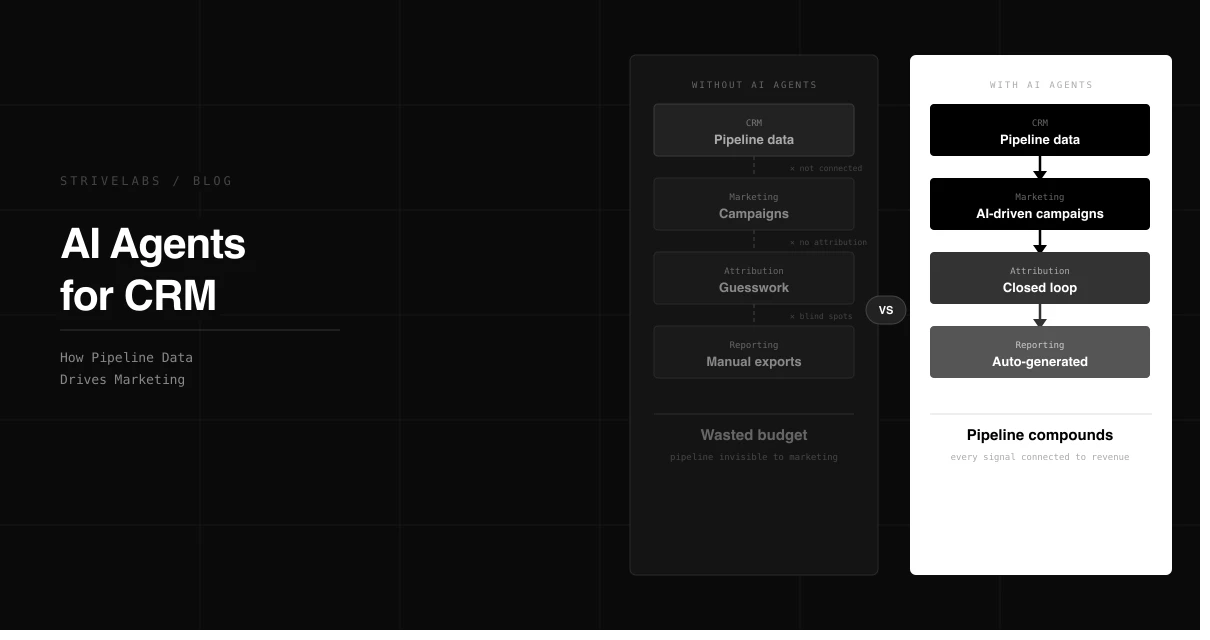
Your CRM is the most signal-rich system in your marketing stack. It knows who is in the active pipeline, who just hit a product milestone, who went cold three weeks ago, and which campaigns are appearing in your winning deals. None of that automatically tells your paid campaigns what to do, your content team what to write, or your attribution model what to measure.
A contact moves to Opportunity on Tuesday. Your awareness ads keep running on Wednesday. Your sales rep is in a commercial conversation while your LinkedIn campaign is showing the same prospect a top-of-funnel ad. The messaging is disconnected. The budget is wasted. And nobody noticed because the CRM and the ad platform have never been in the same room.
CRM marketing automation closes that gap. The Agentic Marketing Engine reads HubSpot signals continuously, deal stage changes, contact activity, product usage events, win/loss patterns, and connects them to marketing actions across paid, content and attribution. With your approval before anything executes.
Over 64% of HubSpot marketing automation users exceeded revenue targets in 2026. The difference between the teams hitting that number and the teams that aren't is not the CRM they use. It is whether their CRM signals are connected to their marketing execution layer or sitting in a database nobody acts on.
This post covers the four CRM signal types that drive the highest pipeline impact for B2B SaaS teams, and exactly what Strivelabs does with each one.
At a Glance
-
Your CRM is a live signal source, not a record of what happened. Deal stage changes, contact activity, product usage and win/loss patterns should all trigger marketing actions automatically.
-
Four signal types drive the most pipeline impact: pipeline stage signals, engagement signals, product usage signals, and win/loss signals.
-
78% of mid-market B2B organisations now run at least one marketing automation platform, but most have not connected their CRM signals to their paid and content execution layer. That connection is the gap Strivelabs closes.
-
Human approval stays at every step. The agent reads the signal, generates the recommended action, and waits for sign-off before anything executes.
-
Setup takes under five minutes via OAuth. No engineering required.
Why CRM Marketing Automation Breaks Without the Right Signals
Most B2B SaaS marketing teams use HubSpot as a record, a place where deal data lives, contact history is stored, and lead scores accumulate. They do not use it as a signal source.
The distinction matters. A record tells you what happened. A signal source tells you what to do next.
When a contact moves to Opportunity in HubSpot, that is not just a record update. It is a signal that this contact is in active commercial discussion with your sales team. Marketing's job for that contact changes in that moment, from demand generation to deal support. The content they should receive changes. The ads they should see change. The attribution weight of future touches changes.
Without CRM marketing automation, none of those changes happen automatically. The awareness campaign keeps running. The nurture sequence keeps sending. The ad audience keeps targeting. The marketer finds out a week later when the sales rep asks why the contact is still getting top-of-funnel emails.
Sales-marketing alignment is cited as a top challenge by 27% of marketers, yet only 8% name improving it as a top goal. The alignment gap is not a communication problem. It is a data connection problem. When CRM signals automatically update marketing execution, alignment happens structurally, not through weekly syncs.
What Your CRM Data Actually Tells the Agent Every Day
The Strivelabs agent reads four types of signals from HubSpot continuously. Each one maps to a specific category of marketing action.
Pipeline stage signals
Deal stage changes, probability updates, close date changes. These signal where the buyer is in the commercial journey right now. Not last week. Not when the segment was built. Right now.
Engagement signals
Email opens, site visits, demo requests, time since last touch. These signal whether a contact is moving toward a decision or going cold. A contact that has not opened an email, visited the site or clicked an ad in 14 days is showing a disengagement signal. Most CRMs record this. Almost no marketing teams act on it automatically.
Product usage signals
Trial activations, feature usage events, milestone completions synced from the product to HubSpot. These are the strongest buying signals most B2B SaaS teams never act on because the data sits in a product analytics tool that has never been connected to the marketing execution layer.
Win/loss signals
Deal closed won or lost, with the full campaign attribution path attached. These signal which marketing touchpoints are appearing in winning deals and which ICP segments are converting at the highest rate.
The agent reads all four signal types every day. When a signal fires, it identifies the marketing action the signal requires, generates the recommendation with its reasoning, and queues it for the marketer's approval.
Better decisions start with better infrastructure.
Most mid-market teams pick a channel and hope. Strivelabs gives you the data to know, and the infrastructure to act on it.
Book a Demo →
How CRM Marketing Automation Connects Pipeline to Paid Media
This is the most immediately valuable connection for most B2B SaaS teams, and the one with the most visible waste when it does not exist.
Pipeline stage → ad suppression
When a contact moves to Opportunity in HubSpot, they are in active commercial discussion with your sales team. Continuing to serve them awareness ads does three things: wastes budget, creates a dissonant experience for a buyer who is already evaluating, and makes your sales team's job harder because the marketing message contradicts the sales conversation.
The agent reads the HubSpot stage change. It generates a recommended action: suppress this contact from awareness ad audiences on Google Ads and LinkedIn. It queues the recommendation with its reasoning for the marketer's approval. Once approved, the audience update executes automatically. The next ad impression this contact sees is not a top-of-funnel awareness creative, because they no longer receive one.
Product milestone → upgrade creative
A trial user activates the core feature of your product three times in seven days. That is a strong buying signal. Without a CRM connection, your ad targeting does not know this happened. They continue to see the same awareness creative as every other trial user.
The agent reads the product usage event from HubSpot. It identifies the activation pattern as a high-intent signal. It recommends updating the Google Ads remarketing audience for this contact to show upgrade-focused creative rather than awareness creative. It drafts the copy variant. Both the audience update and the copy variant are queued for approval before anything reaches the contact's feed.
The full mechanics of how this connects to paid channel execution are covered in the AI Agents for Paid Media post.
How the Agent Uses CRM Data to Trigger Content Actions
The CRM-to-content connection is the one most teams have never built, because it requires pipeline data, product data and content performance data to exist in the same system simultaneously.
Win/loss → content brief
Your sales team is losing deals where a specific competitor is mentioned in three out of five lost opportunities this month. That pattern exists in HubSpot deal notes. Your content team does not know about it. They are publishing based on a content calendar built last quarter.
The agent reads the HubSpot deal notes, identifies the competitor mention pattern, cross-references with Search Console data showing competitor comparison queries rising on your site, and generates a content brief targeting the comparison keyword. The brief is routed to the content marketer for review. The post that addresses the live market question is briefed this week, not next quarter.
Engagement gap → re-engagement content
A contact has gone dark, no email engagement, no site visits, no ad clicks in 21 days. The agent detects the disengagement pattern. It identifies the last content touchpoint the contact engaged with and generates a re-engagement content recommendation, a specific post or resource calibrated to where that contact was in the buyer journey before they disengaged. Queued for approval before it sends.
The AI Agents for SEO post covers the full content workflow, from signal detection to published brief, in detail.
How CRM Marketing Automation Closes the Attribution Loop
This is the section most attribution guides miss, because most attribution guides stop at "which channel drove the conversion." CRM marketing automation closes the loop all the way to closed revenue.
Paid data shows clicks and spend. SEO data shows traffic and rankings. Neither tells you which campaigns are generating revenue, only which ones are generating conversions. In a B2B SaaS sales cycle where the average time from first touch to closed deal runs 90-120 days and involves multiple stakeholders, a conversion is not a sale. It is a starting point.
HubSpot closes the loop. When a deal closes, HubSpot holds the full record, which contacts were involved, which campaign IDs they came from, which content they consumed, how long the cycle ran. The agent traces the attribution path from first marketing touch to closed revenue and feeds that data back into the targeting and content decisions for future campaigns.
Marketing automation programs return $5.44 per dollar spent on average, with top-quartile programs achieving $8.71 per dollar, driven specifically by tighter CRM integration and multi-touch attribution. The gap between average and top-quartile performance is the CRM connection. Teams with it know which channels are generating revenue. Teams without it know which channels are generating clicks.
The Marketing Attribution post covers how to build multi-touch attribution correctly for a 90-day B2B SaaS sales cycle. The Closed Loop Marketing post covers the five-layer architecture that connects spend to revenue automatically.
Lead Routing and Scoring — What the Agent Handles Automatically
Lead routing and scoring are the two CRM operations that consume the most manual time for a lean B2B SaaS marketing team, and the two where automation delivers the fastest visible impact.
Lead scoring
The agent reads contact activity across HubSpot continuously, email engagement, site visits, demo requests, product usage events, and interactions. It updates lead scores in real time based on live behaviour rather than static scoring rules built six months ago. When a contact crosses a score threshold, pricing page visited twice, trial activated, demo requested, the agent flags them and generates a routing recommendation: move to SDR queue, trigger a specific email sequence, alert the account owner.
Audience routing
As contacts move through pipeline stages, their audience membership across paid platforms should update automatically. A contact who converts from trial to paid should be suppressed from acquisition audiences and added to expansion audiences. A contact who churns should be added to a win-back audience. Without automation, these audience updates happen manually or not at all.
The agent connects HubSpot lifecycle stage changes to Google Ads and LinkedIn audience definitions automatically. Every audience update is queued for the marketer's review before it executes. The result: ad audiences that reflect the actual current state of the pipeline, not the state it was in when someone last ran an export.
What Still Needs You in CRM Marketing Automation
The agent handles signal detection, pattern identification, action generation and execution. The marketer handles the four things that require judgment the agent does not have.
Routing logic decisions
When a signal fires, the agent recommends the action. Whether that action is the right strategic call, suppressing a contact from all paid rather than just awareness, or escalating to a senior rep rather than an SDR, requires context about the account, the relationship and the business situation that the agent does not hold.
Sequence content and brand voice
The agent recommends which sequence to trigger. The content inside that sequence, the specific language, the competitive claims, the proof points, was written by a marketer and approved before the sequence was built. The agent routes it. It does not write it in real time.
Score threshold calibration
The agent applies the scoring model. The marketer decides what score qualifies a contact for SDR routing, what engagement pattern constitutes a genuine buying signal vs. casual browsing, and when to adjust thresholds based on what the sales team is reporting from their calls.
Win/loss interpretation
The agent surfaces the pattern, competitor X appearing in 60% of lost deals this month. The marketer decides what that means strategically, whether it is a positioning problem, a pricing problem, a feature gap, or a sales enablement problem. The agent identifies the signal. The human interprets its meaning.
The human-in-the-loop model defines exactly where the boundary sits between what the agent handles and what the marketer decides. Understanding that boundary is what makes CRM marketing automation genuinely useful rather than a source of unexpected automated actions.
How Strivelabs Connects HubSpot to Your Full Marketing Stack
Strivelabs connects to HubSpot via OAuth in under five minutes. No engineering required. Once connected the agent begins reading all four signal types, pipeline stage, engagement, product usage and win/loss, immediately.
The agent routes outputs to three personas:
Paid Marketers receive audience suppression recommendations when contacts move to Opportunity, upgrade creative recommendations when trial users hit activation milestones, and budget reallocation recommendations when pipeline velocity data shows where spend is generating closed revenue.
Content Marketers receive competitor mention alerts from HubSpot deal notes, content brief recommendations driven by what ICP segments are engaging with before they convert, and re-engagement content recommendations for contacts showing disengagement signals.
Product Marketers receive win/loss pattern alerts, which competitor is appearing in lost deals, which feature objections are appearing in deal notes, which ICP segments are converting at the highest rate and what their content engagement looked like before the deal closed.
Every recommendation waits for approval. Every execution is logged. The audit trail is automatic.
Everstage runs 4x more experiments per quarter using Strivelabs. Spendflo 3x'd published content. Obbserv saved days of manual work monthly, the manual CRM exports, audience updates and routing decisions that the Strivelabs agent now handles before the marketer opens their laptop.
The marketing engineer function, delivered as software.
See how Strivelabs gives mid-market teams the operational capacity without the hiring cost.
Explore Strivelabs →
Frequently Asked Questions (FAQs)
What is CRM marketing automation?
CRM marketing automation connects live signals from your CRM, deal stage changes, contact activity, product usage events, win/loss patterns, to marketing actions across paid, content and email automatically. Instead of manually exporting audience lists and updating campaigns when pipeline changes, the system detects the signal and generates the recommended marketing action for human approval.
How do AI agents use HubSpot data?
Strivelabs' agent reads HubSpot continuously, deal stages, contact scores, product usage events synced from your product, email engagement data. When a signal fires, a contact moves to Opportunity, a trial user hits an activation milestone, a lead goes dark, the agent identifies the marketing action required, generates the recommendation with its reasoning, and queues it for approval.
Does the agent write to HubSpot without approval?
No. Every action the agent recommends, audience update, sequence trigger, lead routing change, requires the marketer's explicit approval before it executes. The agent reads HubSpot data continuously. It does not write to HubSpot or connected platforms without sign-off. The human-in-the-loop principle applies to every CRM action without exception.
What CRM signals matter most for B2B SaaS marketing?
Pipeline stage changes, particularly the move to Opportunity, deliver the most immediate paid media impact by enabling audience suppression before budget is wasted on in-pipeline contacts. Product usage milestones deliver the highest conversion lift by enabling upgrade-focused messaging at the exact moment of peak engagement. Win/loss patterns deliver the highest strategic value by showing which marketing touchpoints are appearing in closed-won deals.
How does Strivelabs connect to HubSpot?
Via OAuth in under five minutes. No engineering work required. The integration reads deal stage data, contact activity, lead scores and product usage events synced to HubSpot. Once connected the agent surfaces its first prioritised action recommendations within 24 hours.