Most marketing automation projects fail before they produce results. Not because the software doesn't work, because it was deployed on top of messy data, without a clear architecture, and without anyone owning the outcomes.
Marketing automation programs return $5.44 per dollar spent on average, but top-quartile programs achieve $8.71 per dollar, driven by tighter CRM integration, multi-touch attribution, and AI-assisted segmentation. The gap between those two numbers is not a tool problem. It's an architecture problem.
This guide covers the four-layer framework that separates the teams compounding results from the ones running expensive workflows that don't connect to revenue.
At a Glance
-
A marketing automation strategy is not a list of workflows. It's an architecture, data, triggers, experimentation, and measurement connected in a loop that compounds over time.
-
Most automation projects fail before they produce results. Not because the software doesn't work, because it was deployed on top of messy data without clear ownership. Fix the data layer first.
-
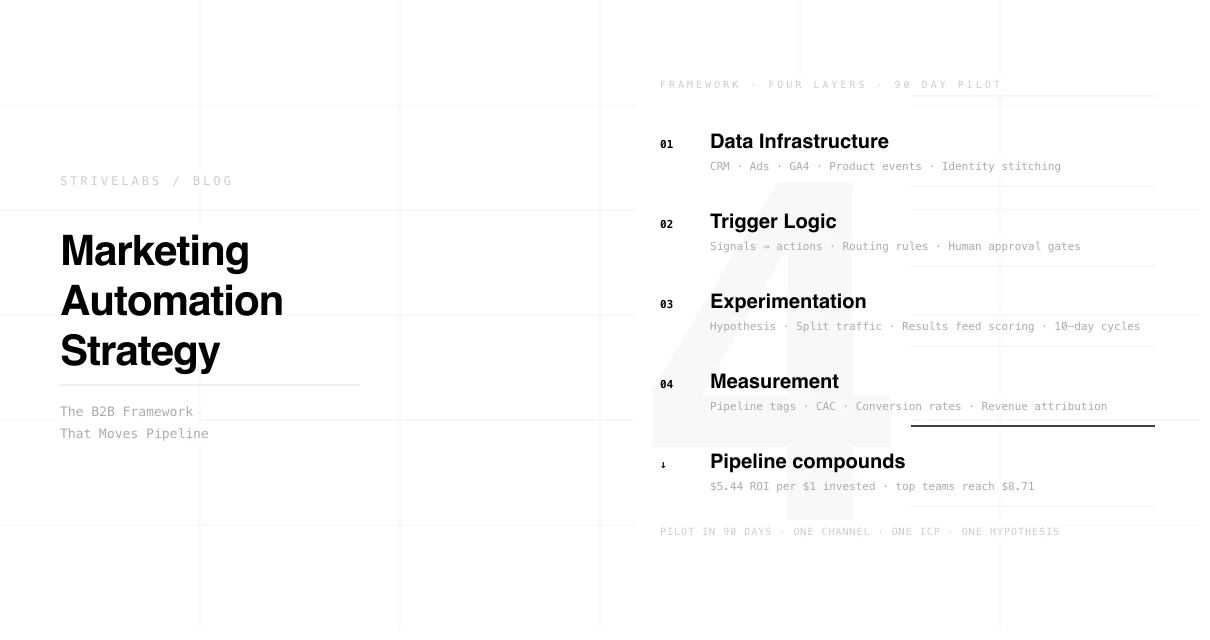
The four-layer framework in this post, data infrastructure, trigger logic, experimentation, and measurement, is the sequence that separates teams compounding results from teams running expensive workflows that don't connect to revenue.
-
Agentic automation is the next layer, not the starting point. Agents need clean, unified data to make reliable decisions. Build the foundation before you deploy the agents.
-
A 60–90 day pilot focused on one channel, one ICP, and one revenue hypothesis is the fastest path to proving the model before scaling it.
Marketing automation strategy TLDR
Think of a marketing automation strategy as a map linking ads, SEO, and CRM. A pipeline's a blind spot without one. Results are hard to track if that link's missing.
While the Head of Marketing's in charge of the vision, engineers handle the technical plumbing to keep systems stable.
-
Success doesn't happen unless you link SEO and CRM data directly to your software stack.
-
Consider moving toward agentic marketing automation after cleaning up your data.
-
This framework's four layers cover data, triggers, testing, and metrics.
An infographic shows how data flows.
Why automation strategies fail
In most cases, buying software in a vacuum almost never yields a long-term win. Often, you get a flimsy setup that just drains your budget. Rather than chasing app features, focus on the architecture needed to keep a pipeline moving.
Tactics versus systems
Connecting a workflow to a single tool is usually a tactic. A true system needs feedback loops and rigid data governance to function.
-
Tactics typically provide fast wins, but tool-specific rules are often hard to track or grow.
-
A system relies on a central data model and an owner who watches the output.
-
Success involves tracking pipeline influence and using tests that can move money around on their own.
44% of marketers consider data integration the biggest challenge in automation implementation, per Gartner. That stat explains most failed automation projects. The software works. The data underneath it doesn't, and no automation layer can compensate for bad inputs.
Why strategies fail before they start
Projects often don't make it to launch because of operational friction. Most of that trouble comes from messy data. This might look like lag during a CRM sync or duplicate records that break workflows. It is usually possible to fix these problems directly.
-
While poor data quality causes failure, you can solve it by auditing records and setting strict limits on latency.
-
Bringing in a Marketing Operations Manager provides a clear owner to handle integrations through formal service agreements.
-
Because mismatched goals lead to a mess, the whole team should agree on definitions for conversions that tie back to the pipeline.
-
Every individual automation needs a plan to undo its changes and a checkup scheduled for 60 to 90 days after it goes live.
Better decisions start with better infrastructure.
Most mid-market teams pick a channel and hope. Strivelabs gives you the data to know, and the infrastructure to act on it.
Book a Demo →
Four layers every B2B marketing automation strategy needs
Keeping functions separate requires a solid architecture. When you build four distinct layers, it becomes possible to swap out individual components without risking a total system crash. You'll get the best results by linking these layers to your paid ads, SEO, and CRM data.
Layer 1: data infrastructure
Strategies often fail when data sits in silos, so starting with a unified model is the first step. Triggers remain accurate only if you merge paid media, SEO, and CRM data with conversation history.
-
Sync your ad platforms and website analytics with the CRM. You can also pull in ranking data from search engines.
-
Track specific details like contact IDs and attribution tags. This helps you see how different experiments are performing.
-
Setting up rules for data cleaning ensures routing happens instantly. High-growth technical teams find this approach quite effective.
This is where most projects stall. The gap between top-quartile and average automation ROI is almost entirely explained by CRM integration depth and lead scoring sophistication. Before any trigger logic is built, the data foundation has to be clean, connected, and governed.
Layer 2: trigger logic
This layer is responsible for turning signals into actions. Use rules that are easy to audit.
-
When a potential buyer visits a pricing page, the system can alert sales. It can also rotate out stale ads.
-
While you can build automated routing gates, it's usually better to keep a human involved for major shifts.
-
A SaaS company might use this logic to raise bids for top keywords. They could also use it to update older content automatically.
For teams building human-in-the-loop AI approvals, trigger logic is where the approval gates live, the rules that determine which actions run autonomously and which require human sign-off before execution.
Layer 3: experimentation
Systems can go stale without regular testing. Automation makes this easier, but you'll need to set strict limits on sample sizes.
-
Begin with a clear hypothesis. Then, split your traffic to identify which version actually wins.
-
Feed results back into your scoring models. This prevents the team from repeating the same mistakes.
-
Run these tests on a loop if necessary. Still, don't make permanent changes until the data is ready. Most tests take ten days to reach a conclusion.
The experimentation layer connects directly to marketing experimentation as infrastructure, the operating model that turns one-off tests into a compounding growth system.
Layer 4: measurement
Tracking is the bridge between your actions and real revenue. Pay attention to data that helps you make better decisions.
-
Use specific tags and tracking windows to connect automated workflows to the sales pipeline.
-
Monitor conversion rates and the total cost to acquire a single customer. These metrics matter most.
-
Daily dashboards provide quick reviews. Use monthly meetings to adjust your broader strategy.
For teams building full marketing attribution infrastructure, the measurement layer is where automation results connect to pipeline outcomes, not just activity metrics.
What shifts when automation runs as AI agents
The automation stack is changing structurally. Forrester predicts fewer than 15% of firms will enable genuinely agentic features in their automation suites in the near term, governance and ROI concerns keep most on deterministic automation. The capability exists. The readiness to operate it does not.
That readiness gap is a data problem. Agents need clean, unified, consistently structured data to make reliable decisions. Teams that have built the four-layer framework in this guide are the ones positioned to move from rules-based automation to agentic workflows. Teams that haven't will deploy agents on bad data and get confidently wrong outputs at scale.
See how agentic marketing works in practice, and why the data layer underneath it determines whether agents compound results or compound errors.
How agentic AI affects every layer of your strategy
Decisions occur constantly when you move from scripts to agents. Your team won't need to construct every individual step.
| Dimension | Classic workflow automation | Agentic automation |
|---|---|---|
| Speed | Fixed rules on a schedule | Decisions happen in real time |
| Autonomy | Follows set steps exactly | Adjusts path within safety limits |
| Learning | People update rules manually | System learns from results |
| Oversight | Checking and pushing updates | Approvals keep people in control |
-
You need cleaner data and strict identity checks for these agents to work.
-
Because tasks get sorted as they arrive, the need for manual triggers drops.
-
Does traffic move automatically? Yes, once an experiment finds a winner.
-
These tools link learning and changes to revenue for better measurement.
Where Strivelabs fits into your 90-day strategy
Strivelabs is the marketing engineer for your automation stack. It connects your CRM, ad platforms, Search Console, and product analytics into one place, runs the data layer, the trigger logic, the experiment infrastructure, and the measurement layer as managed software — and deploys AI agents for each marketing function with human approval gates before anything executes.
The 90-day playbook in this post is Strivelabs' default starting point, not the optimistic case:
-
Weeks 1–2: CRM, Google Ads, LinkedIn, and GA4 connected. Data baseline established. Duplicate records resolved.
-
Weeks 3–6: Trigger logic live. First AI agents monitoring signals and surfacing recommendations for approval. First experiment.
-
Weeks 7–12: Attribution model clean. Experiment results feeding next sprint. Leadership dashboard showing marketing-attributed pipeline — not just activity.
No internal engineering required. No 6-month build. Operational within the first week.
Conclusion
Your marketing automation strategy is a whole system instead of a random pile of workflows. You should focus on unified data, sharp triggers, constant testing, and tracking to ensure these tools drive your pipeline every single day.
Assign owners and a 90 day plan first. Later, you'll add agentic automation once your data and rules are solid so the path succeeds.
The marketing engineer function, delivered as software.
See how Strivelabs gives mid-market teams the operational capacity without the hiring cost.
Explore Strivelabs →
Frequently Asked Questions (FAQs)
What is the difference between marketing automation and a marketing automation strategy?
Marketing automation is the software. A marketing automation strategy is the architecture that makes the software produce results. 56% of companies use less than 50% of their automation platform's available features, not because the features don't exist, but because the data layer underneath them isn't clean enough to use them reliably. The strategy is what you build before you configure the tool.
What ROI should a B2B team expect from marketing automation?
Marketing automation programs return $5.44 per dollar spent on average, with top-quartile programs achieving $8.71 per dollar. The difference between those two figures is almost entirely explained by CRM integration depth, attribution model quality, and whether the data layer was cleaned before the workflows were built. Teams that deploy automation on messy data get messy results at scale.
How long does it take to see results from a marketing automation strategy?
With clean data and a focused 60-90 day pilot, most B2B teams see measurable lead velocity improvement within the first month and pipeline attribution improvement within 60 days. Teams adopting agent workflows report 27% faster campaign build times and 19% lower cost per qualified lead, but those outcomes require the four-layer architecture to be in place first. Deploying agents before fixing the data layer produces faster wrong answers, not faster right ones.
What is agentic marketing automation and how is it different from traditional automation?
Traditional automation follows fixed rules, if X then Y. Agentic automation works toward a defined goal and adjusts its approach based on observed outcomes. 45% of marketing teams report using at least one agentic AI system for automation tasks in 2026, up from 15% in 2024. But Forrester predicts fewer than 15% of firms will enable genuinely agentic features in the near term, governance and ROI concerns keep most on deterministic automation. The readiness gap is a data quality and governance problem, not a technology problem.
What should the first hire be for a marketing automation team?
A Marketing Operations Manager who owns the data model and integration governance, before any automation is built. Without a single owner for data standards, every workflow produces inconsistent outputs and every attribution report is contested. Once the data layer is clean and governed, the automation layer compounds. Before that, it just scales the mess. For teams that need the function faster than a hire allows, Strivelabs delivers the combined ops and engineering capability as managed software.