A high-intent buyer asks an assistant which tool solves their problem. It names three competitors and not you. There's no click that didn't happen, no ranking that dropped, nothing in GA4. You simply weren't in the answer.
The twelve platforms worth comparing are Strivelabs, AthenaHQ, Profound, Rankscale, Otterly, Peec AI, Scrunch AI, Evertune, Knowatoa, xFunnel, Slate, and the Semrush and Ahrefs add-ons.
At a Glance
- Twelve platforms, from $29 a month to enterprise quotes. What separates them is engine coverage per tier, sampling depth, and whether anything happens after the finding.
- The single most useful question: do you capture front-end answers, or model visibility from simulations? Captures are evidence. Models are estimates.
- Monitor ChatGPT, Gemini, Perplexity, Google AI Overviews and Copilot as the baseline. That's the mix B2B buyers actually use.
- AI engines pull short extractable facts, not long narratives. Structured data, answer-first openings, clear entity mentions and current timestamps are what get cited.
- Per-prompt pricing looks cheap and scales badly. Per-brand or per-seat is easier to budget against.
- Pilot for four weeks on five to ten pages, with a person approving every change before it ships.
What these tools actually do
Answer engine optimization tools help you become the source an assistant pulls from when answering a buyer's question. Three functions, and most platforms do one or two of them well rather than all three.
Monitoring. Sampling prompts across engines to see where you're cited, where a competitor is cited instead, and how that moves.
Structuring. Shaping content so it can be extracted: short factual passages, answer-first paragraphs, schema markup, consistent product facts.
Acting. Turning a finding into a change that ships, with someone accountable for it.
AI engines behave differently from classic search because they extract rather than rank. They favour structured facts, brief opening paragraphs that answer the question directly, authoritative entity mentions and recent timestamps. Keeping on-page facts consistent with your own product registry is what makes a system treat your data as reliable.
The metrics that matter are which prompts surface your content, which specific passages get cited, whether the sentiment around those mentions is accurate, and whether any of it reaches the pipeline.
How to evaluate a platform
| Criterion | Ask the vendor | What you'll typically find |
|---|---|---|
| Data quality | Do you capture front-end answers, or model visibility from simulations? | Front-end captures, screenshots, or modelled data. Captures are better. |
| Multi-engine coverage | Which engines are in my tier, and how often do you refresh? | Prebuilt engine sets, with regional coverage often costing extra |
| Prompt-level tracking | Can I trace a citation back to the exact prompt? | Daily sampling against a defined prompt set |
| Attribution | Can citations map to HubSpot contacts or GA4 sessions? | Native integrations on some, manual export on others |
| Actionability | Does it prioritise fixes and connect to my CMS? | Editorial playbooks on some, monitoring only on others |
| Governance | Are SSO and SOC 2 available? | Usually on higher tiers, often absent on entry plans |
| Pricing transparency | Exactly how do prompts, engines and seats price out? | Per-prompt at volume, per-seat for smaller teams |
| Human in the loop | How do editorial gates and approvals work? | Slack alerts and role-based workflows |
The test that settles it: ask a vendor to walk through a live workflow before you sign. Have them show an actual engine capture and the exact content change they'd recommend from it, then show how that change reaches your CMS. Vendors who can't do this on a call can't do it in production either.
Pricing models and what to watch
| Model | When it fits | Procurement note |
|---|---|---|
| Per-prompt | Pilots and light tracking | Costs spike as you scale. Demand a hard spending cap. |
| Per-brand or per-domain | Single-brand teams wanting predictable invoices | Easy to budget. Check for extra fees on additional languages. |
| Per-seat | Small teams where few people need access | Editorial teams prefer this. Confirm view-only seats are free. |
| Credit bundles | Seasonal pushes or campaign-specific tracking | Negotiate rollover of unused credits. |
| Per-engine add-ons | Regional or niche engine targeting | Get a written price per engine during the trial. |
Per-prompt looks cheapest on a pricing page and is where budgets break. At a few thousand tracked queries it stops being the cheap option.
And total cost isn't the subscription. It's the subscription plus the hours your team spends on setup and reconciliation, which is the number to use when you calculate whether the pilot worked.
Better decisions start with better infrastructure.
Most mid-market teams pick a channel and hope. Strivelabs gives you the data to know, and the infrastructure to act on it.
The 12 Answer Engine Optimization Platforms
Ordered by how directly visibility data becomes action. A team buying purely for measurement depth would reverse it.
1. Strivelabs
Quoted. Samples ChatGPT, Gemini, Claude, Perplexity and Google AI Overviews with user-defined prompt sets and three samples per prompt, working standalone. Connects to HubSpot, Google Ads, GA4, Search Console and LinkedIn Ads, so a finding becomes a routed task with a named owner and enforced approval rather than a dashboard entry. Limitation: three samples per prompt tells you whether you appear consistently, occasionally or not at all, which is enough to act on but lighter than specialists running higher counts. Teams needing statistically robust trend reporting want a specialist alongside.
2. AthenaHQ
Starting from $295/mo, free tier below. Nine or more models with an Action Center that converts findings into owned tasks. The most balanced monitor-and-act option among the specialists, and the most-reviewed vendor in the category. Limitation: credit costs move with usage, so model your volume first.
3. Profound
Enterprise, by quote. The deepest measurement available, with crawler analytics showing which AI systems reach your site and what they take, plus long-retention history and enterprise controls. Limitation: slow onboarding, and the depth assumes a dedicated owner.
4. Rankscale
Starting from $385/mo. ChatGPT, Gemini, Perplexity, Claude and Grok, with page-level recommendations and refresh as often as hourly. The most actionable of the monitoring-first tools. Limitation: newer, so less accumulated history behind the trends.
5. Peec AI
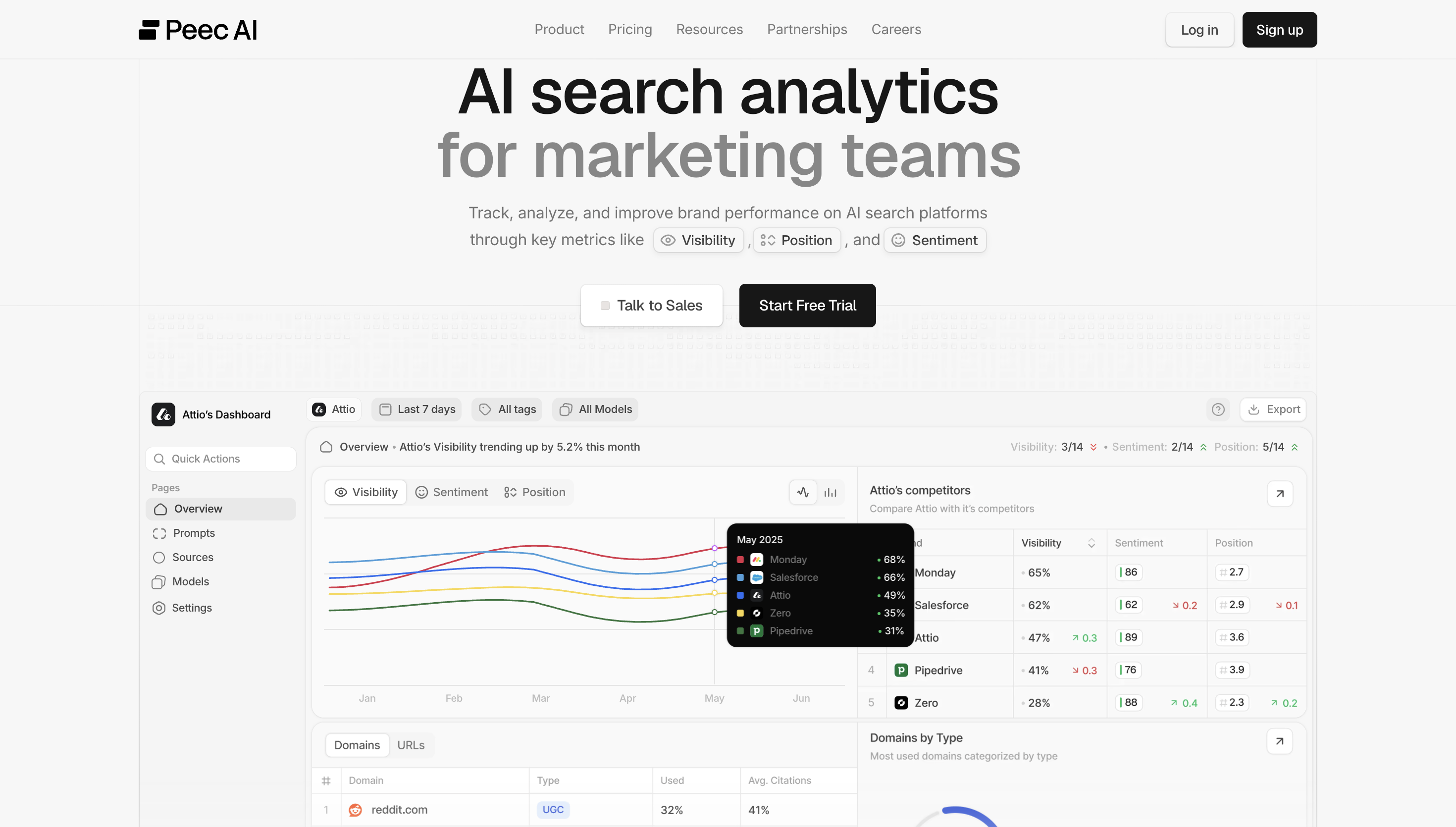
Starting from $80/mo for 50 prompts. Interface-level monitoring with a clean dashboard and fast setup. Strongest coverage is European and German-language, and it handles multi-market tracking well. Limitation: thin crawler analytics. Confirm US English prompt handling if that's your market.
6. Otterly
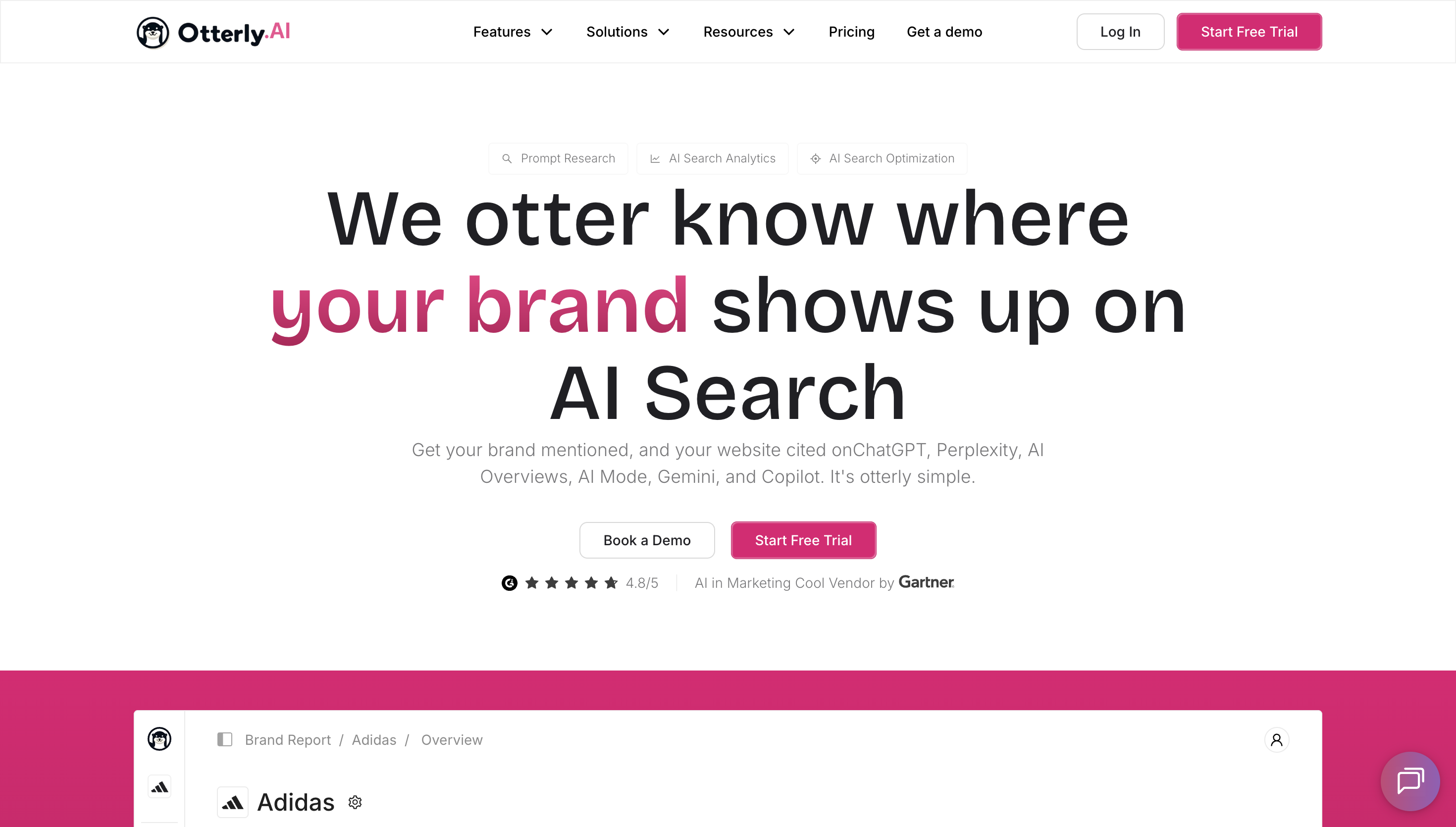
Starting from $29/mo for 15 prompts. Cheapest credible entry point. Scheduled scans, citation alerts, connectors for reporting tools, useful on day one. Limitation: API access and exports restricted on lower tiers, and prompt costs climb as you add volume.
7. Scrunch AI
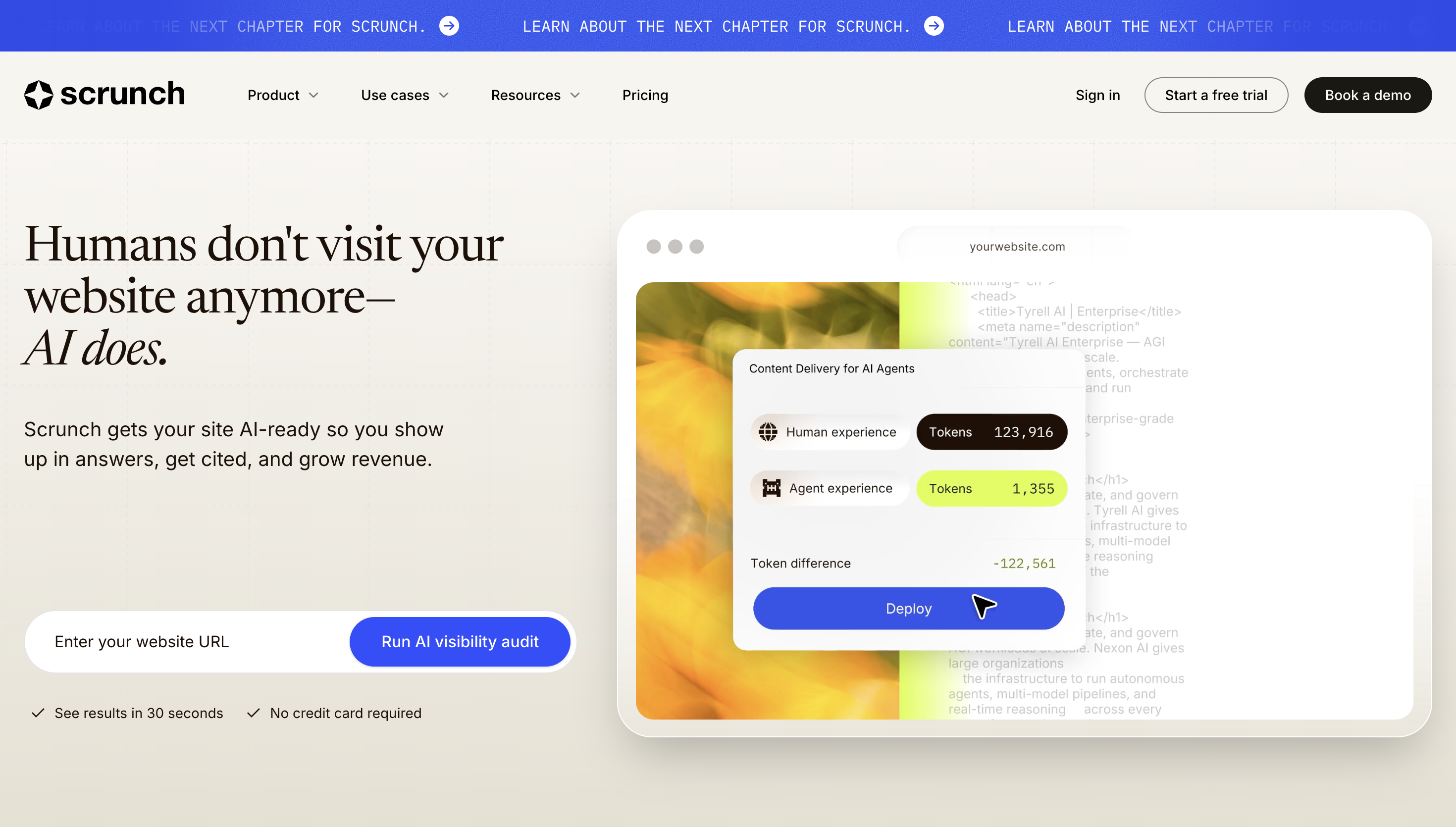
Starting from $250/mo. Crawler control is the differentiator: understanding and shaping how AI systems access your content at a technical level. Limitation: needs technical ownership to be worth the cost.
8. Evertune
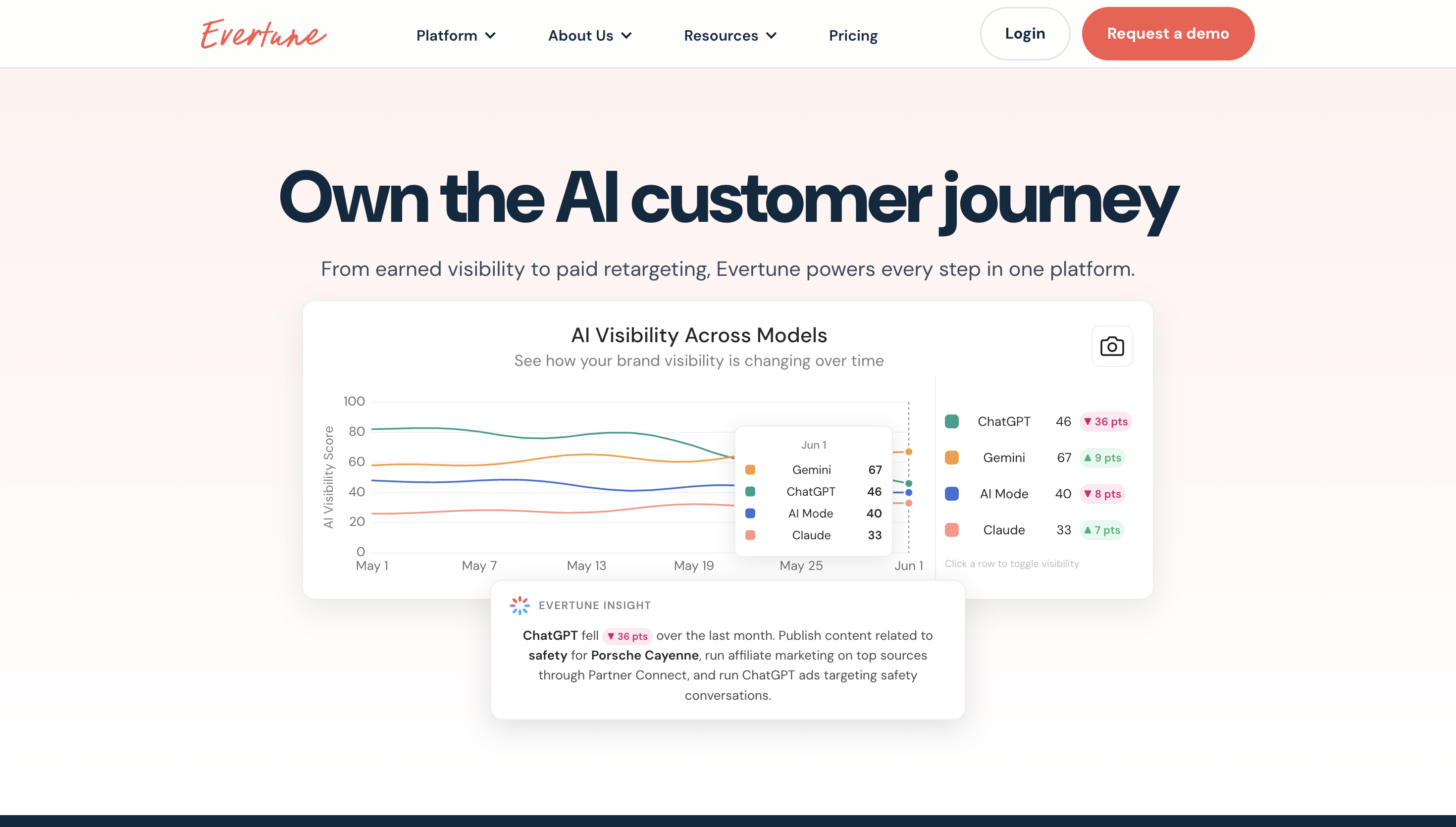
Starting from $800/mo. Aimed at larger brand teams, stronger on sentiment and distribution analysis than on core citation depth. Limitation: price sits outside most mid-market budgets.
9. Knowatoa
Starting around $59/mo self-serve. Fast, inexpensive audits for a read on where you currently stand. Limitation: smaller dataset, better for a snapshot than a programme.
10. xFunnel
Not published. Connects AI visibility to funnel attribution, which is a genuinely different framing. Limitation: less depth in the underlying data than the platforms above.
11. Semrush AI Visibility Toolkit
Starting at ~$99/mo per domain. AI visibility data next to the keyword and audit data you already have. Cheapest route if Semrush is already paid for. Limitation: works from estimates rather than dedicated prompt-level capture.
12. Ahrefs Brand Radar
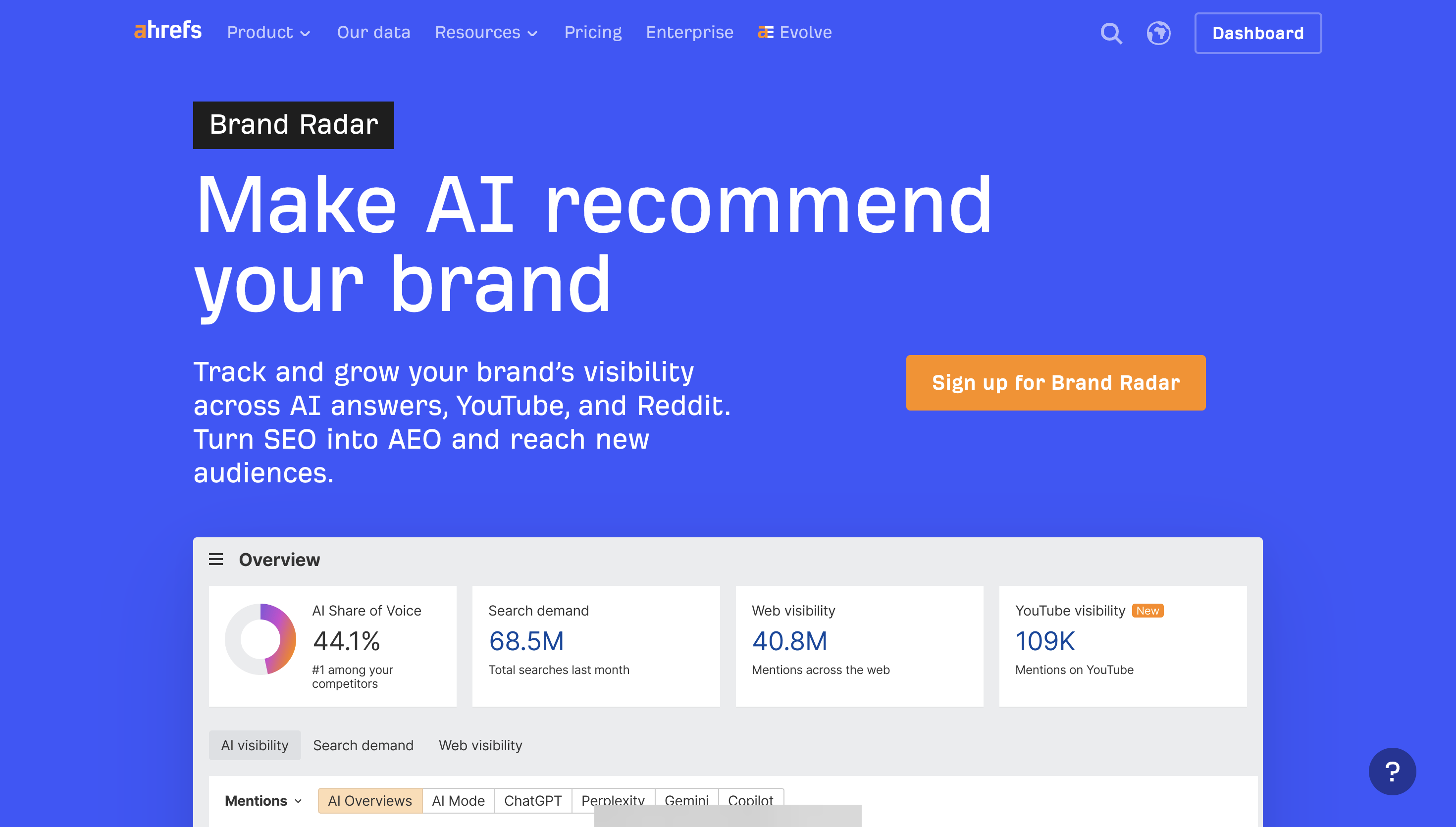
Starting from $129 base, ~$199 per engine. URL-level citation signals rather than raw mention counts, extending beyond AI engines into Reddit and the wider web. Limitation: slow refresh on standard indexes, and cost climbs per engine.
Before shortlisting: verify engine coverage per tier against each vendor's own documentation. Third-party roundups copy each other and go stale within weeks.
Which one fits your situation
| Your situation | Look at |
|---|---|
| Testing whether AEO matters at all | Otterly ($29/mo), Knowatoa (~$59/mo) |
| Already paying for Semrush or Ahrefs | The relevant add-on before anything else |
| Need findings to become assigned work | Strivelabs (quoted), AthenaHQ ($295/mo) |
| Buyers primarily in Europe | Peec AI ($80/mo) |
| Crawler behaviour is the actual problem | Scrunch AI ($250/mo), Profound (quoted) |
| Board-level reporting and compliance | Profound (quoted) |
| Want optimisation recommendations included | Rankscale ($385/mo) |
Integrations and data sources
AEO works when external visibility data lines up with your own internal signals. One without the other produces either dashboards nobody acts on or actions nobody can justify.
| Internal sources you feed in | External sources the tool should capture |
|---|---|
| GA4 sessions and events for citation-driven traffic | Front-end captures of AI answers, screenshots or HTML |
| Search Console for query and impression context | ChatGPT outputs and citation metadata per prompt |
| HubSpot contact and lifecycle stage data | Gemini responses and cited sources |
| CMS publish APIs, page metadata, schema markup | Perplexity answers and the URLs cited |
| Google Ads and LinkedIn Ads for paid overlap | Google AI Overviews and integrated snippets |
| Product facts registry: pricing, SKUs, feature facts | Public signals including Reddit, forums, competitor pages |
When assessing quality, ask for the specific prompt, the resulting snippet, and the capture timestamp. Confirm refresh rates in writing, and confirm the analytics connections work before the contract rather than after.
Implementation checklist
Assign one owner per line.
- Map top pages to buyer prompts using Search Console queries and HubSpot first-touch data
- Put the answer first on every page, with short paragraphs and plain headings
- Maintain a product facts document covering pricing, integrations and feature claims, and treat it as the single source
- Add schema and confirm the visible text matches what's in the markup
- Set a review cadence: weekly citation checks, deeper content refreshes monthly
- Name an approver per content area, usually a product marketer, who verifies before anything publishes
- Run a four-week pilot on five to ten pages, tracked in GA4 and Search Console
- Log every edit with a unique ID so you can attribute movement to a specific change
- Keep a rollback path, and review legal or regulated copy manually
- Export vendor data monthly so you retain your own record independent of the tool
Conclusion
Pick the platform that captures real answers on the engines your buyers use, exports evidence rather than charts, and connects to the systems where your outcomes live.
Run four weeks on ten pages before signing anything annual. Feed it HubSpot, GA4 and Search Console data, then check whether citations moved and whether sessions and leads followed.
Keep a person approving every change. The tool proposes; your team decides.
Upgrade to an Agentic Marketing OS
Connect your stack, get work routed to the right person with enforced approvals. No more decisions made blind to what you're spending on paid.
Frequently Asked Questions
What are the best answer engine optimization tools?
Twelve worth comparing: Strivelabs, AthenaHQ, Profound, Rankscale, Otterly, Peec AI, Scrunch AI, Evertune, Knowatoa, xFunnel, plus the Semrush and Ahrefs add-ons. Otterly is cheapest at $29 a month, Profound deepest, AthenaHQ the most balanced monitor-and-act option.
How does AEO differ from SEO?
SEO competes for position in a list of links and measures clicks. AEO competes to be the cited source inside a generated answer and measures citation share. The technical foundations overlap; the success metric doesn't.
Which engines should a B2B brand monitor?
ChatGPT, Gemini, Perplexity and Google AI Overviews as the baseline. Add Copilot if you sell into Microsoft-heavy enterprises, and Claude if your buyers are technical.
What metrics show AEO is working?
Citation frequency and share against a fixed prompt set, sentiment accuracy in those mentions, and GA4 or HubSpot activity from the pages being cited. Not raw mention counts.
How often should content be updated for AI visibility?
Immediately when pricing or product facts change, since stale facts get repeated. Otherwise a monthly audit of prompt gaps, with weekly citation checks to catch shifts early.
Can I track AI referral traffic with tools I already have?
Partly. Search Console plus GA4 will surface some AI-sourced sessions, and UTM tags on updated pages help attribute content changes. What you can't get that way is which prompts triggered a citation.
What's the risk of ignoring sentiment in AI answers?
An assistant repeating an inaccurate claim about your pricing or capabilities reaches buyers before your site does. Sentiment monitoring exists to catch that, and correcting it is usually a content and PR job rather than a technical one.
Is per-prompt pricing worth it?
For a pilot, yes. At a few thousand tracked queries it becomes the most expensive model on the market. Ask for a hard cap in the contract if you go this route.