Most marketing automation is not actually automated.
It is conditional logic that executes when conditions you pre-programmed are met. If a contact downloads a whitepaper, wait three days, send email B. If they click, move to sequence two. If they do not, wait seven more days and try again.
The marketer designed every branch of that decision tree in advance. The software runs the program. When reality diverges from the diagram, and in a 90-day B2B SaaS sales cycle it always does, the automation executes the pre-programmed instruction anyway. A contact who moved to Opportunity yesterday keeps receiving awareness emails today because nobody updated the workflow.
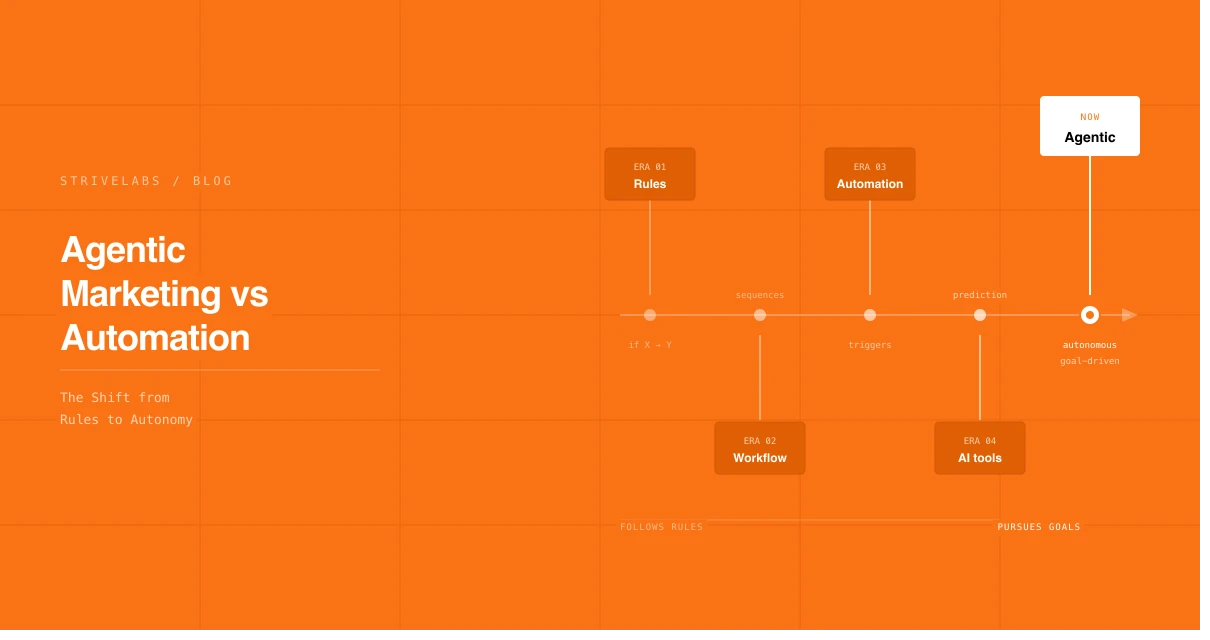
Agentic marketing is architecturally different. Not because the AI is smarter, because who decides is different. In automation, the marketer decides everything in advance. In agentic marketing, the marketer sets the goal. The system figures out how to achieve it, acts toward it continuously, and learns from what worked.
That distinction, instructions vs goals, is what this post unpacks. Only 17% of organisations have deployed AI agents to date, yet more than 60% expect to within two years, the most aggressive adoption intent curve for any emerging technology. The teams that understand the distinction now will build the right infrastructure before the window closes.
At a Glance
-
Marketing automation executes instructions. Agentic marketing pursues goals. The difference is not sophistication, it is architecture.
-
Most B2B SaaS teams think they are at Tier 2. They are usually at Tier 1. The Three-Tier Framework in this post shows exactly where your stack sits.
-
Automation is not wrong, it is the right tool for structured, repeatable, low-stakes tasks. Agentic marketing is the right tool for dynamic, cross-channel, high-stakes decisions.
-
Successful agent deployments report 4.1x-5.3x ROI on the specific workflows they replace. The returns are real, but only when the right tasks are moved to the right system.
-
Human approval stays at every step in agentic marketing. The engine proposes. The marketer decides.
Most Marketing Automation Is Not Actually Automated
Here is the test. Open your HubSpot workflows right now. Pick any three.
Does the workflow do anything without a contact triggering it first? Does it adapt based on what worked last week without you editing the logic? Does it work across paid, SEO and CRM simultaneously, or only inside HubSpot?
If the answer to all three is no, the workflow is not automated. It is scheduled conditional logic. You built the decision tree. The software runs it. The automation is your thinking, pre-recorded.
78% of mid-market B2B organisations now run at least one marketing automation platform. Most of them are running Tier 1 systems and calling it marketing automation. That is not a criticism, Tier 1 is genuinely useful for the right tasks. The problem is when Tier 1 logic is applied to tasks that require Tier 3 thinking.
What Marketing Automation Was Built to Do — and Where It Stops
Marketing automation solves a specific, real problem: how do you execute high-volume, repeatable, rules-based tasks without a human doing each one manually? Welcome emails. Meeting confirmations. Lead routing to the right rep based on company size. Renewal reminders. These are tasks where the right action is known in advance and does not change based on context.
For these tasks, automation is the correct tool. It is predictable, auditable, scalable and does not require clean data or complex setup to deliver value. A HubSpot workflow that routes enterprise leads to a senior rep and SMB leads to a junior rep works reliably for years with minimal maintenance.
Where automation stops is at the boundary of the pre-programmed decision tree. The moment reality presents a situation the workflow diagram did not anticipate, a contact who is simultaneously in three different lifecycle stages across three different products, or a campaign whose performance shifted overnight because a competitor dropped their pricing, the automation executes the nearest pre-programmed instruction. It does not adapt. It does not ask for help. It does the wrong thing confidently and repeatedly until someone notices and edits the workflow.
For a B2B SaaS marketing team running paid, SEO and CRM simultaneously, that boundary is hit constantly. The pre-programmed decision tree cannot account for everything that changes in a live market.
Better decisions start with better infrastructure.
Most mid-market teams pick a channel and hope. Strivelabs gives you the data to know, and the infrastructure to act on it.
Book a Demo →
What Makes Agentic Marketing vs Marketing Automation Different
The distinction is not about intelligence. It is about agency.
A marketing automation platform executes instructions. It does what it was told, when it was told to do it, in the way it was configured. Human intelligence went in at the setup stage. After that, the system runs the program.
An AI marketing agent pursues outcomes. It received a goal, improve pipeline contribution from paid search by 20% this quarter, and it figures out how to achieve it. It monitors data across connected channels continuously. It identifies what is working and what is not. It generates hypotheses about what to do differently. It drafts recommended actions and queues them for approval. It measures what happened and updates its approach.
The marketer does not trigger each cycle. The engine runs continuously, sensing data, deciding what to do, acting with approval, learning from outcomes, whether or not the marketer is looking at a dashboard.
Three specific things agentic marketing does that automation structurally cannot:
Cross-channel simultaneous decision-making
A HubSpot workflow operates inside HubSpot. A Google Ads automation rule operates inside Google Ads. Neither knows what the other is doing. An AI agent reads Google Ads, LinkedIn, HubSpot and Search Console simultaneously and generates recommendations that account for all four channels at once. A contact moving to Opportunity in HubSpot should suppress awareness ads on Google and LinkedIn simultaneously — that action requires reading two systems at once. Automation cannot do it. An agent can.
Outcome-based adaptation
Automation logic is static until someone edits it. If a workflow is producing poor results, the workflow keeps running until a human notices and changes it. An agent measures outcomes after every action and updates its model. If a content refresh brief it generated did not recover the ranking, it adjusts its diagnosis approach for the next decay detection. The system gets more accurate over time without manual reprogramming.
Continuous sensing without prompting
Automation waits for a trigger. An agent watches for signals. A CTR drop that started Monday is visible to the agent by Tuesday morning. In a workflow-based system it surfaces on Friday when the marketer runs the weekly report. In a B2B SaaS sales cycle, those four days compound into budget waste and missed pipeline.
The Three-Tier Framework — Where Does Your Stack Sit Today
This is the framework that clarifies where any B2B SaaS marketing stack currently sits, and what the path forward looks like.
Tier 1 — Rules-based automation
Every decision pre-programmed by the marketer. The system executes instructions.
- Trigger: contact action you defined in advance
- Decision: marketer built the logic before anything happened
- Adapts: never, unless manually reprogrammed
- Example: HubSpot workflow sends a follow-up email three days after a form fill regardless of what the contact does between filling the form and receiving the email
Tier 2 — AI-assisted automation
AI makes recommendations. The marketer executes them.
- Trigger: contact action or AI-generated flag
- Decision: AI recommends, marketer decides and executes manually
- Adapts: with human intervention each time
- Example: HubSpot AI suggests the best send time for an email campaign. The marketer reviews the suggestion and clicks send. The AI improves the timing. The marketer still decides and executes.
Tier 3 — Agentic Marketing Engine
The system pursues goals. The marketer approves high-stakes actions.
- Trigger: continuous data sensing across all connected channels
- Decision: engine generates recommended actions toward the goal, marketer approves
- Adapts: learns from every outcome automatically
- Example: engine detects a 23% CTR drop on the highest-spending ad group, diagnoses three possible causes, drafts copy variants for two of them, queues a budget reallocation recommendation, all before the marketer opens their laptop. Nothing went live overnight.
The self-diagnostic — which tier are you actually at?
Answer these three questions honestly:
- Does your system do things without you triggering them first?
- Does it adapt its approach based on what worked last week without you reprogramming it?
- Does it work across paid, SEO and CRM simultaneously, or only inside one tool?
If the answer to all three is no, you are at Tier 1. Most B2B SaaS teams who think they are at Tier 2 are at Tier 1 with a few AI-suggested send times.
Agentic Marketing vs Automation — Side by Side
| Marketing automation | AI-assisted | Agentic Marketing Engine | |
|---|---|---|---|
| Trigger | Pre-programmed event | Contact action or AI flag | Continuous data sensing |
| Decision maker | Marketer in advance | AI recommends, marketer executes | Engine + marketer approval |
| Adaptability | Manual reprogramming | Human intervention each cycle | Learns from every outcome |
| Experiment velocity | 1-2 per month | 2-4 per month | 10+ per week |
| Reporting effort | 4+ hours manually built | 2-3 hours with AI assistance | Automated, reviewed in minutes |
| Works across channels | No — one tool at a time | Partial | Yes — paid, SEO, CRM simultaneously |
What Agentic Marketing Does That Automation Structurally Cannot
Three concrete scenarios where automation hits its ceiling and agentic marketing does not:
Paid media anomaly response. A Google Ads group starts losing CTR on Monday. The automation rule you set up, pause if CPC exceeds $X, does not fire because CPC has not crossed the threshold yet. The CTR drop is a leading indicator of a problem that the rule was not written to catch. By Friday when the weekly report is built manually, the ad group has spent four days in decline.
The Agentic Marketing Engine detects the CTR drop on Tuesday morning. It does not wait for the CPC rule to fire. It diagnoses the cause, generates three hypotheses, drafts copy variants for the two most likely fixes, and queues the recommendations for approval. The marketer reviews and approves on Tuesday afternoon. The fix goes live before Wednesday's spend.
Pipeline stage mismatch. A contact moves to Opportunity in HubSpot on Tuesday. Your HubSpot automation is not connected to your Google Ads or LinkedIn audiences. The awareness campaign targeting this contact keeps running on Wednesday, Thursday, Friday. The sales rep is in a commercial conversation while marketing is showing the same prospect a top-of-funnel brand awareness ad. The automation cannot fix this because it does not know the ad campaign exists.
The agent reads the HubSpot stage change and queues audience suppression recommendations across Google Ads and LinkedIn simultaneously. Approved and executed before the next ad impression fires.
Content decay and pipeline connection. Search Console shows a post losing impressions over 90 days. Your content calendar does not have a refresh scheduled for three months. The automation rule that would trigger a content task does not exist, you never built it for this scenario. The post continues losing traffic and the pipeline attribution it was generating quietly disappears.
The agent detects the decay signal, connects it to the HubSpot pipeline attribution data showing this post appeared in 14 deals last quarter, generates a refresh brief, and routes it to the content team as a priority task. Not because the calendar said so. Because the pipeline data said so.
When to Keep Automation and When to Move to Agentic Marketing
This is the section most posts in this space skip, because it is more nuanced than a clean before/after story.
Automation is the right tool when:
- The task is high-volume, repeatable and the correct action is known in advance
- Auditability and compliance matter, billing emails, contract workflows, legal notifications
- The data involved is clean and the context does not change
- The stakes of a wrong action are low
Agentic marketing is the right tool when:
- The task requires reading multiple data sources simultaneously
- The correct action changes based on what happened in the last 24-48 hours
- The stakes of inaction are high — wasted budget, missed pipeline, stale content
- The task currently requires a human to investigate before they can decide
Most B2B SaaS marketing teams should run both. Structured, repeatable tasks stay in HubSpot automation workflows. Dynamic, cross-channel, signal-driven decisions move to the Agentic Marketing Engine.
The question is not "should I replace automation with agentic AI." It is "which tasks belong at Tier 1 and which tasks belong at Tier 3."
The Human Approval Question in Agentic Marketing vs Automation
The most common objection to agentic marketing: "does the agent do things without asking me?"
No. And this distinction matters more than most vendor content acknowledges.
Automation executes without asking because you told it what to do in advance. You approved the logic at setup. Every subsequent execution is a pre-approved action.
Agentic marketing operates differently. The engine proposes. The marketer decides. The engine executes. Nothing goes live without explicit sign-off on the specific action being taken.
The human-in-the-loop model is not a limitation of agentic marketing, it is the design principle. The engine is faster than the marketer at detection, diagnosis and action-building. The marketer is better than the engine at judgment, brand voice and strategic context. The approval gate is where those two capabilities meet.
For a Head of Marketing at a 150-person B2B SaaS company where one wrong budget move or one off-brand ad can affect a quarter's pipeline, an agent that acts without asking is not a feature. It is a risk. The Agentic Marketing Engine is built around the principle that speed of execution and human control are not in tension. The engine handles the speed. The marketer handles the control.
How Strivelabs Delivers Tier 3 for B2B SaaS Teams
Strivelabs is the Agentic Marketing Engine for B2B SaaS teams. It connects to Google Ads, LinkedIn Ads, Meta Ads, HubSpot, Search Console and GA4 via OAuth in under five minutes. No engineering required.
Once connected the engine operates at Tier 3 immediately, sensing data across all connected channels continuously, generating persona-specific recommended actions, executing with approval, learning from outcomes.
Three personas receive specific outputs:
Paid Marketers receive budget reallocation recommendations, creative fatigue alerts, CTR anomaly diagnoses and weekly reports, all generated before the Monday morning dashboard check.
Content Marketers receive content decay alerts with pipeline attribution context, refresh briefs built from live Search Console data, and topic recommendations driven by what is appearing in winning deals in HubSpot.
Product Marketers receive competitor alerts from G2 and LinkedIn, win/loss patterns from HubSpot deal notes, and positioning recommendations from what is resonating in the market right now.
40% of enterprise applications will feature task-specific AI agents by the end of 2026, up from less than 5% in 2025. The teams building the infrastructure now will compound the advantage before the window closes.
Everstage runs 4x more experiments per quarter. Spendflo 3x'd published content. Obbserv saved days of manual work every month. Those results are not from better automation. They are operating at Tier 3.
The marketing engineer function, delivered as software.
See how Strivelabs gives mid-market teams the operational capacity without the hiring cost.
Explore Strivelabs →
Frequently Asked Questions (FAQs)
What is the difference between agentic marketing and marketing automation?
Marketing automation executes instructions the marketer pre-programmed, if X happens, do Y. Agentic marketing pursues goals the marketer sets, here is the outcome, figure out how to achieve it. The difference is who decides: in automation the marketer decides everything in advance, in agentic marketing the engine generates recommended actions and the marketer approves them.
Will agentic AI replace my marketing automation platform?
No. Automation is the right tool for structured, repeatable, high-volume tasks, lead routing rules, welcome sequences, billing notifications. Agentic marketing is the right tool for dynamic, cross-channel, signal-driven decisions. Most teams should run both. The question is which tasks belong at each tier.
Does the agent make changes without asking me?
No. Every action the Agentic Marketing Engine recommends, budget reallocation, audience update, content brief, ad pause, requires the marketer's explicit approval before it executes. The engine proposes with reasoning attached. The marketer decides. The engine executes. Nothing touches a live account or contacts a buyer without sign-off.
Which marketing tasks should stay in automation?
High-volume, repeatable tasks where the correct action is known in advance and does not change based on context, welcome emails, meeting confirmations, basic lead routing, renewal reminders, compliance notifications. These tasks are efficient in automation and do not benefit from agentic decision-making.
How long does it take to move from automation to agentic marketing with Strivelabs?
Most teams are fully connected within a single meeting, integrations via OAuth take under five minutes per tool. The engine delivers its first prioritised action recommendations within 24 hours. The first paid media optimisations are typically visible within the first week.