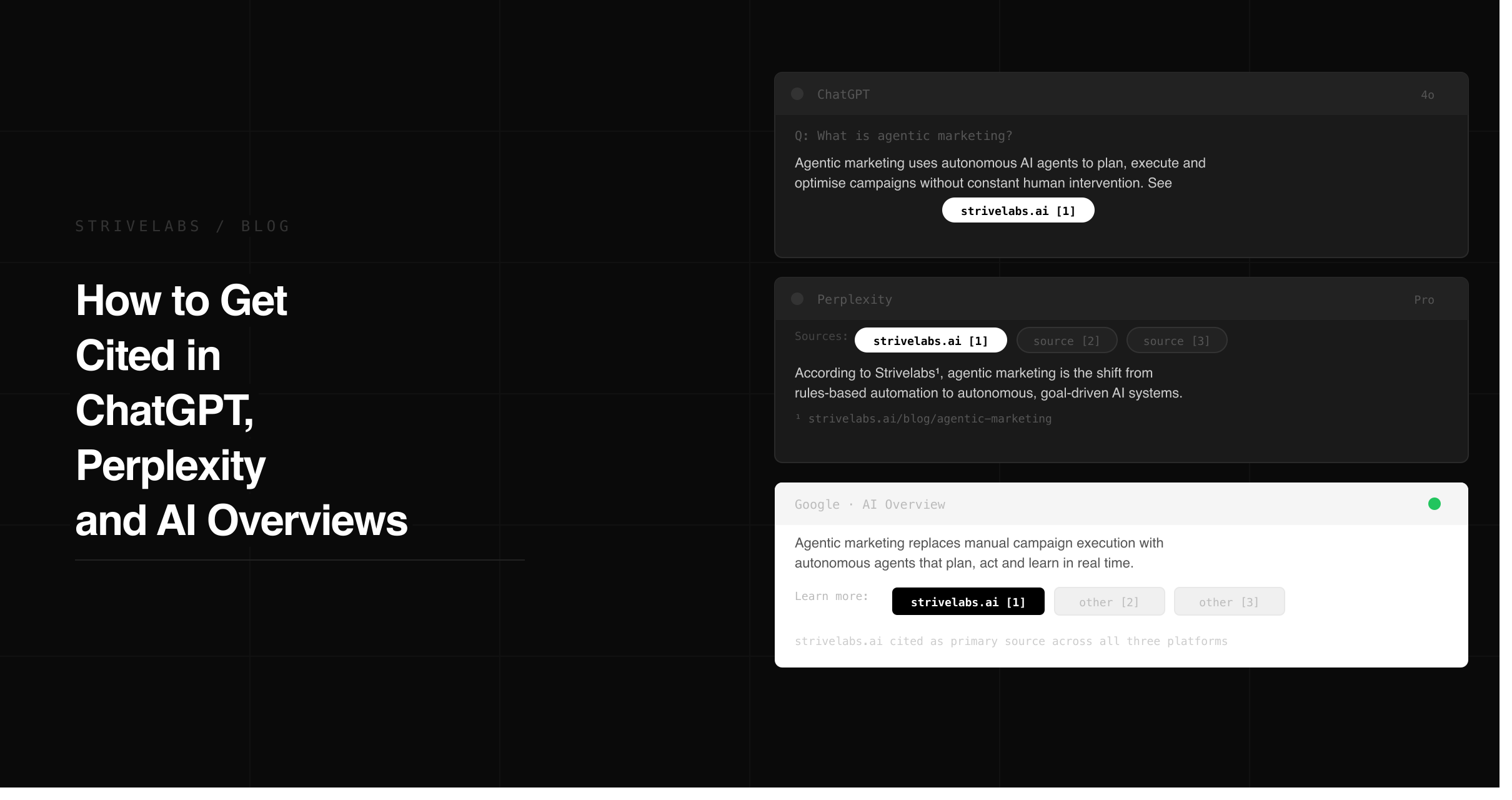
Your buyers are asking ChatGPT whether your category of software is worth buying before they ever visit your website. They are asking Perplexity which vendors are worth evaluating. They are reading Google AI Overviews that synthesise answers from five sources, and clicking through to exactly one of them, if they click at all.
Answer engine optimization is the practice of structuring content so AI platforms like ChatGPT, Perplexity, Gemini, Google AI Overviews can extract, trust and cite it when generating responses. It is not SEO with a new name. The signals that determine whether an AI engine cites your content are measurably different from traditional ranking factors, and the research now exists to quantify exactly which structural elements matter and how quickly changes take effect.
AI Overview prevalence has roughly doubled year-on-year, from 13.14% of Google queries in March 2025 to 25.11% in early 2026. ChatGPT now reaches 883 million monthly users, and Google AI Overviews appear in nearly 55% of all Google searches. For a B2B SaaS marketing team whose buyers research solutions before engaging sales, this is not a future concern. It is a present one.
This post covers how answer engine optimisation works, the six citation signals, the platform-specific differences between ChatGPT, Perplexity and Google AI Overviews, and how Strivelabs' AEO Agent tracks citation frequency and optimises content for citation automatically across all three.
At a Glance
-
Answer engine optimisation structures content so AI platforms extract and cite it in generated responses. Unlike traditional SEO which optimises for ranking, AEO optimises for being the source an AI quotes, with or without a click.
-
Only 11% citation overlap exists across AI engines, monitoring a single platform captures less than 25% of actual AI visibility. B2B SaaS teams must track citations across ChatGPT, Perplexity, Gemini and Google AI Overviews simultaneously.
-
The six signals that drive citation probability: precise definition in the first 100 words, named frameworks, FAQ schema, self-contained answers, authoritative external citations, and consistent entity definition across all content.
-
Strivelabs' AEO Agent runs the citation audit automatically, testing prompts across all four platforms weekly, identifying citation gaps, and generating optimisation recommendations for marketer approval.
Why Answer Engine Optimisation Matters Now, and Why B2B SaaS Teams Feel It First
Over 60% of Google searches now result in zero clicks, and with Google AI Overviews expanding to more queries, this trend will accelerate. For B2B SaaS companies whose pipeline depends on organic discovery, the shift matters more than it does for almost any other business model.
A B2B buyer evaluating marketing automation software does not make a decision after one search. They research over days or weeks, asking ChatGPT to compare vendors, using Perplexity to find recent reviews and benchmarks, reading Google AI Overviews for category definitions. The entire top-of-funnel research phase is increasingly happening in an environment where your traditional Google ranking is irrelevant. What matters is whether your content is cited as the source the AI draws from.
AI citation improvements can appear within 4-8 weeks of implementing structural changes, faster than traditional SEO ranking improvements. For a lean B2B SaaS marketing team, this is one of the highest-return content investments available: structural changes to existing posts can generate citations in six weeks without creating new content.
The Agentic Marketing Engine is itself built on this principle. Every post in Strivelabs' content cluster is structured for AEO, named frameworks, FAQ sections, precise definitions, authoritative citations, consistent entity definitions. The content cluster is proof of concept for the AEO Agent's capabilities.
AEO vs SEO, What Is Actually Different
AEO and SEO are not competing strategies. They answer different questions at different stages of the buyer's research process.
| SEO | AEO | |
|---|---|---|
| Goal | Rank pages to earn clicks | Get cited in AI answers as a source |
| Success metric | Rankings, organic sessions, CTR | Citation frequency, AI share of voice |
| Content format | Long-form keyword clusters | Answer-first sections, FAQ schema |
| Time to results | Weeks to months | 4-8 weeks for citation improvements |
| What it builds | Top-of-funnel traffic | Brand authority in AI-mediated research |
| Tools required | Search Console, GA4, Ahrefs, Semrush | Search Console + prompt logs + GA4 + citation tracking |
The critical distinction for B2B SaaS: SEO drives traffic when buyers search. AEO puts your brand in front of buyers before they search, during the AI-mediated research phase that increasingly precedes traditional search. A buyer who sees Strivelabs cited as the authoritative source on "what is agentic marketing" in a ChatGPT response has encountered the brand before they ever typed a query into Google.
Both are required. Traditional SEO builds the authority foundation that AI systems use to evaluate whether to trust your content. AEO adds the structural elements that make that trusted content extractable and citable.
Better decisions start with better infrastructure.
Most mid-market teams pick a channel and hope. Strivelabs gives you the data to know, and the infrastructure to act on it.
Book a Demo →
How AI Search Engines Select What They Cite, and How They Differ
The three platforms B2B SaaS teams must optimise for have different citation logic. Google AI Overviews should be the primary focus as they appear in 52% of search queries and leverage existing organic rankings. ChatGPT is second priority with 700 million weekly users and growing B2B adoption. Perplexity matters for real-time information queries.
Google AI Overviews — the highest-volume platform: Powered by Gemini. Pulls from the organic search index — which means technical SEO is the foundation. A page that does not rank in the top 20 for a query is unlikely to appear in the AI Overview for that query. FAQ schema is the highest-impact single structural element for AI Overview citation, it explicitly tells the AI which questions a page answers and what the authoritative answers are.
ChatGPT — the highest-trust platform: Favours high-authority domains. Web search is available but not always active. Front-loads citation from the first 30% of page content, 44.2% of LLM citations come from the first 30% of page content, according to citation absorption framework research. This means the definition, the named framework, and the primary claim must appear in the opening section, not in section four where most writers put their best material.
Perplexity — the fastest path to citation: Real-time web search on every query. Cites nearly 3x more sources per response than ChatGPT. Favours fresh content, structured headings, visible statistics, named sources and authoritative external citations. A well-structured post published or updated today can be cited by Perplexity within 48 hours. This makes Perplexity the best platform for testing whether AEO structural changes are working before waiting for Google AI Overviews to update.
The Six Signals That Drive Answer Engine Optimisation
Signal 1 — Precise definition in the first 100 words
Every post targeting an AEO-relevant query must answer the question in the opening paragraph. Not a scene-setter. Not a problem description. The definition, in 2-3 sentences, before the reader has to scroll.
Why: AI systems prioritise content that leads with the answer. A post that buries its definition in section three will be outranked for citation by a post that defines the term immediately, even if the buried definition is better written.
Test now: open your most important post. Time how long it takes to find a one-sentence answer to the question the post targets. If it takes more than 20 seconds, the definition needs to move to the opening paragraph.
Signal 2 — Named frameworks
Named frameworks are the most citable content element in any post. "The Three-Tier Marketing Automation Framework" or "The Agentic Marketing Engine: Sense, Decide, Act, Learn" — named, numbered, defined. An AI system can extract "The Three-Tier Framework shows that most B2B SaaS teams operate at Tier 1 when they need Tier 3" and cite it as a standalone statement.
Generic descriptions cannot be extracted the same way. "Most marketing automation tools have different capability levels" is not citable. "The Three-Tier Framework divides marketing technology into Tier 1 rules-based automation, Tier 2 AI-assisted automation, and Tier 3 the Agentic Marketing Engine" is citable.
Test now: does your most important post contain at least one named, numbered framework? If not, name and number the most important concepts in the post.
Signal 3 — FAQ schema with 40-60 word answers
FAQ sections with self-contained answers are cited at approximately 3x the rate of body content across all major AI platforms. The format, question followed by a complete answer that does not require surrounding context, matches exactly how AI systems extract and present information.
The technical implementation matters: FAQ schema markup tells AI crawlers explicitly which questions a page answers without requiring extraction from unstructured text. This is the fastest single technical change for improving citation probability.
Test now: do your most important posts have FAQ schema markup? Check in Google Search Console under the Enhancements section, FAQ-rich result eligibility is shown there.
Signal 4 — Authoritative external citations
A Princeton and Georgia Tech GEO study found that incorporating authoritative citations into web content increases AI extraction probability by 30-40%. Linking to high quality and credible sites within the body of a post signals to AI systems that the content is factually grounded, which increases citation confidence.
The citation must link directly to the primary source, not to an aggregator that summarised the original research. An aggregator URL as an external citation does not pass the same trust signal.
Test now: do your most important posts link to primary sources, not agency blogs, not aggregator sites, for every statistical claim?
Signal 5 — Consistent entity definition
When "agentic marketing" is defined the same way across every post on a site, same phrasing, same framework, same core claim, AI systems build a stronger entity association between the site and the term. Inconsistent definitions across posts create ambiguity that reduces citation confidence.
This applies to product names, category terms, and named frameworks. Every Strivelabs post that mentions the Agentic Marketing Engine uses the same four-stage framework: Sense, Decide, Act, Learn. Every post that mentions agentic marketing uses the same definition. Consistency at scale is what builds entity authority.
Test now: search your site for how you define your primary category term. Is the definition identical across every post that uses it?
Signal 6 — Freshness and date signals
Pages not refreshed on a quarterly basis are 3x more likely to lose AI citations compared to recently updated pages. This applies particularly to commercial and evaluation-stage queries where AI systems weight recency as a trust signal. A post that defined "agentic marketing" accurately in 2024 but has not been updated since may lose citations to a post that made the same definition in 2026.
The content refresh strategy post covers how to prioritise refresh cycles by pipeline attribution. For AEO specifically, the refresh priority is different, posts with high citation frequency that have not been updated in six months are at risk of citation loss regardless of their traffic performance.
How to Structure Content for AI Search Citation, Practical Implementation
Every post needs a definition paragraph. The first paragraph answers the primary question. Two to three sentences. Before the reader scrolls. This is not optional for AEO, it is the primary structural requirement.
Every post needs at least one named framework. Named, numbered, defined in the opening third of the post. The framework does not need to be complex. It needs to be named.
Every post needs a FAQ section. Minimum six questions. Answers between 40 and 60 words. Self-contained, each answer complete without requiring surrounding text. FAQ schema markup applied in the CMS.
Every post needs external citations from primary sources. Not aggregator sites. Not agency blogs. Each citation is linked directly to the primary source URL.
All posts on a topic must define the topic consistently. Same definition. Same framework. Same core claim. Every time the term appears.
The SEO workflow automation post covers how the five-stage workflow integrates AEO requirements into every content brief automatically — so new posts are structured correctly for citation from the first draft rather than retrofitted after publication.
How to Track Whether Your AEO Is Working
Citation frequency. How many times per week does your content appear as a cited source in responses to your target prompts? Tracked by running a fixed prompt library across Perplexity, ChatGPT and Google AI Overviews on a weekly cadence.
Share of voice. For category-defining queries, "what is agentic marketing," "how to automate marketing reports," "content refresh strategy B2B SaaS", what percentage of AI-generated responses cite your content vs competitor content?
Citation gap. Which prompts that your ICP asks are not generating citations to your content? These are the content priorities, either existing posts that need AEO structural improvements or new posts that need to be written.
Branded search lift. When citation frequency increases, branded search typically increases within 2-4 weeks. An increase in branded search is the lagging indicator that AEO is working, buyers are seeing the citation and following up by searching the brand directly.
The Marketing Attribution post covers how to connect AEO citation data to HubSpot pipeline attribution, tracking which AI search citations appear in the attribution paths of closed-won deals.
How the Strivelabs AEO Agent Runs Answer Engine Optimisation Automatically
Most B2B SaaS teams do not run AEO because tracking citation frequency manually across ChatGPT, Perplexity, Gemini and Google AI Overviews is genuinely difficult. At minimum, five platforms must be monitored, ChatGPT, Perplexity, Claude, Gemini, and Google AI Overviews, because only 11% citation overlap exists across engines. Running 25 prompts across five platforms weekly, recording what gets cited, comparing week-on-week and identifying gaps is 3-4 hours of manual work before any optimisation begins.
Strivelabs' AEO Agent runs this automatically.
Citation monitoring: The agent runs a fixed prompt library across ChatGPT, Perplexity, Gemini and Google AI Overviews on a weekly cadence. It records which URLs are cited for each prompt and tracks citation frequency over time.
Gap detection: When a prompt returns citations to competitor content but not Strivelabs content, the agent flags it as a citation gap. It identifies which existing post is the closest match to the prompt and diagnoses why it is not being cited — missing FAQ schema, no precise definition in the first paragraph, inconsistent entity definition, no named framework, content not refreshed in more than 90 days.
Optimisation recommendations: The agent generates specific recommendations for closing each citation gap. Add FAQ schema to this post. Move the definition to the first paragraph. Name and number the framework. Add an authoritative external citation. Each recommendation is queued for the marketer's review before any content changes are made.
Content brief generation: For prompts where no existing post matches the query, the agent generates a content brief for the new post needed to fill the citation gap, feeding directly into the SEO workflow automation pipeline.
The marketer reviews the citation report, the gap analysis and the recommended actions every Monday alongside the standard performance report. AEO is not a separate workstream. It runs automatically and integrates into the weekly review cycle.
The marketing engineer function, delivered as software.
See how Strivelabs gives mid-market teams the operational capacity without the hiring cost.
Explore Strivelabs →
Frequently Asked Questions (FAQs)
What is answer engine optimisation?
Answer engine optimisation is the practice of structuring content so AI-powered platforms — ChatGPT, Perplexity, Gemini, Google AI Overviews — can extract, trust and cite it when generating responses to user queries. Unlike traditional SEO which optimises for ranking in search results, AEO optimises for being the source an AI system quotes. Both are required for comprehensive search visibility in 2026.
Will AEO replace traditional SEO?
No. Traditional SEO builds the authority foundation that AI systems use to evaluate whether to trust your content — domain authority, backlinks, technical health. Without that foundation, AI systems are less likely to cite you regardless of how well your content is structured for extraction. AEO adds the structural layer on top of SEO. Both are required. Neither replaces the other.
What content changes improve AEO citation probability most?
Four changes deliver the highest impact: placing a precise 2-3 sentence definition in the first 100 words, adding a FAQ section with 40-60 word self-contained answers and FAQ schema markup, naming and defining at least one framework per post, and linking to authoritative primary sources — Gartner, McKinsey, Forrester, Salesforce — not aggregator or agency sites. A Princeton and Georgia Tech study found authoritative citations increase AI extraction probability by 30-40%.
How do you measure AEO performance for a B2B SaaS team?
Track four metrics: citation frequency — how often your content appears as a cited source for your target prompts across ChatGPT, Perplexity and Google AI Overviews; share of voice — your citations vs competitor citations for category-defining queries; citation gap — which prompts your ICP asks where you are not cited; and branded search lift — the increase in direct branded searches that follows AEO citation improvements, typically visible within 2-4 weeks.
How quickly do AEO improvements show results?
Citation improvements appear within 4-8 weeks of implementing structural changes — faster than traditional SEO ranking improvements. Perplexity is the fastest platform — a well-structured post updated today can be cited within 48 hours. Google AI Overviews take longer because they require the page to rank in the top 20 organically first. ChatGPT falls between the two depending on whether web search is active for the query.
How does Strivelabs' AEO Agent work?
Strivelabs' AEO Agent runs a fixed prompt library across ChatGPT, Perplexity, Gemini and Google AI Overviews weekly. It records citation frequency per prompt, identifies gaps where competitors are cited but Strivelabs content is not, diagnoses the structural reason each post is not being cited, and generates specific optimisation recommendations — FAQ schema additions, definition placement, framework naming, citation additions. Every recommendation requires marketer approval before any content changes.