B2B SaaS has the most complex marketing environment of any business model. Sales cycles average 121 days for mid-market and 218 days for enterprise. Buying committees now average 11.2 stakeholders. Free trial to paid conversion requires product event tracking most marketing teams don't have. And attribution across all of it requires infrastructure that a CRM and GA4 alone cannot provide.
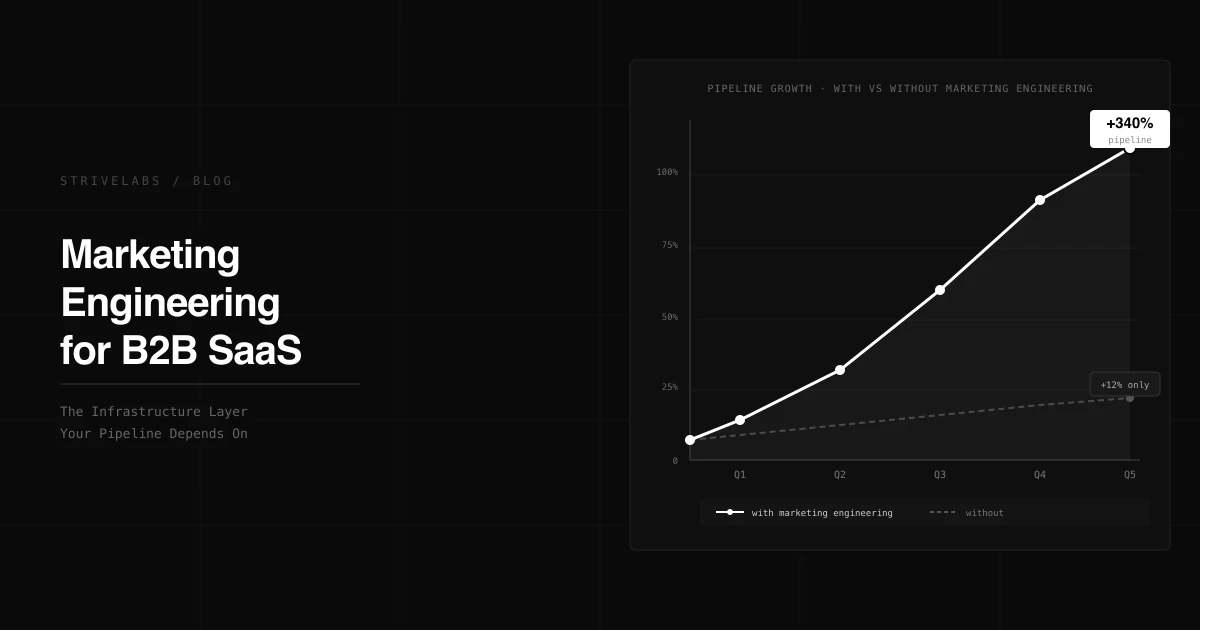
Marketing engineering is the function that builds and maintains that infrastructure, the data pipelines, attribution models, automation logic, and experiment systems that connect marketing spend to closed revenue. Without it, every budget decision is made on incomplete data. With it, the entire go-to-market motion compounds quarter over quarter.
This guide covers what marketing engineering delivers specifically for B2B SaaS, how the function scales from 50 to 500 people, and why most mid-market teams are choosing software over a hire to get there faster.
At a Glance
-
B2B SaaS has the longest sales cycles, the most complex buyer journeys, and the highest attribution stakes of any business model. Marketing engineering is not optional, it's the infrastructure layer that determines whether the entire GTM motion compounds or leaks.
-
78% of organisations now use AI in at least one marketing function, per McKinsey, but only 5.5% report seeing real financial returns. The gap is almost always data infrastructure and attribution quality, both of which marketing engineering solves.
-
The three B2B SaaS-specific challenges that make marketing engineering non-negotiable: long sales cycles that break standard attribution windows, high-touch buying committees that create multi-session identity problems, and PLG motions that require product event tracking most marketing stacks don't instrument correctly.
-
Strivelabs delivers the marketing engineering function as managed software, attribution, lead ops, experimentation, and orchestration, without the hire, the ramp time, or the infrastructure build cost.
Why B2B SaaS Needs Marketing Engineering More Than Any Other Model
Most marketing infrastructure was designed for short-cycle, single-buyer, direct-response environments. B2B SaaS is none of those things.
A prospect might read three blog posts, attend a webinar, start a free trial, have four sales calls, and come back six weeks later through a branded search before signing a contract. Every one of those interactions happens in a different system. None of them connect automatically. And the deal took 140 days from first touch to close.
Without marketing engineering infrastructure, that journey produces a CRM entry that says "Source: Direct" and a pipeline report that your CFO doesn't trust. With it, every touchpoint is tracked, attributed, and connected to the revenue outcome, and the next quarter's budget is allocated accordingly.
This is why the function matters more in B2B SaaS than anywhere else. The complexity is not a reason to avoid building the infrastructure. It's the reason the infrastructure is non-negotiable.
The Three B2B SaaS Challenges That Make This Function Non-Negotiable
Long sales cycles break standard attribution
Standard attribution windows of 7–30 days are meaningless for a 121-day mid-market sales cycle. First-touch attribution overvalues top-of-funnel activity. Last-touch undervalues the nurture sequence that converted the committee. Multi-touch models with time decay are the only attribution approach that reflects reality, and building them requires marketing engineering infrastructure, not a CRM setting.
The practical implication: if your current attribution model doesn't cover a 90–180 day lookback window, you are making budget decisions on incomplete data every single quarter. The channels that look like they're working aren't necessarily the ones that are actually driving the pipeline.
See the full marketing attribution guide for a complete breakdown of which models work for B2B SaaS sales cycles and what data infrastructure each one requires.
High-touch buying committees create identity problems
Buying committees averaging 11.2 stakeholders each touch different content, visit different pages, and interact with different channels across the same deal. The CFO reads a case study. The head of RevOps attends a webinar. The champion runs a free trial. Each interaction looks like a separate anonymous user in your analytics, unless you have account-level identity stitching connecting them.
Without that connection, your attribution model credits different channels with different committee members' conversions, your retargeting misses stakeholders who haven't identified themselves, and your pipeline data tells a story that doesn't match what sales is experiencing on calls.
PLG motions require product event tracking most stacks don't have
Product-led growth teams need to know which in-app actions predict conversion from trial to paid. Which features correlate with 90-day retention. Which activation milestones separate customers who expand from those who churn. None of that is possible without marketing engineering, specifically, event tracking infrastructure that connects product usage signals to marketing attribution and revenue outcomes.
Most B2B SaaS teams have the product analytics tool. Very few have correctly instrumented the connection between product events and marketing pipeline data. That gap is where PLG motions stall.
Better decisions start with better infrastructure.
Most mid-market teams pick a channel and hope. Strivelabs gives you the data to know, and the infrastructure to act on it.
Book a Demo →
What Marketing Engineering Actually Delivers
Marketing engineering is not a job title. It's a set of outputs that your go-to-market motion depends on. Here's what the function produces and what breaks without it:
| Output | What it does | What breaks without it |
|---|---|---|
| Attribution | Connects every touchpoint to revenue across the full sales cycle | Budget allocated to the wrong channels every quarter |
| Testing | Instruments experiments with clean baselines and control groups | Experiments produce unreliable results, no trustworthy conclusions |
| Lead ops | Scores, cleans, and routes leads based on behaviour and intent signals | Leads arrive at sales 3–5 days late, conversion rate drops predictably |
| Orchestration | Maintains data quality and triggers alerts when signals break | Measurement errors compound silently until a bad board report |
These four outputs compound. Clean attribution improves lead scoring. Better lead scoring improves experiment baselines. Better experiment results improve attribution models. A marketing engineering function that's been running for two quarters produces better data than one that started yesterday, which is exactly why waiting to build it is expensive.
Attribution Across 90-Day B2B SaaS Cycles
Tracking a customer journey over three months presents specific technical challenges that most marketing platforms don't solve out of the box.
You need to connect individual digital interactions, web sessions, email clicks, ad impressions, demo requests, trial events, sales calls, to a single account record and ultimately to a closed revenue outcome. You need a lookback window that covers your actual sales cycle, not a platform default. And you need attribution logic that gives appropriate credit to touchpoints that happened 90 days before the deal closed, not just the last interaction before conversion.
Multi-touch models solve this. Position-based models (U-shaped or W-shaped) weight first touch and lead creation while distributing the rest across the journey. Algorithmic models use machine learning to assign credit based on actual conversion paths. Both require engineering to implement correctly.
The data inputs you need:
- Web session logs with anonymous-to-known identity stitching
- CRM records with consistent lead source fields and deal stage timestamps
- Ad platform data with impression and click-level attribution
- Product event data connecting trial usage to pipeline outcomes
- Sales activity logs connecting outreach to opportunity progression
Without all five connected, your attribution model produces numbers that conflict with each other and erode trust with leadership.
Running Experimentation Without a Large Team
Most B2B SaaS teams assume they need a dedicated data scientist or a large ops team to run experiments. They don't, but they do need the infrastructure to be correct before they start.
The prerequisites for reliable experimentation:
- A consistent UTM taxonomy applied to every campaign before it launches
- Conversion events that fire correctly and connect to pipeline outcomes
- A control group isolation mechanism that prevents audience contamination
- A measurement layer that connects experiment IDs to CRM opportunity records
With those in place, a small team can run 4–6 meaningful experiments per quarter. Without them, every experiment produces results that can't be trusted, because the baseline data is wrong.
Effective starting points for B2B SaaS experimentation: sequential A/B tests on landing pages with clean UTM tracking, paid holdout groups measuring the incremental lift of specific channels on MQL velocity, and content cluster tests measuring whether topical authority affects pipeline conversion rate rather than just organic traffic.
For teams building experimentation as a compounding capability rather than a one-off project, see marketing experimentation as infrastructure.
Lead Ops Tied Directly to Pipeline
Lead operations in B2B SaaS is not a CRM administration function. It's the system that determines whether a qualified account reaches sales in time to convert, or sits in a queue until the moment has passed.
The components that make lead ops work in a B2B SaaS context:
Behavioural scoring that combines product usage signals (feature adoption, login frequency, trial depth) with marketing engagement signals (content consumption, ad interaction, webinar attendance) to produce a score that actually predicts conversion, not just activity.
Intent signal integration that surfaces accounts showing buying behaviour across channels, G2 category views, competitor research, pricing page visits, and routes them to sales with context, not just a name and email.
Automated hygiene that runs continuously: deduplicating records, standardising field values, enforcing UTM naming conventions, and flagging data quality issues before they corrupt the scoring model.
Speed-to-lead routing that connects a qualified lead to the right sales rep within minutes of the trigger event firing, not hours later when the prospect has moved on.
A single well-designed routing rule change can double conversion rate on inbound leads. That's not an exaggeration, it's the operational leverage that marketing engineering produces when the data layer underneath it is clean.
The Always-On Orchestration Layer
Marketing engineering includes a layer of continuous background processes that most teams don't see until they break.
This is the infrastructure that:
- Monitors pixel firing rates and alerts when they drop below baseline
- Checks that server-side events contain all required fields and removes duplicate entries
- Watches for changes in event payloads that signal a breaking change in the product
- Verifies that audience syncs between the CRM and ad platforms completed without errors
- Fires budget reallocation alerts when spend pacing diverges from pipeline contribution
When this layer is working correctly, campaigns launch on time, attribution is clean, and dashboards tell the truth. When it breaks, and without engineering oversight it will break, the marketing team spends the next two weeks untangling data problems instead of running campaigns.
The AI marketing agent layer sits on top of this orchestration infrastructure, monitoring signals, surfacing recommendations, and routing specific actions to the right team member for approval. The orchestration layer is what makes agentic marketing possible at the speed B2B SaaS teams need.
Building the B2B SaaS Marketing Engineering Stack
The stack has four layers. Each one depends on the one below it. Building them out of order is the most common reason marketing engineering projects fail.
Layer 1: Data ingestion — Pull from every source your GTM motion touches, Salesforce or HubSpot, Google Ads, LinkedIn Ads, GA4, product analytics (Mixpanel or Amplitude), trial event streams. Standardise on consistent user IDs and timestamps across every source before anything else.
Layer 2: Identity and storage — Stitch anonymous sessions to known accounts using deterministic matching (CRM IDs, email addresses) supplemented by probabilistic methods where exact matches aren't available. Store everything in a warehouse that your attribution models can query directly. A 90-day lookback window requires at least 180 days of clean historical data to initialise correctly.
Layer 3: Analytics and attribution — Build the attribution models on top of clean, stitched data. Start with position-based models before moving to algorithmic approaches, the simpler model running on clean data outperforms the sophisticated model running on messy data every time. Connect attribution outputs back to CRM deal records so pipeline reports reflect marketing influence accurately.
Layer 4: Activation and AI agents — Sync attribution insights back to ad platforms for revenue-based bidding optimisation. Deploy AI agents for continuous monitoring, opportunity scoring, brief generation, and budget reallocation recommendations. Route outputs to the right team member with a specific recommendation and an approval gate.
For a complete breakdown of every tool and integration at each layer, see the marketing engineer tech stack guide.
Scaling from 50 to 500 Employees
The marketing engineering function looks different at different stages of company growth, but the need for it is present at every stage.
| Company size | Internal team | Key outputs needed |
|---|---|---|
| 10–50 | Marketing head + Strivelabs | Closed-loop attribution, basic lead routing, experiment pipeline |
| 50–200 | Marketing head + demand lead + Strivelabs | Advanced attribution, automated lead ops, AI agent layer |
| 200–500 | Small internal engineering team + Strivelabs as infrastructure | Data governance, agent orchestration, pipeline reporting at board level |
The progression is not "hire more people as you grow." It's "build better infrastructure as the complexity increases." A team of five with the right stack produces better marketing outcomes than a team of twenty without it.
For most teams under $30M ARR, Strivelabs is faster and cheaper than the hiring path at every stage. The marketing engineer vs marketing ops post covers the hire vs buy decision in detail.
When to Outsource vs Hire
The decision framework is straightforward:
Hire internally when: you're above $50M ARR, you have complex custom data models that require full-time architecture ownership, and your engineering needs are specific enough that a platform can't cover them without significant customisation.
Use software when: you need the output faster than a 6-month hiring cycle allows, the function is well-defined enough that a platform delivers it reliably, and the cost is meaningfully lower than the fully-loaded hire. For most B2B SaaS teams under $30M ARR, all three conditions are simultaneously true.
The cost comparison is stark: a marketing engineer hire runs $163K base salary plus benefits, equity, management overhead, $230K–$280K fully loaded annually. That's before the 3–6 month recruiting timeline and the 90-day ramp before measurable output. Strivelabs delivers the same function as managed software, operational within weeks, at a fraction of that cost.
A hybrid approach works well at the growth stage: Strivelabs runs the infrastructure while a fractional marketing engineer handles the architecture decisions that require deep business context. This gives you the speed of software with the strategic oversight of an experienced practitioner.
How Strivelabs Delivers Marketing Engineering for B2B SaaS
Strivelabs is the marketing engineer for your B2B SaaS team, the full function delivered as managed software.
It connects your CRM, ad platforms, product analytics, and Search Console into one place. It runs the multi-touch attribution models that reflect your actual 90-day+ sales cycle. It generates persona-specific actions for every member of your marketing team, budget recommendations for the paid manager, content briefs for the SEO lead, experiment results for the Head of Marketing, pipeline attribution for the CFO.
Standard setup:
- Week 1: CRM, Google Ads, LinkedIn, and GA4 connected via OAuth
- Week 2: Attribution baseline established, lead scoring configured
- Week 3: Experiment infrastructure live, AI agents monitoring first signals
- Day 60: Defensible pipeline attribution report ready for board review
No data engineer required. No six-month hiring cycle. No 90-day ramp.
See how closed loop marketing connects every touchpoint to revenue, and how marketing attribution models handle the specific complexity of B2B SaaS sales cycles.
Conclusion
B2B SaaS marketing without engineering infrastructure is marketing in the dark. You have the data. You have the tools. But without the layer that connects them, the pipelines, the attribution models, the identity stitching, the experiment infrastructure, every budget decision is made on incomplete information and every quarter starts from scratch.
Marketing engineering is what makes the compounding happen. Clean attribution this quarter informs better budget allocation next quarter. Better allocation produces better pipeline data. Better pipeline data builds CFO trust. CFO trust unlocks budget growth. That's the compounding cycle. And it only starts when the infrastructure is right.
The question is not whether your B2B SaaS team needs marketing engineering. It does. The question is whether you build it internally over 6–12 months, or deploy it as software in 30 days.
The marketing engineer function, delivered as software.
See how Strivelabs gives mid-market teams the operational capacity without the hiring cost.
Explore Strivelabs →
Frequently Asked Questions (FAQs)
Why does B2B SaaS specifically need marketing engineering?
Three reasons that don't apply to other business models. First, 121-day average sales cycles break standard attribution windows, you need multi-touch models with time decay that require engineering to build correctly. Second, buying committees averaging 11.2 stakeholders create multi-session identity problems that a CRM alone cannot resolve. Third, PLG motions require product event tracking that most marketing stacks don't instrument correctly without dedicated engineering. These are B2B SaaS-specific problems that demand B2B SaaS-specific infrastructure.
What is the difference between marketing ops and marketing engineering in B2B SaaS?
Marketing ops manages the systems that already exist, CRM hygiene, campaign execution, workflow governance. Marketing engineering builds the systems that don't exist yet, custom attribution models, data pipelines, lead scoring infrastructure, experiment frameworks. The ops team drives the car. The engineer builds the engine. Both are necessary, but hiring one when you need the other is the most common and most expensive mistake in B2B SaaS marketing team design.
When should a B2B SaaS team hire a marketing engineer vs use software?
When three conditions are simultaneously true: you need the output faster than a 6-month hiring cycle allows, the function is well-defined enough that a platform can deliver it reliably, and the platform cost is meaningfully lower than the fully-loaded hire. For most B2B SaaS teams under $30M ARR, all three conditions apply. Above $30M ARR, the right answer is often both, Strivelabs as the infrastructure layer with an internal engineer owning the architecture decisions.
What does a multi-touch attribution model require to work in B2B SaaS?
Four things: a CRM with consistent lead source fields and deal stage tracking, event-level tracking with unique IDs connecting marketing actions to pipeline outcomes, a lookback window matching your actual sales cycle length of 90–180 days, and identity stitching connecting anonymous website sessions to known account records. Without all four, the model produces numbers nobody trusts. With all four, it produces the pipeline attribution report your CFO will actually use for budget decisions.
Can marketing engineering help with product-led growth?
Yes, and PLG is where the function adds the most value that ops alone cannot deliver. PLG teams need product event instrumentation that fires correctly and consistently, free trial to paid conversion tracking connecting product usage to revenue outcomes, cohort analysis showing which activation milestones predict retention, and experiment infrastructure testing onboarding flows against activation rate outcomes. All four require marketing engineering infrastructure. None work correctly without it.