Most job descriptions for a marketing engineer list skills and responsibilities. They don't tell you what the person actually does at 9AM on a Tuesday, or what a month-end review looks like, or how the work shifts between sprint cycles.
The marketing engineer creates business value by improving pipeline attribution fidelity, audience targeting, campaign velocity, and data quality, while reducing risk, cost, and operational toil. That's the mission. But what does it look like as a daily working rhythm?
This post maps exactly that. Day by day, week by week, and month by month, so Heads of Marketing know what to expect from the hire, and so anyone considering the role knows what they're actually signing up for.
For context on the broader role definition, see what a marketing engineer is and does. This post is the operational layer underneath that.
At a Glance
-
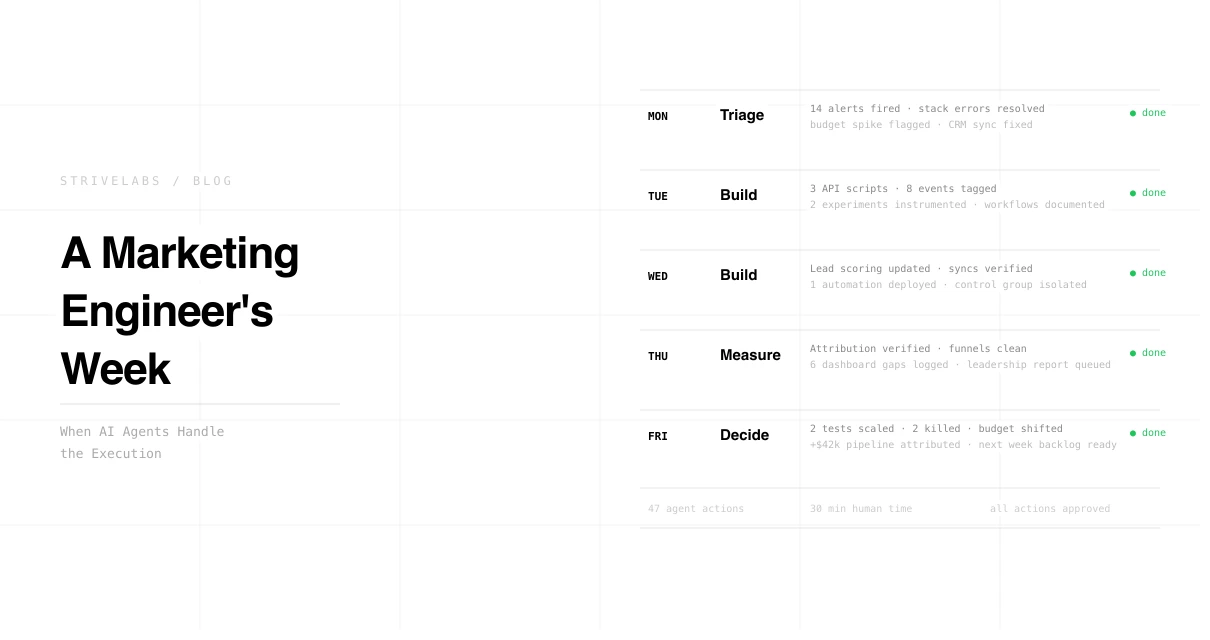
A marketing engineer's week splits roughly into four modes: triage (Monday), build (Tuesday–Wednesday), measure (Thursday), and decide (Friday). Each mode has specific outputs that compound week over week.
-
The month follows a similar pattern: the first week is reactive (fixing what broke), weeks two and three are generative (building new systems), and the final week is evaluative (closing the attribution loop and reporting to leadership).
-
GTM engineer job postings grew 205% year over year in 2025, and 9 in 10 responsibilities listed also appear in RevOps postings. The role is real, in demand, and increasingly urgent for B2B SaaS teams trying to scale without adding headcount.
-
The daily rhythm of a marketing engineer is not glamorous. It's systematic maintenance punctuated by high-leverage builds. The value compounds over quarters, not days.
-
Strivelabs delivers this entire operating rhythm as managed software, the always-on monitoring, the attribution reporting, the experiment infrastructure, without requiring an internal hire to run it.
The Daily Rhythm
Before mapping the week, here's the baseline daily operating rhythm that repeats regardless of what else is happening:
Morning (first 30 minutes):
- Check overnight sync errors, broken pixels, and budget anomalies across ad accounts
- Review the anomaly queue, anything that fired overnight that needs human triage
- Prioritise the day's work against the sprint backlog
Core hours:
- Build, connect, test, or instrument, whichever mode the sprint week is in
- Respond to requests from paid media, content, and RevOps teams
- Document anything built so it doesn't become a single point of failure
End of day:
- Verify that scheduled syncs ran correctly
- Log any data quality issues with business impact rating
- Update the experiment log with any new results
This baseline repeats every day. What changes is what the core hours contain.
Better decisions start with better infrastructure.
Most mid-market teams pick a channel and hope. Strivelabs gives you the data to know, and the infrastructure to act on it.
Book a Demo →
Day by Day: The Working Week
Monday: Triage and Prioritisation
Monday is reactive by design. The marketing engineer arrives at whatever broke over the weekend, and in a complex stack, something always has.
Specific tasks:
- Pull the overnight error log: failed syncs, pixel fires that dropped below baseline, ad spend anomalies
- Cross-reference GA4, CRM, and ad platform data for discrepancies that emerged since Friday
- Prioritise the triage list by business impact, revenue-affecting bugs first, reporting gaps second, cosmetic issues last
- Align with the paid media and RevOps teams in a 15-minute standup: what's broken, what's the impact, what's the fix timeline
- Update the sprint backlog with anything that emerged over the weekend
Output: a prioritised triage list with business impact ratings. Leadership gets a 5-line summary of what broke and what's being fixed.
What good looks like: the triage list is short because the monitoring layer caught issues before they became crises. Bad Mondays are a signal that the always-on layer needs improvement.
Tuesday and Wednesday: Build Days
Tuesday and Wednesday are the core build days. Interruptions are kept to a minimum. This is where the compounding value of the role gets created.
Specific tasks:
- Build the campaign logic and tracking instrumentation for the week's experiments
- Set up API scripts and data connections for any new integrations in the sprint
- Tag event tracking for the backend of experiments, ensuring every variant is instrumented correctly before it goes live
- Build reusable workflow templates wherever a process is likely to repeat
- Write documentation for everything built, not optional, not post-sprint, done as part of the build
Output: working integrations, instrumented experiments, documented workflows. Nothing leaves the build days undocumented, if the marketing engineer leaves the role, the systems should still work.
What good looks like: reusable components that reduce future build time. A system built on Tuesday should not require the engineer's attention again for routine operation.
Thursday: Measurement and Attribution
Thursday is the verification day. The marketing engineer checks whether the data produced by Tuesday and Wednesday's builds actually reflects reality.
Specific tasks:
- Update leadership dashboards with the week's performance data
- Cross-check sales funnel data against CRM records, verifying that what the dashboard shows matches what sales is actually experiencing
- Audit experiment data for time zone errors, double-counted leads, and attribution mismatches
- Verify that test group data is clean and separated from control group data
- Produce a gaps list, every discrepancy between GA4, CRM, and ad platform data, with a root cause and a fix plan
Output: a dashboard that tells the truth. Every number on it has been verified. Every discrepancy has a logged explanation.
What good looks like: leadership can trust the Thursday report without asking "is this number right?" If they're still asking that question, the Thursday verification process isn't working.
For teams building full marketing attribution infrastructure, Thursday is when the attribution models get validated, connecting campaign spend to pipeline outcomes in a way the CFO can defend.
Friday: Experimentation and Decisions
Friday is evidence day. Tests get reviewed, winners get scaled, losers get killed.
Specific tasks:
- Review the week's experiment results against the pre-defined hypotheses
- Apply a permanent rule to any experiment that proved its value, automation should make the winning behaviour the default
- Add new experiment ideas to the backlog with a hypothesis, expected impact, and required sample size
- Prepare the weekly brief for the Head of Marketing: what ran, what moved, what the recommendation is
Output: a decision memo, which experiments moved the needle, which get scaled, which get killed. Budget allocation shifts based on evidence, not instinct or platform recommendations.
What good looks like: every budget shift on Friday is backed by a tested hypothesis. No money moves because of a gut feeling or a platform-generated recommendation without supporting data.
Week by Week: The Monthly Rhythm
The four weeks of a month each have a distinct character. Understanding this rhythm is what separates a marketing engineer who compounds value from one who just reacts to fires.
Week 1: Reactive Week
The first week of the month is dominated by close-out work from the previous month and early triage of what the new month needs.
- Close the previous month's attribution model, final pipeline report, verified numbers, gaps documented
- Audit the stack for anything that degraded in the final days of the previous month
- Align with the Head of Marketing on the month's experiment agenda and priority builds
- Set baseline KPIs for the month against which all experiments will be measured
Output: a clean close of last month, a clear agenda for this month.
Week 2: Build Week
The primary infrastructure build for the month happens in week two. New integrations, new experiment setups, new automation logic.
- Deploy the month's primary experiment, tagged, instrumented, control group isolated
- Build any new integrations or data connections prioritised in the week one alignment
- Connect the marketing engineer tech stack layers that need updating, attribution models, audience syncs, warehouse pipelines
Output: new systems live, instrumented, and documented. The experiment is running against a clean baseline.
Week 3: Iteration Week
Week three is where the month's first experiment results start to surface and early adjustments get made.
- Review early experiment signals, not final results, but leading indicators that suggest directional outcomes
- Adjust audience targeting, bidding logic, or content variants based on early data
- Add internal links and content updates surfaced by the SEO agent monitoring layer
- Prepare mid-month reporting for the Head of Marketing
Output: informed adjustments to running experiments. The mid-month report shows what's working, what isn't, and what the team is doing about it.
For teams running marketing experimentation as infrastructure, week three is when the experiment queue for the following month gets populated, hypotheses, expected impact, and required instrumentation.
Week 4: Evaluation and Close
The final week of the month is about closing the loop, evaluating what worked, documenting what was learned, and preparing the evidence for the next month's investment decisions.
- Close the month's primary experiment with a final results report: hypothesis, treatment, control, lift, pipeline impact
- Run the month-end attribution close, connecting campaign spend to closed revenue for the month
- Prepare the leadership report: marketing-sourced pipeline, experiment results, CAC trend, and attribution confidence
- Brief the Head of Marketing on next month's experiment agenda based on this month's learnings
Output: a month-end report that tells the full story, what was built, what was tested, what moved the pipeline, and what the team will do differently next month.
This is the output that connects the marketing engineer's work to closed loop marketing, every campaign decision next month is informed by this month's closed revenue data.
What Changes Quarter by Quarter
Beyond the weekly and monthly rhythm, the marketing engineer's work shifts in character across a quarter:
Month 1: Foundation — audit the existing stack, fix the attribution model, instrument the first clean experiment baseline
Month 2: Velocity — the stack is stable, experiments are running, the team is acting on data rather than instinct
Month 3: Compounding — experiment results feed next month's hypotheses, budget allocation shifts to proven channels, the attribution model is trusted by leadership
By month three of a well-executed quarter, the Head of Marketing is presenting pipeline attribution data to the CFO with confidence. That's the compounding output of a marketing engineer working at full capacity.
What Strivelabs Delivers Instead
Strivelabs is the marketing engineer for your team, running the daily, weekly, and monthly rhythm as managed software.
The Monday morning triage, the Thursday attribution verification, the Friday experiment review, the month-end pipeline report, all of it runs automatically, routes to the right person with a specific recommendation, and requires your approval before anything executes.
Most teams are operational within a single onboarding meeting. The always-on monitoring layer is live on day one. The attribution model is connected within the first week. The first experiment report arrives at the end of the first month.
The marketing engineer function, delivered as software.
See how Strivelabs gives mid-market teams the operational capacity without the hiring cost.
Explore Strivelabs →
Frequently Asked Questions (FAQs)
How much of a marketing engineer's week is reactive vs proactive?
In a well-run setup, Monday is reactive (triage and fix), Tuesday through Wednesday is proactive (build), Thursday is verification, and Friday is evaluation. That's roughly 20% reactive and 80% proactive. In a poorly instrumented stack, those ratios flip, Monday through Wednesday disappear into firefighting and the builds never happen. The quality of the always-on monitoring layer determines which pattern dominates.
What does a marketing engineer actually own vs influence?
The marketing engineer owns stack integration, attribution fidelity, audience targeting infrastructure, campaign velocity systems, and data quality. They influence experiment design, budget allocation recommendations, and content prioritisation, but the final decisions on those sit with the Head of Marketing. The line is: engineers own the systems, marketers own the strategy.
How long before a new marketing engineer produces measurable output?
First week: the monitoring layer is audited and the worst data quality issues are documented. First month: the attribution model is clean enough to trust. Month two: the first experiment produces a result that changes a budget decision. Month three: the compounding effect starts, each experiment informs the next, and the attribution model is being used to defend budget allocation to the CFO. Teams that see a longer ramp almost always have a data quality problem that the engineer is spending the first months cleaning rather than building.
How does the marketing engineer's rhythm change as the company scales?
At under $5M ARR, the marketing engineer is largely solo, building everything from scratch, setting the instrumentation baseline, running experiments manually. At $5M–$50M, the role becomes more supervisory, the engineer designs systems that marketing ops manages, and agents handle the routine monitoring. Above $50M, the role splits: one person owns infrastructure and governance, another owns experiment velocity and attribution. GTM engineer postings grew 205% year over year in 2025, the role is scaling faster than most teams are prepared for.
What does a marketing engineer do that Strivelabs automates?
The monitoring layer (daily triage), the audience sync verification (daily), the attribution model updates (weekly), the experiment instrumentation (weekly build), and the month-end pipeline report (monthly). The things Strivelabs doesn't replace: architectural decisions about which systems to connect, experiment hypothesis design, and the strategic judgment about which results to scale. Those stay with the human. Everything else runs automatically.