
Marketing ROI Metrics: The Agentic Marketing Guide
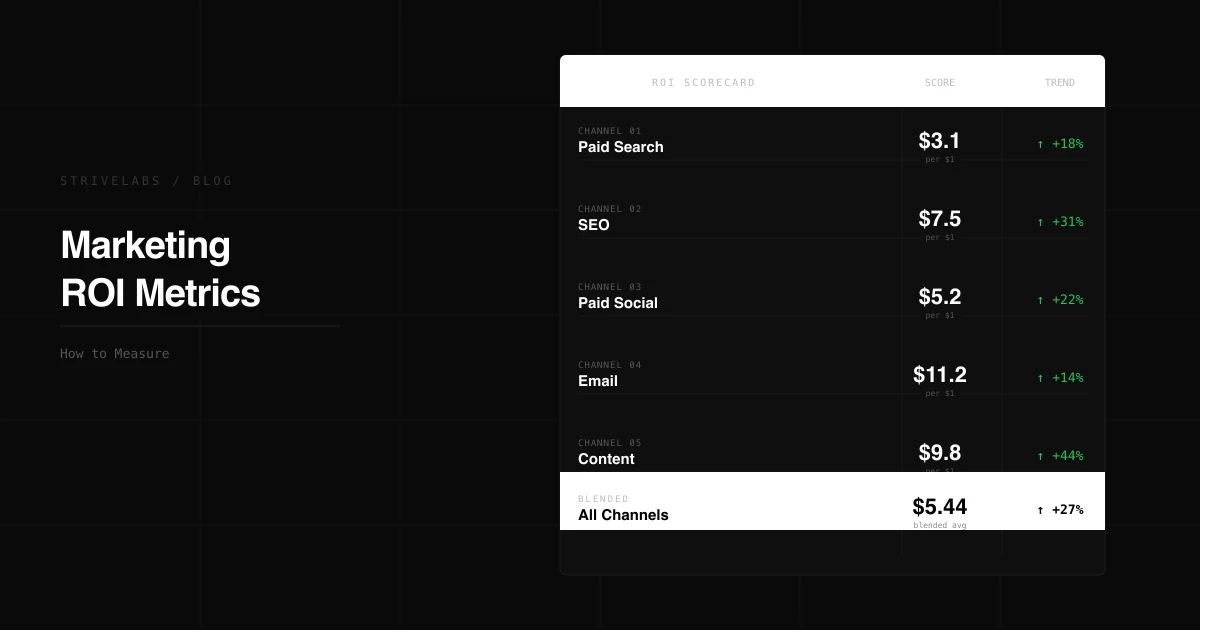
Most marketing teams measuring agentic marketing ROI are asking the wrong question. They want to know what the agent produced. The right question is what the agent changed, how fast decisions happened, what waste was prevented, and which pipeline the cross-channel attribution loop finally closed.
Standard marketing measurement was built for manual operations. It measures outputs, clicks, conversions, pipeline influences, after they happen. Agentic marketing produces a different category of value: velocity gains that compound over time, waste prevention that shows up as avoided cost, and cross-channel attribution that was previously impossible to connect. Measuring it correctly requires three metric categories that did not exist before the agent was running.
83% of executives expect AI agents to improve process efficiency and output by 2026, and 71% believe agents will autonomously adapt to changing workflows, according to the IBM Institute for Business Value study of 2,900 executives globally. For marketing teams, that efficiency improvement does not show up in standard dashboards. It shows up in how fast a budget decision gets made, how quickly a decaying post gets refreshed, and how many experiments run in a week instead of a month. Measuring those outcomes requires a different framework, not a retrofit of the reports you were already building.
This post gives you the three metric categories, the CFO formula, and the specific benchmarks to take into a leadership meeting this week.
At a Glance
-
Standard marketing ROI measurement, CAC, LTV, pipeline influenced, captures what happened. Agentic marketing ROI measurement captures how fast it happened, what was prevented, and which channels actually drove revenue.
-
Three metric categories define agentic marketing ROI: velocity metrics, counterfactual metrics, and cross-channel attribution metrics.
-
Average marketers recover 6.1 hours per week using AI workflows, senior practitioners save 8-10 hours, according to HubSpot AI Trends 2026. Time recovered is a measurable financial input to the ROI calculation, not a soft benefit.
-
The CFO formula: attributable revenue + operational savings + avoided waste + recovered time, divided by agent cost. This turns agentic marketing output into a boardroom number.
-
Human approval stays at every step, every agent action is logged with who approved it and what changed, giving the audit trail the finance team needs.
Why Measuring Marketing ROI Metrics Is Still Broken in 2026
Measuring and proving marketing ROI remains the top concern across B2B SaaS marketing yet most teams lack the technical setup to track multi-touch attribution, with marketing budgets flatlined at 7.7% of company revenue for the second consecutive year. The measurement breakdown happens in three specific places:
Siloed data
Revenue signals sit locked in HubSpot, GA4, Google Ads and Search Console separately. Without a system that connects them, attribution is always incomplete. A deal closes in HubSpot but the marketing touchpoints that contributed to it are spread across four platforms that have never been joined at the contact level.
Lag
Analytics run on weekly or monthly cycles. By the time a performance drop surfaces in a standard report, it has been compounding for days. Standard ROI measurement tells you what happened. It does not tell you how much faster it would have happened with better data.
Vanity metrics
Lead counts, click volumes, impression share, these metrics were designed for campaign reporting, not for measuring whether an agentic system is delivering value. When an agent is making budget decisions and refreshing content automatically, the metrics that matter are different: how fast did it act, what did it prevent, and what did it close.
Agentic marketing fixes all three, but only if you measure the right things from the start.
Better decisions start with better infrastructure.
Most mid-market teams pick a channel and hope. Strivelabs gives you the data to know, and the infrastructure to act on it.
Book a Demo →
What Changes About Marketing ROI Metrics When an Agent Runs
The Agentic Marketing Engine changes the measurement landscape in four specific ways:
Faster feedback loops
More experiments running simultaneously means decisions happen in days rather than weeks. The ROI of speed is measurable, every day a wrong budget allocation runs is a day of wasted spend. The agent catches it faster.
Higher experiment volume
34% of enterprise marketing teams now run at least one autonomous agent in production, more than double the 14% reported just six months ago. The teams running agents are running more tests. Experiment velocity is the primary leading indicator of future performance improvement.
New categories of measurable value
Saved time, avoided waste, and prevented negative touches are real financial values. Standard marketing measurement ignores them. Agentic marketing measurement counts them explicitly.
Complete audit trails
Every action the Strivelabs agent takes is logged, what signal fired, what action was recommended, who approved it, what happened after execution. This is the audit trail the CFO needs to trust the numbers.
The Three Metric Categories Agentic Marketing Introduces
Three categories define agentic marketing ROI. Each one answers a different question for the leadership team.
| Metric category | Primary KPIs | CFO question answered |
|---|---|---|
| Velocity metrics | Experiments per week, signal to action time, report build time | How fast are insights turning into revenue actions? |
| Counterfactual metrics | Budget waste prevented, pipeline recovered, negative touches avoided | Did the agent cause a real improvement beyond the baseline? |
| Cross-channel attribution | Pipeline capture rate, multi-touch crediting, time to closed revenue | Which specific actions drove revenue and when does it pay back? |
Velocity Metrics — How Fast Your Marketing Actually Moves
Velocity measures the pace of progress. In agentic marketing, this means how quickly a signal becomes a live test and how quickly that test produces a learnable outcome.
Experiments per week
How many unique tests does the agent run based on the rules you set? A lean B2B SaaS marketing team running manual ops typically runs 1-2 tests per month. With an agent running within defined guardrails, 8-10 per week is achievable. Everstage runs 4x more experiments per quarter using Strivelabs. That is the velocity benchmark.
Signal to action time
The clock between when a pattern is detected and when an action is approved and executed. A CTR drop detected on Monday that surfaces in a Friday report has a signal-to-action time of 4-5 days. With the Strivelabs agent, that time drops to under 24 hours. In a 90-day B2B SaaS sales cycle, each day of delay compounds.
Report build time
How long does the weekly performance report take to produce? For most teams the answer is 3-4 hours of manual data pulling and formatting. With the agent building the report automatically, that time drops to 20-30 minutes of review. At a fully-loaded hourly cost of $75, recovering 3 hours per week per marketer is $11,700 per year per person in recovered capacity.
How to measure it
Track the baseline before the agent runs for the first 30 days. Then compare week-by-week after activation. Velocity improvements are visible within the first two weeks, they are the fastest and most defensible metric to show a leadership team.
Counterfactual Metrics — What the Agent Saved You From
Counterfactuals show the value the agent created compared to a world where it did not exist. This is the hardest category to measure, and the most financially significant.
Budget waste prevented
When a contact moves to Opportunity in HubSpot, the AI agent for CRM queues awareness ad suppression before the next impression fires. For a team spending $15k per month on LinkedIn and Google Ads combined, suppressing in-pipeline contacts from awareness targeting typically recovers 8-15% of spend. At $15k per month, that is $1,200-$2,250 per month in prevented waste, $14,400-$27,000 per year.
Pipeline attribution recovered
A content post that was generating $45k in attributed pipeline per quarter begins losing impressions on its primary keyword. The AI content agent detects the decay, generates a refresh brief, and the post is updated before it falls off page one. The pipeline attribution is maintained rather than lost. That is a counterfactual value, the $45k per quarter that would have disappeared without the intervention.
Negative touches avoided
A contact in active commercial discussion with the sales team continues to receive awareness emails from a nurture sequence that did not update when the deal stage changed. Every irrelevant email in that sequence is a negative touch, it creates dissonance in the buying experience. The agent prevents them. Measuring the conversion rate difference between contacts who receive appropriate vs inappropriate marketing during active sales cycles quantifies this value.
How to measure it
Set up holdout groups for the first 60 days, a portion of your audience where the agent does not run. The performance gap between the agent-managed group and the holdout group is your counterfactual lift. Even a 10% holdout over 60 days gives you statistically defensible numbers for the leadership meeting.
Cross-Channel Attribution — The Marketing ROI Metric That Closes the Loop
This is the metric category that has been missing from B2B SaaS marketing measurement for the entire existence of multi-channel marketing. Standard attribution tools measure each channel separately. The Agentic Marketing Engine measures them together, and traces the full path from first touch to closed revenue.
With roughly 80% of the B2B buying journey happening before a buyer enters the sales pipeline and an average of 88 touchpoints along the way, traditional last-touch attribution misses most of the picture.
Full pipeline attribution rate
What percentage of closed deals have a clear, complete marketing attribution path from first touch to close? Most teams with manual attribution can account for 50-60% of deals. Teams with connected CRM and paid data running through the Strivelabs agent typically reach 80%+ pipeline attribution completeness within one full sales cycle. The missing 20-40% is not untouched by marketing, it is untraceable by manual methods.
Multi-touch crediting
Which specific agent actions, budget reallocation, content refresh, audience suppression, appear in the attribution path of closed-won deals? This requires the agent's audit trail to be connected to HubSpot deal records. When it is, the attribution model shifts from "which channel gets the last click" to "which specific automated decisions appeared in our winning deals."
Time to revenue after an agent action
How long between a specific agent action, a content refresh, a budget shift, an audience update, and a measurable impact on pipeline? This is the payback period at the action level, not the campaign level. For paid media changes, the window is typically 1-2 weeks. For content refreshes, one full sales cycle. Tracking this by action type builds a predictive model of which agent decisions deliver fastest.
The Marketing Attribution post covers how to build the multi-touch attribution model correctly for a B2B SaaS sales cycle. The Closed Loop Marketing post covers the five-layer architecture that connects spend to closed revenue automatically.
The Agentic Marketing Engine Dashboard — What Good Looks Like
A working agentic marketing ROI dashboard has four views. Each one corresponds to one of the metric categories above plus the CFO formula.
Velocity view
Weekly experiment count, average signal-to-action time, report build time this week vs baseline. Updated automatically. No manual assembly.
Counterfactual view
Budget waste prevented this month, pipeline attribution maintained vs projected loss, negative touches avoided. Requires the holdout group to be running for the first 60 days to populate accurately.
Attribution view
Pipeline attribution completeness rate, closed-won deals with full attribution paths, top-performing agent actions by revenue contribution. Requires HubSpot deal data connected to agent action logs.
CFO formula view
Attributable revenue from agent actions
+ Operational savings (time recovered × hourly cost)
+ Avoided waste (budget suppression + decay prevention)
─────────────────────────────────────────────────────
Agent cost

Example — 2-person marketing team:
Pipeline from refreshed content:      $180,000
Budget waste prevented:                $24,000/yr
Time recovered (8hrs/wk × 2 × $75):   $62,400/yr
─────────────────────────────────────────────────────
Total value:                          $266,400
Strivelabs cost:                       $[X]
ROI:                     ($266,400 - X) / X × 100
This calculation is the most shareable element in the post. A CFO who sees this formula with your specific numbers filled in will forward it to the Head of Marketing as the basis for the next budget conversation.
How to Set Marketing ROI Benchmarks for Agentic Workflows
Realistic benchmarks for a B2B SaaS team in the first 90 days:
| Metric | Baseline (manual) | 30-day target | 90-day target |
|---|---|---|---|
| Experiments per week | 1-2 | 5-6 | 8-10 |
| Signal to action time | 72-120 hours | 48 hours | Under 24 hours |
| Report build time | 3-4 hours | 1 hour | 20-30 minutes |
| Pipeline attribution completeness | 55-65% | 65-70% | 80%+ |
| Budget waste (in-pipeline ad spend) | Baseline measured | 5% reduction | 10-15% reduction |
Only 6% of organisations qualify as AI high performers, those where AI contributes 5%+ of EBIT, and what separates them is not better tools but better measurement, according to McKinsey's State of AI 2025. Teams that build the measurement framework before they scale the agent join that 6%. Teams that retrofit it afterward spend months arguing about which numbers to trust.
How Strivelabs Measures ROI Across Paid, SEO and CRM
Strivelabs surfaces all three metric categories automatically from the connected data sources, Google Ads, LinkedIn Ads, HubSpot, Search Console and GA4.
Velocity metrics are tracked automatically, weekly experiment counts, signal-to-action timestamps, report build time compared to the 30-day baseline established at connection.
Counterfactual metrics are calculated from the agent's action log, every budget suppression, every content refresh brief, every audience update, with the pipeline attribution impact mapped from HubSpot deal records. The holdout group comparison is built into the first 60-day pilot framework.
Cross-channel attribution is built from the agent's audit trail connected to HubSpot closed-won deal records. Every agent action that appeared as a touchpoint in a winning deal is credited and surfaced in the weekly attribution report.
The weekly agentic ROI report, velocity trends, incremental pipeline, attribution completeness, CFO formula with current numbers, is built automatically and ready for review every Monday morning. Not assembled by the marketer. Reviewed by them.
Everstage's 4x experiment velocity, Spendflo's 3x content output, Obbserv's days of work recovered monthly, these are the benchmarks the measurement framework is designed to capture and replicate.
The marketing engineer function, delivered as software.
See how Strivelabs gives mid-market teams the operational capacity without the hiring cost.
Explore Strivelabs →
Frequently Asked Questions (FAQs)
What is a good marketing ROI for a B2B SaaS company?
Most B2B SaaS firms target a marketing ROI between 5:1 and 8:1, with top performers achieving CAC payback under 80 days and a 4:1 LTV:CAC ratio. Agentic marketing improves those numbers through three mechanisms: faster experiment velocity, waste prevention through real-time audience management, and attribution completeness that shows which channels are actually generating revenue.
How fast can you see ROI from agentic marketing?
Velocity gains, more experiments, faster reports, reduced signal-to-action time, are visible within the first two weeks. Budget waste prevention shows up within the first month. Pipeline attribution improvement requires one full sales cycle, typically 60-90 days for B2B SaaS. Financial impact on CAC payback typically becomes measurable at the 90-day mark.
What is the difference between agentic AI and generative AI for marketing ROI?
Generative AI saves time on asset creation, copy, images, briefs. The ROI is measured in hours recovered. Agentic AI changes how decisions are made and executed across channels. The ROI is measured in velocity, waste prevention and attribution completeness. The financial scale is different, generative AI saves hours, agentic marketing changes pipeline outcomes.
How do holdout tests prove agentic marketing ROI?
A holdout group, typically 10-20% of your audience where the agent does not run, creates a clean baseline. The performance gap between the agent-managed group and the holdout group shows the incremental lift attributable specifically to the agent's actions. Run holdouts for the first 60 days and the counterfactual evidence is statistically defensible.
Can agentic marketing deliver ROI without perfectly unified data?
Yes. Starting with three connected sources, HubSpot, GA4 and Google Ads deliver measurable velocity and waste prevention value immediately. Attribution completeness improves as more sources are connected. Strivelabs connects all sources via OAuth in under five minutes. Most teams start with HubSpot and paid media and add Search Console in the first week.
Related Posts

What Is Creative Fatigue and How to Detect It Before It Costs You
Creative fatigue costs 35% CTR before dashboards catch it. Here are the frequency thresholds and leading indicators for Google, LinkedIn and Meta that let you act before the damage compounds.

How to Build a Negative Keyword List That Stops Wasting Budget
Most Google Ads accounts waste 15 to 25% of budget on irrelevant searches. Here is the eight-category B2B SaaS negative keyword framework and the weekly review process that keeps it compounding.

8 AI Search Visibility Mistakes B2B Teams Are Making Right Now
96% of B2B companies are invisible in AI search. Here are the eight structural mistakes causing it and the specific fix for each one a lean team can implement this week.