
Closed Loop Marketing: How to Build the Loop That Ties Spend to Sales

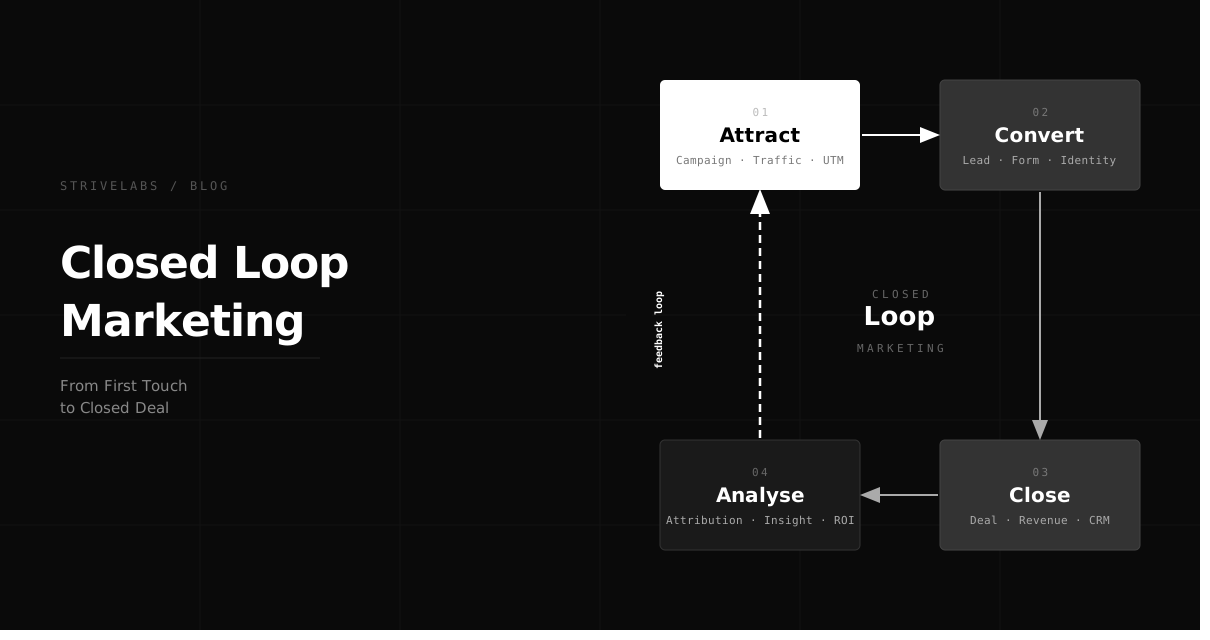
Most marketing teams can tell you how many leads they generated last quarter. Far fewer can tell you which campaigns generated the revenue. That gap between campaign activity and sales outcome is the problem closed loop marketing is built to solve.
This guide is written for all those who need to tie spend to revenue, not just report on impressions and MQLs. It covers a clear definition of closed loop marketing, how the loop operates, which software categories form a working stack, and how to run a pilot in under 90 days. About 80% of marketing leaders entering 2026 cite budget pressure and attribution measurement chaos as their top challenges. This guide addresses both.
Start with one channel, one hypothesis, and one revenue metric. Prove the model. Then scale.
At a Glance
-
Closed loop marketing connects sales outcomes back to marketing campaigns so teams can tie spend directly to revenue, not just lead volume.
-
Only 21% of marketers can accurately tie content to revenue, and that is not a content quality problem, it is an attribution infrastructure problem.
-
A successful implementation runs in four stages: attract, convert, close, and analyse.
-
It requires an integrated stack, CRM, attribution platform, and analytics, to create a unified data pipeline.
-
Closed loop attribution is the only methodology that produces deterministic, audit-grade ROI evidence.
-
Strivelabs delivers this infrastructure for mid-market teams without the implementation overhead of building it internally.
What is Closed Loop Marketing?
Closed loop marketing is a strategy that feeds sales outcome data back into marketing systems so every campaign decision is informed by what actually generated revenue. It closes the feedback loop between the marketing team that drives demand and the sales team that converts it.
The core value is simple: instead of optimising for leads, you optimise for revenue. Instead of asking which campaign got the most clicks, you ask which campaign produced customers.
The loop runs in four stages:
-
Attract - drive traffic and tag every session with source, medium, and campaign parameters
-
Convert - capture lead identity and associate it to the originating touchpoint at conversion
-
Close - record the deal outcome in CRM and link it back to the lead's marketing source
-
Analyse - surface which campaigns produced closed revenue and feed that insight back into budget decisions
How Does Closed Loop Marketing Work?
The mechanism is a data pipeline that persists identity from first touch to closed deal.
-
Track touchpoints at session level - every page visit, ad click, and form fill gets tagged with UTM parameters. GA4, server-side tracking, or a CDP handles this layer.
-
Capture identity at conversion - when a visitor fills a form, session data gets associated with a named lead record and UTM parameters are written to CRM source fields.
-
Persist identity through the sales cycle - as the lead moves through pipeline stages, the original marketing source stays attached. This is where most teams lose the loop, CRM hygiene failures and overwritten fields break the chain.
In practice, this is the core function of a marketing engineer — the person who builds and maintains the data pipeline that keeps source attribution intact from first touch to closed deal.
-
Attribute revenue at close - when a deal closes, revenue is associated with the originating lead source. This produces marketing-sourced revenue as a reportable metric, not an estimate.
-
Feed insight back to campaigns - high-revenue source campaigns get more budget. Low-converting campaigns get paused or restructured. The cycle repeats on a defined cadence.
Your dashboard should show spend, CRM-attributed revenue, ROI, cost per acquisition, and average deal size broken down by channel, campaign, and time period.
Better decisions start with better infrastructure.
Most mid-market teams pick a channel and hope. Strivelabs gives you the data to know, and the infrastructure to act on it.
Book a Demo →
Closed Loop Marketing Software
No single tool delivers closed loop marketing. It is a multi-layer stack where each category handles a specific function: capture, unify, attribute, and action.
When your marketing automation and CRM live in the same ecosystem, tracking leads from first touch to closed deal becomes seamless, the native integration creates closed-loop reporting that standalone tools struggle to achieve.
| Software category | Primary function | When to use |
|---|---|---|
| CRM | Persist lead, pipeline, and revenue data | Always |
| Attribution platform | Multi-touch modelling and channel comparison | When you have 3+ channels |
| CDP | Identity resolution and first-party data unification | When you have cross-device identity gaps |
| Analytics (GA4) | Session-level behavioural tracking | Always |
| Marketing automation | Trigger journeys based on attribution signals | When acting on attribution data in real time |
For a deeper look at how AI marketing platforms handle attribution, orchestration, and reporting as a unified system, see the AI marketing platform guide.
CRM Systems
The CRM is the revenue record. Without a properly configured CRM, the loop cannot close, you have attribution data at the top and revenue data at the bottom with nothing connecting them.
Key capabilities to require:
-
Deal stage tracking with revenue values at every stage
-
Custom source fields that cannot be overwritten by later touchpoints
-
API access for bidirectional sync with attribution and analytics tools
-
Offline conversion logging for deals that close via phone or in-person
Attribution and Analytics Platforms
Attribution platforms model which touchpoints deserve credit for a conversion. Multi-touch attribution assigns fractional credit across all touchpoints, best for complex, multi-channel funnels. Last-touch attribution credits the final touchpoint before conversion, simple but systematically undersells awareness channels. Algorithmic attribution uses machine learning to weight touchpoints based on observed patterns, most accurate but requires significant data volume.
Use a specialist attribution platform when you need cross-channel model comparison. Use GA4's built-in attribution when your funnel is primarily digital and your data volume is modest.
Data Warehouses and CDPs
The warehouse is where identity resolution happens at scale. A CDP unifies first-party behavioural data with CRM records to produce a single customer profile across devices and sessions.
For mid-market teams, a full CDP is often overkill in the first 90 days. Start with CRM, GA4, and one ad platform properly connected. Add warehouse and CDP infrastructure once the basic loop is proven.
Measurement and KPIs for Closed Loop Marketing
The KPIs that matter connect campaign activity to revenue outcomes, not vanity metrics like impressions or clicks.
Metrics most linked to revenue growth include customer acquisition cost, customer lifetime value, lead-to-close conversion rate, and marketing-attributed revenue.
If you're still deciding whether an AI-driven stack justifies the investment over traditional methods, the ai vs traditional marketing breakdown covers the ROI comparison directly.
Primary KPIs to Track
-
Marketing-sourced revenue - total closed revenue that originated from a marketing touchpoint. The primary lagging indicator.
-
Marketing-influenced revenue - revenue where marketing touched the account at any point in the cycle. Important for enterprise sales where marketing supports rather than source deals.
-
MQL to SQL conversion rate - the percentage of marketing qualified leads that sales accepts. A low rate signals poor targeting or misaligned qualification criteria.
-
CAC by channel - total spend divided by new customers acquired, broken down by channel. This tells you where to invest more and where to cut.
-
LTV:CAC ratio - whether the customers marketing acquires are worth what it costs to acquire them. A ratio below 3:1 signals a structural problem.
Reporting and Attribution Models
Present all attribution models in leadership reviews and explain the differences. Hiding model uncertainty erodes trust faster than acknowledging it.
-
Single-touch models are easy to explain but systematically wrong in multi-channel funnels. Use as sanity checks, not primary models.
-
Linear multi-touch distributes credit equally across all touchpoints. Fair but blunt.
-
Time-decay multi-touch weights recent touchpoints more heavily. Better for short sales cycles.
Report attribution coverage alongside attribution numbers. A marketing-attributed revenue figure with 60% coverage is meaningfully different from one with 95% coverage.
Technical Architecture and Data Flows
A closed loop marketing architecture runs in five layers:
Capture → Unify → Store → Attribute → Surface
-
Capture - server-side tracking captures events with consistent schema. UTM parameters persist through redirects.
-
Unify - identity resolution stitches anonymous sessions to named leads at conversion using deterministic keys (email, phone) with probabilistic fallback.
-
Store - a central warehouse holds the unified event history as the single source of truth.
-
Attribute - attribution models run against unified event history and results are written back to CRM source fields.
-
Surface - dashboards and automated alerts make attribution data actionable for campaign managers and leadership.
First-Party Data Sources
-
CRM - lead source, pipeline stage, deal value, close date
-
GA4 - session-level behavioural data and conversion events
-
Ad platforms - spend, clicks, conversion events by campaign and creative
-
Email platforms - open and click events linked to lead records
-
Call transcripts - deal intelligence that surfaces which messaging resonates through to close
Data quality targets: 95%+ UTM parameter completeness on paid traffic, zero duplicate lead records, conversion events validated on every deployment.
Identity Resolution
Deterministic matching uses exact keys, email address, phone number, to link records with certainty. Always prefer deterministic matching where available. Probabilistic matching uses behavioural signals to infer identity where deterministic keys are absent. Acceptable as fallback only.
Privacy guardrails: consent must be captured before identity data is collected, PII must be encrypted at rest and in transit, and identity graphs must honour deletion requests within regulatory timeframes.
How to Operationalise CLM
Closed loop marketing is not a tool implementation — it is an organisational capability. The technology can be in place and the loop can still fail if ownership is unclear and sales and marketing are working from different definitions.
Roles and Responsibilities
-
Head of Marketing - programme sponsor. Owns the business case and quarterly review cadence with sales and finance.
-
Data owner - responsible for CRM hygiene, UTM governance, and data quality SLAs.
-
Analytics owner - runs attribution models, manages dashboards, and owns experiment analysis.
-
Sales liaison - ensures deal outcome data is recorded consistently in CRM and flags data quality issues from the sales side.
Governance and SLAs
-
Data quality SLA: UTM completeness above 95%, CRM source field coverage above 90%, duplicate record rate below 2%
-
Reconciliation cadence: weekly operational check, monthly strategic review, quarterly model audit
-
Ownership: every data source and every dashboard metric must have a named owner
Change Management
The biggest adoption risk is sales. If reps don't record deal outcomes consistently in CRM, the loop breaks at the most important point. Address this early:
-
Show sales leadership the revenue attribution data, they will care about getting credit for pipeline
-
Build the reporting rhythm into existing sales meetings rather than creating new ones
-
Start with one sales team as a pilot before rolling out to the full organisation
Common Challenges and Solutions
Data Quality Issues
Missing or inconsistent UTM data is the most common failure point. Remediation steps:
-
Audit all paid traffic for UTM completeness monthly
-
Use a UTM governance document that all campaign managers follow
-
Set up GA4 alerts for traffic spikes with no source attribution, these usually signal a broken tracking implementation
Attribution and Long Sales Cycles
For businesses with 6-month-plus sales cycles, waiting for closed revenue to validate a campaign is impractical. Use leading indicators instead:
-
MQL to SQL conversion rate by source as a 30-day proxy for revenue quality
-
Pipeline value by source as a 60-day proxy for revenue volume
-
Run test and control experiments on individual campaigns to measure incrementality independent of the full cycle length
Privacy and Compliance
-
Capture consent before collecting identity data, consent management platform implementation is non-negotiable
-
Minimise PII in your analytics layer, use hashed identifiers where possible
-
Ensure your identity graph can execute deletion requests within 30 days to meet GDPR requirements
How to Build a Pilot Plan
Start small. The goal of the first 90 days is to prove that marketing source data can reliably connect to closed revenue, and not to instrument every channel simultaneously.
Define Your Pilot Hypotheses
Good hypotheses are specific and revenue-connected. Examples:
-
"Leads sourced from paid search close at a 15% higher rate than leads sourced from paid social"
-
"Content-sourced leads have a 30% lower CAC than outbound-sourced leads"
-
"Multi-touch attribution will show that our email nurture programme influences 40% of closed deals even when it is not the last touch"
Set a minimum sample size before the pilot starts, typically 50 closed deals per channel for statistically meaningful comparison.
Pilot Execution Plan
-
Weeks 1 to 2 - audit CRM source field completeness; implement UTM governance; confirm GA4 conversion events
-
Weeks 3 to 4 - connect CRM to attribution platform; validate data match rate; set baseline KPIs
-
Weeks 5 to 8 - run live attribution reporting; hold weekly ops review against baseline
-
Weeks 9 to 12 - close first attribution cycle; compare channel performance against hypothesis; present findings to leadership
Evaluate and Scale
Scale when: attribution coverage exceeds 85%, the revenue story is consistent across two consecutive monthly reviews, and sales leadership trusts the data.
Before scaling: document the data model, write runbooks for the three most common data quality issues, and confirm the analytics owner has capacity to manage a larger programme.
Conclusion
Closed loop marketing turns marketing from a cost centre into a measurable growth function. The teams that implement it correctly stop defending their budget and start directing it — because they can show exactly which spend produced revenue and which did not.
The path is not complicated but it requires discipline: clean data, clear ownership, and a pilot-first approach that proves the model before scaling it. Start with one channel and one hypothesis. Get the CRM integration right. Build the attribution report. Show leadership a number they can trust.
That is the foundation. Everything else compounds from there.
The marketing engineer function, delivered as software.
See how Strivelabs gives mid-market teams the operational capacity without the hiring cost.
Explore Strivelabs →
Frequently Asked Questions (FAQs)
What is the difference between open loop and closed loop marketing?
Open-loop marketing executes campaigns with no data feedback from sales, making ROI measurement impossible beyond proxy metrics. Closed loop marketing integrates sales outcome data to show exactly which campaigns generated revenue. The practical difference is that open-loop teams optimise for activity; closed-loop teams optimise for revenue.
How does closed loop marketing work for a company with a long sales cycle?
For businesses with 6-month-plus sales cycles, closed loop marketing uses leading indicators, MQL to SQL conversion rates, pipeline value by source, and content engagement depth, as proxies for eventual revenue. Multi-touch attribution models connect a closed deal back to the series of touchpoints that occurred over time, so you are not waiting for revenue confirmation to make campaign decisions.
What is a simple example of a closed loop in marketing?
A prospect clicks a LinkedIn ad, downloads a whitepaper, and becomes a lead. Three months later, a sales rep closes the deal. That revenue is automatically credited back to the LinkedIn campaign in your attribution system. The loop is closed: you know the campaign, the spend, and the revenue it produced.
Does closed loop marketing work for B2C companies?
Yes. While common in B2B, it works for any B2C category with a considered purchase, automotive, education, financial services, high-value electronics. It tracks the customer journey from first online interaction to final purchase and attributes the sale to the channels that influenced the decision.
How long does it take to implement closed loop marketing?
A basic loop, CRM connected to GA4 with UTM source fields tracking through to closed deals, can be operational in two to four weeks. A full implementation with multi-touch attribution, warehouse integration, and automated reporting typically takes 60 to 90 days. The 90-day pilot framework in this guide is designed to get a working loop in place before committing to a full infrastructure build.