Clearscope does one job better than almost anything: it grades a draft against what's ranking, and editors trust the score enough to act on it rather than argue with it. At $129 a month, that trust is what you're paying for.
The question worth asking before you switch is whether grading is still the job you need done. Optimising against the current results page is a narrowing target when a growing share of queries get answered above the results entirely.
The seven worth comparing are Strivelabs, Surfer SEO, Rankability, Frase, MarketMuse, NeuronWriter and Dashword.
At a Glance
-
Clearscope starts at $129/mo, roughly double Surfer at $59 and Frase at $49.
-
Judge on cost per outcome, not the monthly bill. The calculation is below and it usually changes the answer.
-
Graders optimise pages. Planners map clusters. Briefing tools speed up outlines. Most teams need two.
-
Term coverage is not the same as extractability. Research suggests statistics and attributed quotes matter more than keyword density for AI citation.
-
Reports rarely port between platforms. Budget time to recreate your best briefs by hand.
When it's time to switch
Four signals, and only one of them is price.
Cost per report exceeds what the page returns. Divide your monthly fee by the number of briefs you actually run. If that figure is higher than the revenue a typical page generates, the maths has stopped working.
You need planning, not just grading. Clearscope optimises drafts. It doesn't tell you which page to write next or which existing page is decaying.
Attribution is missing. Prioritisation needs connections to HubSpot, GA4, Search Console and Google Ads. Without them, writers optimise for whichever metric is visible rather than for pipeline.
Volume outgrew the plan. Seat caps and report limits bite before feature limits do.
One caution. Switching purely on price is the most common mistake here. Cheaper tools frequently create hidden work through missing integrations, and that labour doesn't appear on any invoice. Map your current workflow before comparing anything.
Better decisions start with better infrastructure.
Most mid-market teams pick a channel and hope. Strivelabs gives you the data to know, and the infrastructure to act on it.
The seven alternatives
1. Strivelabs — quoted
Connects Search Console, GA4, Google Ads, HubSpot, LinkedIn Ads and your existing research tools, reads them together, and turns what it finds into work with a named owner and approval enforced by role permission.
The difference from everything else here is where it sits. These tools help you produce a page well. Strivelabs decides which page, from what's actually happening to your traffic and pipeline.
Three things that need more than one system to see: a page losing organic position while you're still paying for traffic to it, a topic gaining impressions with no page behind it, and contacts reading a specific subject before booking a demo. None of those live in a SERP, so no grader can surface them.
It also samples ChatGPT, Gemini, Claude, Perplexity and Google AI Overviews against prompt sets you define, so the same system tells you whether the work is landing in AI answers.
Better than Clearscope at: prioritising by commercial impact, catching decay across a library before it costs a quarter, and connecting content decisions to live ad spend and pipeline data
Falls short on: early-stage sites, since decay detection needs a published library and a few months of Search Console history before there's much to work with
2. Surfer SEO — $59/mo Discovery
The closest like-for-like swap and roughly half the price. Live scoring as you write, topical maps for cluster planning, and internal link suggestions drawn from Search Console. DR 85 with a large user base, so plenty of independent evidence before buying.
Better than Clearscope at: price, keyword research depth, and site-level planning features
Falls short on: grading reliability, where Clearscope's scores carry more editorial trust, and AI writing features cost extra
If Surfer is where you're heading, our Surfer SEO alternatives comparison covers the same ground from that side.
3. Rankability — check current pricing
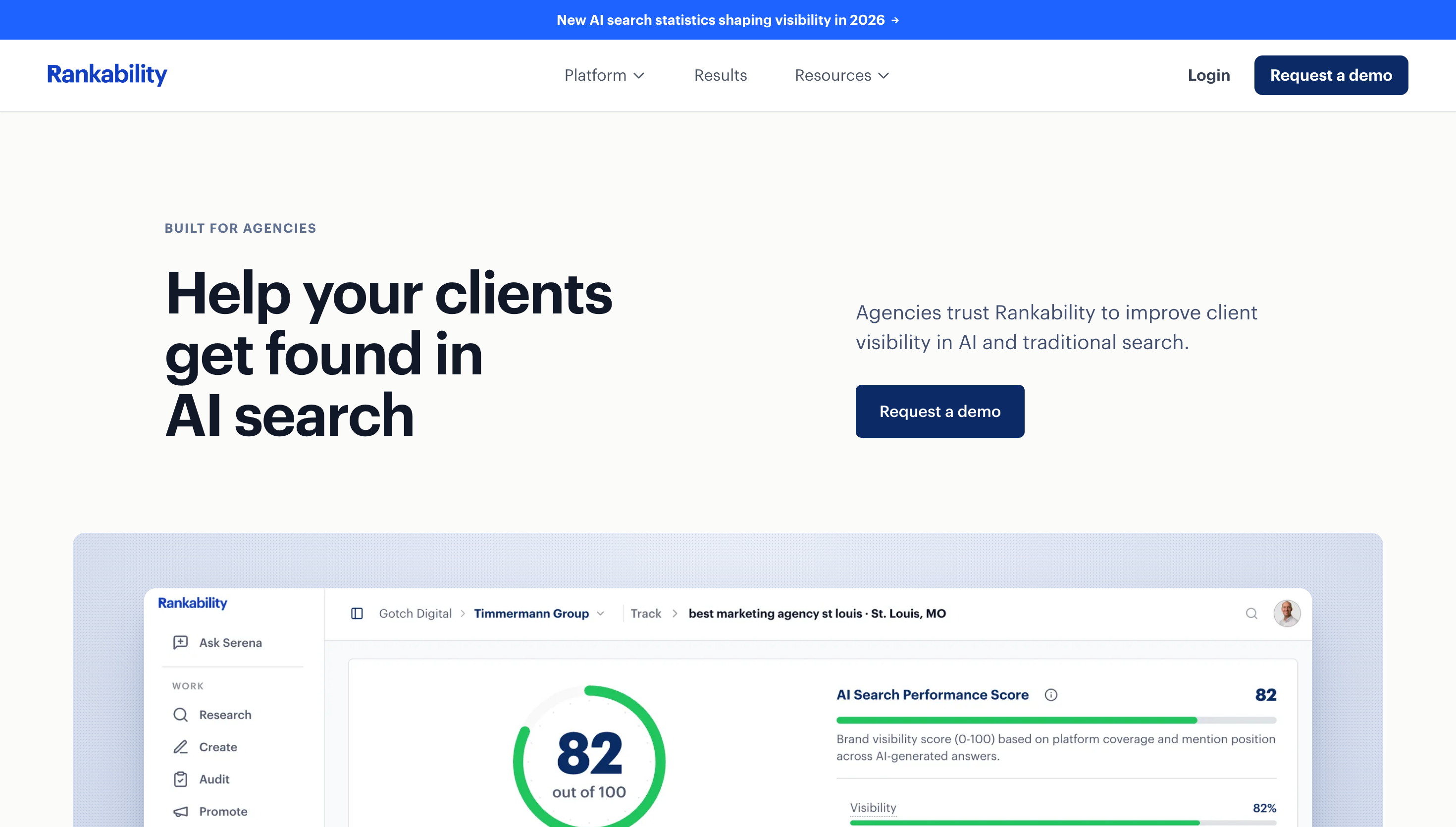
Built around agency workflows: briefs, scoring, client handoffs and white-label reporting across multiple accounts. DR 74 with 34,267 monthly US visits, which is more organic traffic than Clearscope itself.
Better than Clearscope at: managing volume across clients, and reporting exports
Falls short on: relevance if you're a single in-house team, where the multi-account machinery is overhead
4. Frase — $49/mo
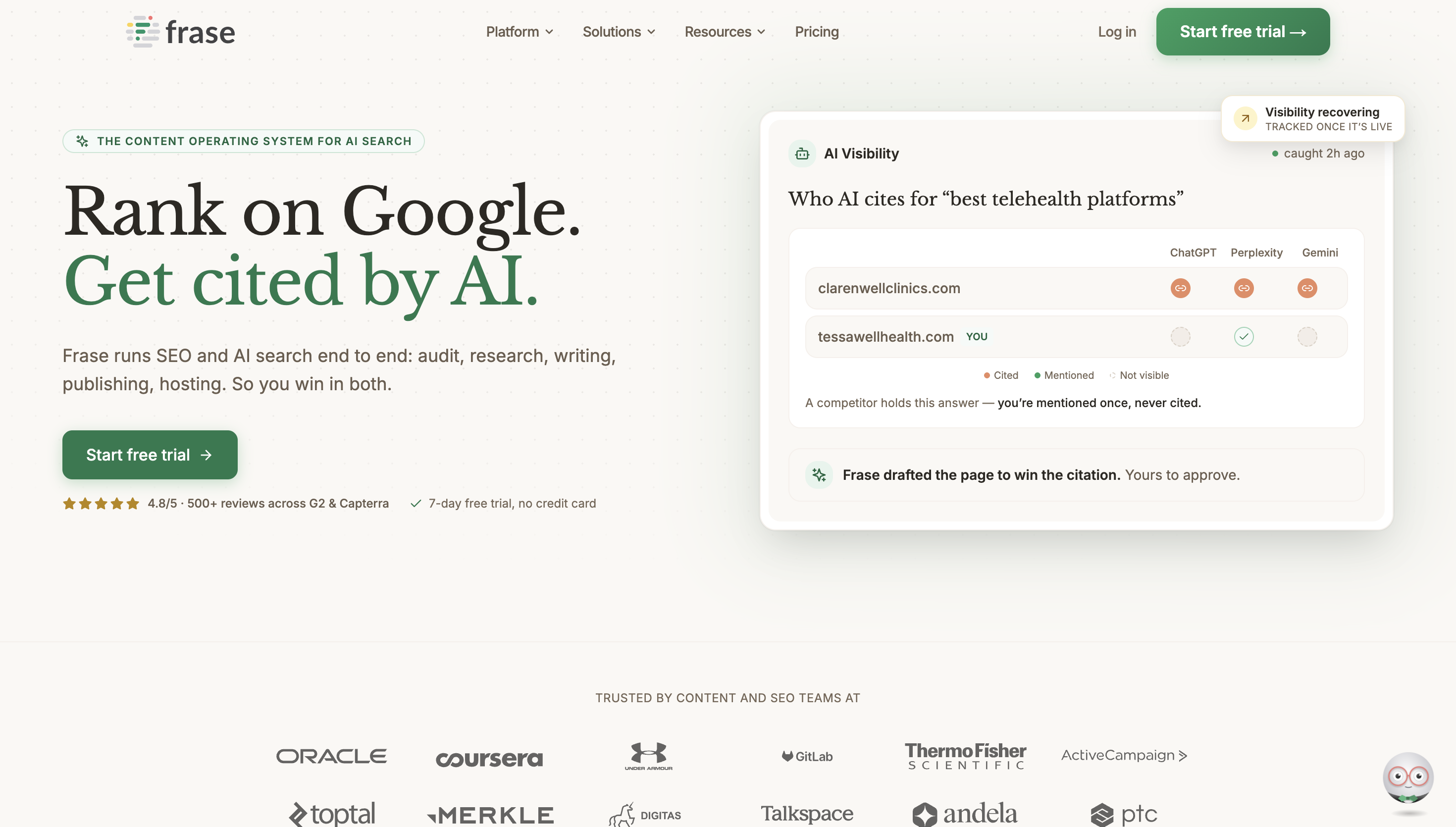
Turns SERP research into a usable brief in minutes, with AI drafting inside the editor. Cheapest credible entry and the fastest from research to first draft.
Better than Clearscope at: speed from research to brief, and entry price
Falls short on: grading depth, and research thins out quickly in specialised niches
We've compared it against the rest of the category in our Frase alternatives piece.
5. MarketMuse — $99/mo Optimize, free tier below
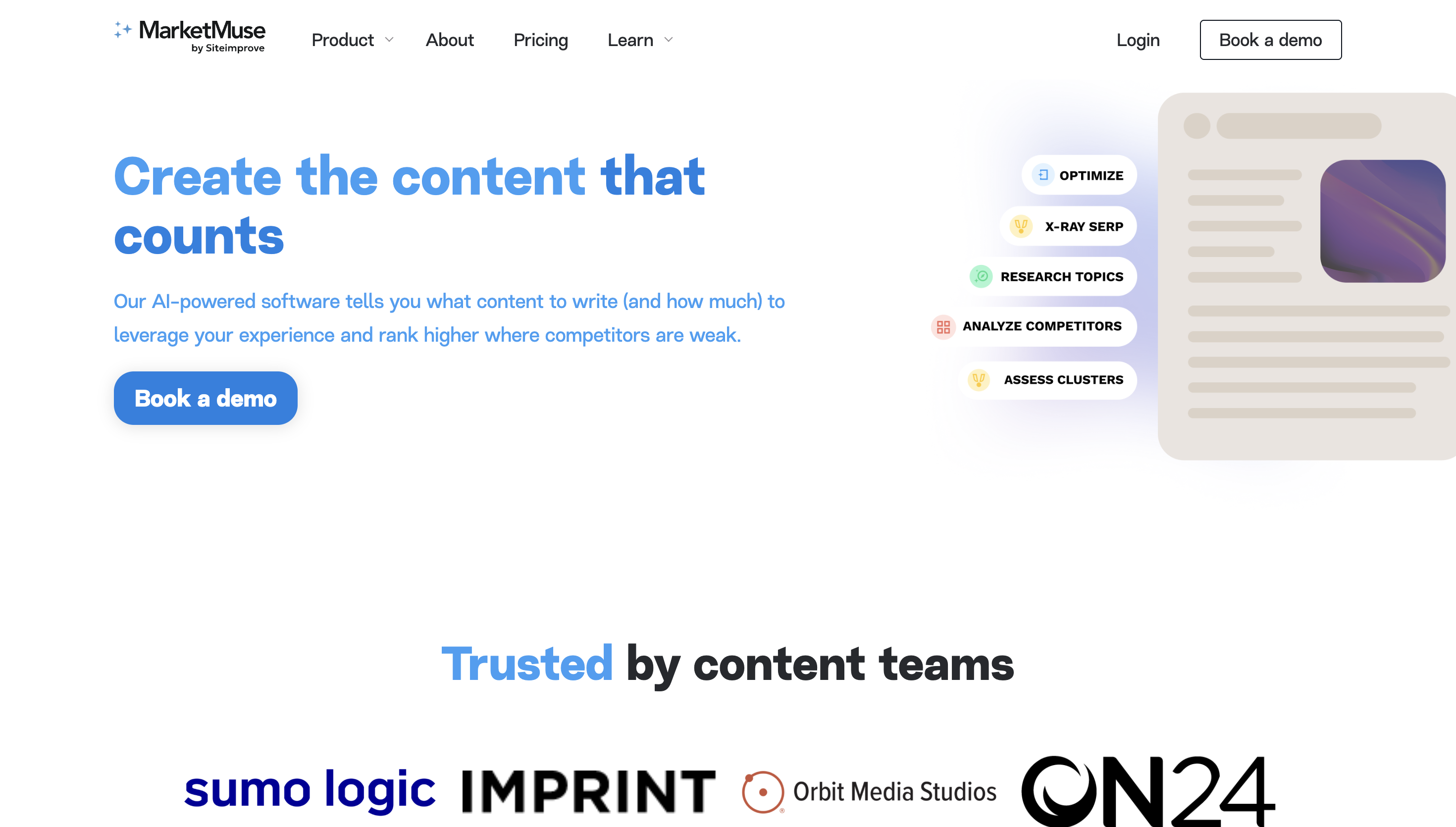
A planning tool rather than a page optimiser, which buyers routinely conflate. Content inventory, topical authority modelling and gap analysis across a whole domain.
Better than Clearscope at: long-horizon planning and finding gaps across a library
Falls short on: the steepest learning curve here, and it won't help you fix a draft this afternoon
6. NeuronWriter — check current pricing
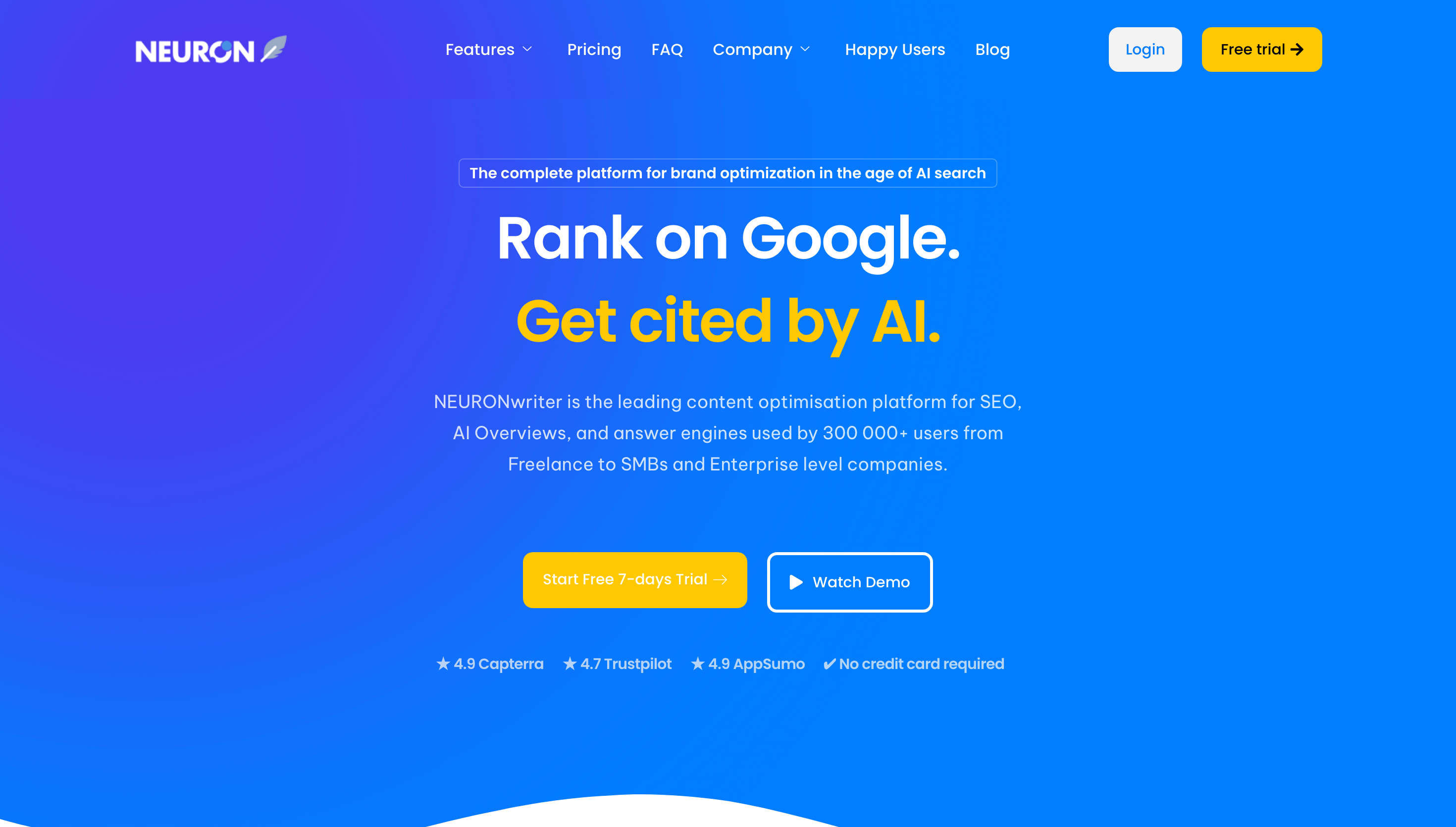
The budget option with genuine NLP recommendations, a basic editor and CMS connections. DR 73 with a substantial backlink profile, so it's an established product rather than a newcomer.
Better than Clearscope at: cost for solo operators and freelancers
Falls short on: interface polish and team features, which is the trade you're making
7. Dashword — check current pricing
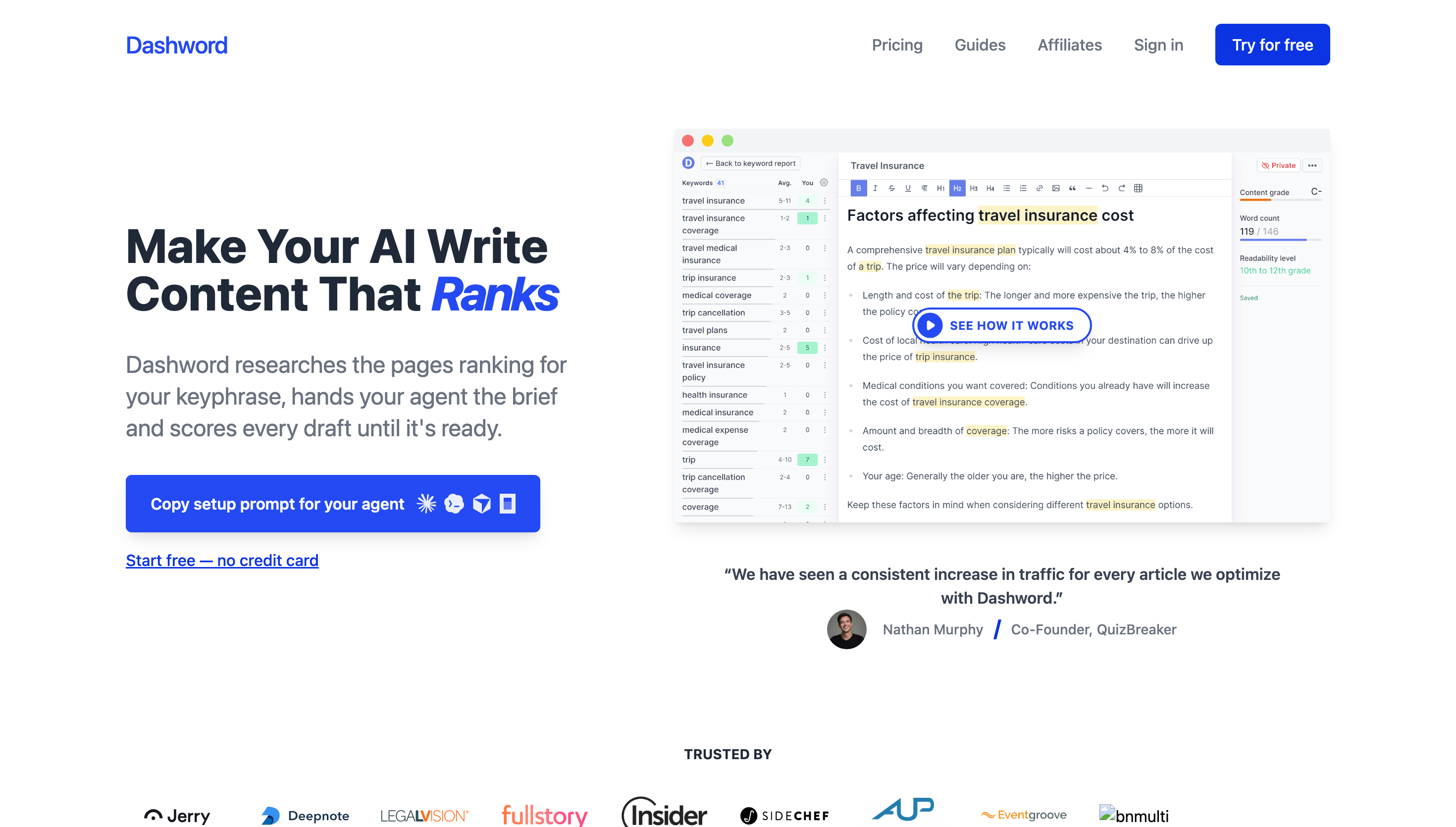
A drag-and-drop brief builder with live optimisation scoring and post-publish monitoring, aimed at small teams. Simpler than most of this list by design.
Better than Clearscope at: simplicity and predictable cost for a growing team
Falls short on: depth at scale, where larger portfolios outgrow it
Also worth knowing: AirOps handles composable content workflows at volume, and Jasper covers generation with brand voice controls. Neither is a Clearscope substitute, but both appear in the same stacks.
What "optimised" means for AI answers
Worth addressing directly, since the title of this page promises it.
Grading tools score against the pages currently ranking, which measures term coverage and structure relative to competitors. That remains useful. It isn't the same as being extractable.
The 2023 paper that coined generative engine optimization, from researchers at Princeton, Georgia Tech, IIT Delhi and the Allen Institute for AI, tested content strategies across 10,000 queries. Adding statistics improved visibility by around 41% and adding quotations by around 28%. The largest effect went to pages ranking around position five, where citing external sources improved visibility by up to 115%, while pages at position one saw little change.
Two consequences. Specific numbers and attributed quotes matter in a way term coverage scores measure imperfectly. And mid-ranking pages gain most from this work, which is a prioritisation answer no grader will give you.
On the technical side, Google's structured data documentation specifies no AI-specific markup. Schema clarifies your facts for machines rather than qualifying you for AI answers, so be sceptical of any tool selling it as the mechanism.
Choosing properly
Start with the bottleneck. Planning, drafting, grading or monitoring. Whichever stalls first is what you're buying for.
Score integrations zero to five. List HubSpot, Search Console, GA4 and Google Ads, then rate each candidate. Anything that can't reach outcome data is guessing.
Check the approval path. Who edits drafts, who signs off. If the tool has no approval step, that work moves to a spreadsheet.
Build a weighted score. Cost per report, brief quality, export quality. An agency weights exports heavily; an in-house team weights the editor.
Cost per outcome, not cost per month
The monthly bill is the wrong number.
Divide your total monthly fee by the number of briefs you actually run. Then add the hours spent moving data between platforms, valued at your loaded hourly cost. That second figure is where cheap tools stop being cheap.
The practical threshold: if you're spending more than about five hours a week shuttling data between systems, an integrated platform is usually cheaper than a stack of niche tools, even at a higher licence cost.
Two paths, and both are defensible:
-
One platform covering more of the workflow, fewer exports, higher licence
-
Niche tools each strong at one job, lower licence, more manual bridging
Pick deliberately rather than by accident.
Migrating without losing work
-
Inventory every active report so nothing gets left behind
-
Confirm data still flows to GA4, HubSpot, Search Console and Google Ads
-
Export current briefs and recreate your best templates in the new tool
-
Pilot on three pages and watch rankings, traffic and publishing speed
-
Define who writes, who reviews and who approves before you scale
-
Check Search Console and GA4 weekly during the transition
Budget a month of overlap paying for both tools, plus editor training. And ask for migration support during negotiation rather than after signing.
Set expectations on the pilot: four weeks on a handful of pages tells you whether the workflow fits. Ranking stability takes longer, and judging a tool on rankings inside a month measures noise.
Where this leaves you
If editorial quality per piece is what you're judged on and your reviewers trust Clearscope's scores, the premium is defensible and switching costs you something real.
If the problem is that nobody knows which page to fix first, or that decay goes unnoticed until a quarter has passed, no grader on this list solves it. That's a different purchase.
Upgrade to an Agentic Marketing OS
Connect your stack, get content work routed to the right person with enforced approvals. No more decisions made blind to what you're spending on paid.
Frequently Asked Questions (FAQs)
What are the best Clearscope alternatives?
Strivelabs at a quoted price, Surfer SEO at $59/mo is the closest like-for-like. Frase at $49 for briefing speed, MarketMuse at $99 for planning, Rankability for agency workflows, and NeuronWriter or Dashword for smaller budgets.
How much does Clearscope cost?
From $129 a month on Essentials, with seat and page caps on entry plans. That's roughly double Surfer and Frase, which is why cost per report matters more than the headline.
Is Surfer better than Clearscope?
Cheaper and broader, with keyword research and topical maps Clearscope doesn't offer. Clearscope's grading carries more editorial trust. For quality-led teams, Clearscope. For budget and breadth, Surfer.
Do these tools integrate with CRM data?
Some connect to HubSpot or Search Console so you can see which posts drive pipeline. Coverage varies considerably, so test the integration during a trial rather than trusting the feature list.
What happens to my reports when I migrate?
Most platforms don't import from competitors, so expect to recreate your best briefs by hand. Start with a small set and compare how the new grading logic behaves against work you already know performed.
Is AI drafting necessary?
No, but it shortens the path from research to a usable first draft. A human editor still verifies every factual claim, particularly anything about pricing or capability.
Are there free options for basic grading?
Some tools offer free tiers covering basic SEO and readability checks. Fine for a solo creator, generally too shallow for building authority or for the tracking a growing team needs.