If you've outgrown Surfer SEO, or you're starting to suspect a good content score isn't the same thing as traffic, the seven platforms worth comparing are Strivelabs, Clearscope, Frase, MarketMuse, SearchAtlas, AirOps, and Jasper.
This is written for content and marketing leads at B2B SaaS companies, usually running teams of two to eight, who are being asked to show that content work turns into pipeline rather than into scores. Where each tool sits on that question is the thread running through everything below.
At a Glance
-
Surfer's editor is genuinely good — nothing else on this list matches it for single-page optimisation feedback. The switching reasons are almost always about what it doesn't do.
-
Frase is the cheapest credible alternative at $49/mo; Clearscope is the closest like-for-like swap at $129; MarketMuse handles planning at $99.
-
Most of this category doesn't watch for content decay across a library — only Strivelabs and AirOps do anything about posts sliding quietly.
-
If content decisions have to reflect live ad spend and conversion data, most of these tools don't reach it.
-
A high content score doesn't guarantee rankings — treat it as one input, not the whole answer.
What is Surfer SEO
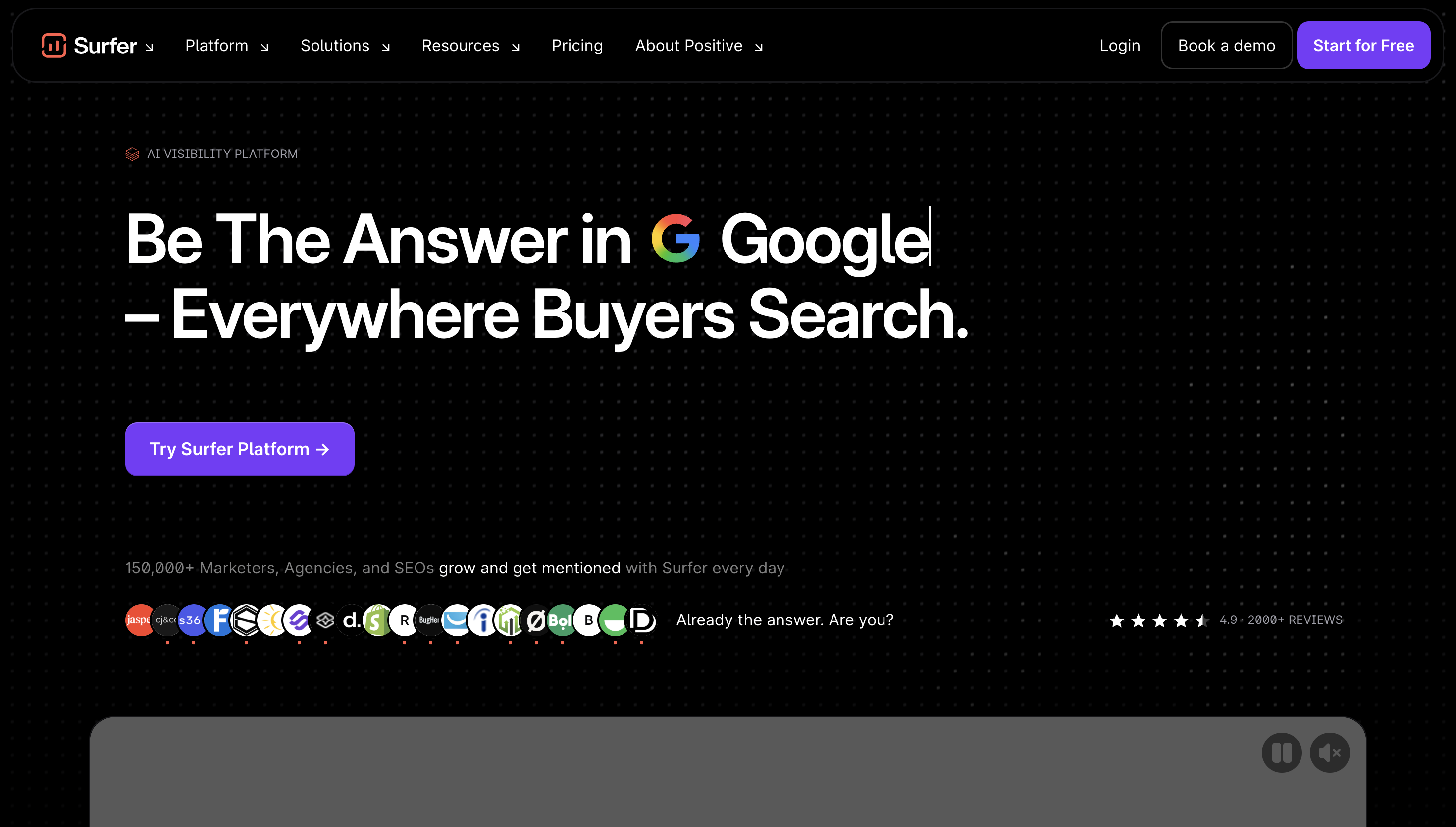
Surfer SEO is a content optimisation tool. You give it a target keyword, it analyses the pages currently ranking for that term, and it grades your draft against them: terms you're missing, headings you should cover, length relative to competitors. Keyword research and a SERP analyser sit alongside the editor.
The reason it's as popular as it is comes down to the feedback loop. The grade updates as you write, it's specific enough to act on, and writers use it rather than working around it. Plenty of optimisation tools get bought and ignored. Surfer generally gets used, which is a harder thing to build than it sounds.
Entry pricing starts around $59 a month on the Discovery tier, with document quotas by plan and AI writing features on higher tiers.
Worth being clear about scope, because it drives most of the switching decisions below. Surfer optimises a page against the search results as they exist today. It doesn't plan a site, manage a production pipeline, watch for decay across a library, or connect to what you're spending on ads. That's a deliberate focus, and for a team whose problem is single-page quality it's exactly the right one.
When Surfer SEO stops fitting
Scores stopped correlating with traffic. This is the one that actually pushes teams to switch. AI answers and shifting authority signals mean a high-scoring page can lose traffic anyway. If your top-graded pages are declining and nothing connects that decline to Search Console impressions or ad spend, the grade has stopped being the useful number.
Nothing watches for decay. Surfer tells you whether a draft is good now. It doesn't tell you that a page which ranked well eighteen months ago has been quietly sliding since March. Across a library of a few hundred posts, that's where most of the recoverable traffic sits.
One page at a time. As you move from publishing posts to running a content programme across clusters, page-level optimisation stops being the constraint and planning starts.
No line to the rest of your stack. Check whether HubSpot, GA4, Google Ads and Search Console data comes in as live signals. Content decisions made without visibility into what you're paying for can contradict it.
And the reason that isn't a criticism: nothing else on this list matches Surfer's editor. If single-page optimisation is genuinely your bottleneck, the alternatives are mostly worse at it.
Quick comparison
| Vendor | What it does | Entry price | Best-fit team | Main limitation vs Surfer |
|---|---|---|---|---|
| Surfer SEO | Grades drafts against live SERPs | $59/mo (Discovery) | Teams optimising single pages | No planning, decay watching or stack connection |
| Strivelabs | Turns connected data into approved actions | Quoted | Teams needing content work to ship | No native keyword research or SERP grading |
| Clearscope | Content grading and topical accuracy | $129/mo (Essentials) | Editorial teams with quality standards | Higher entry price, fewer automated steps |
| Frase | SERP research into briefs, fast | $49/mo | Solos and small teams writing at speed | Lighter grading, tight limits on cheap plans |
| MarketMuse | Topic modelling and cluster planning | $99/mo (Optimize) | Teams planning authority over quarters | Steep learning curve, not for quick page fixes |
| SearchAtlas | Broad SEO platform with audits and ads | $99/mo (Starter) | Growing teams and agencies consolidating | Complex to set up without technical help |
| AirOps | Composable content workflows at volume | Not published, sales-led | Teams who'll build their own pipelines | Credit costs, flexibility needs an owner |
| Jasper | Brand-consistent generation at scale | $69/mo per seat (Pro) | Teams producing many drafts | Not a grader or a planner at all |
Ordered below by how directly each one closes the gap between a score and a shipped result. A team buying purely for editorial quality would put Clearscope first.
Better decisions start with better infrastructure.
Most mid-market teams pick a channel and hope. Strivelabs gives you the data to know, and the infrastructure to act on it.
The seven alternatives to Surfer SEO
1. Strivelabs
Best for: teams whose bottleneck is acting on findings rather than grading drafts
Pricing: quoted
Strivelabs connects to Google Ads, HubSpot, Search Console, GA4, LinkedIn Ads and Slack, then turns signals into work, with a named person approving before anything executes.
The concrete version is more useful than the abstract one. A page carrying meaningful Google Ads spend starts losing clicks. Strivelabs catches the organic decline in Search Console, correlates it with the ad data, and creates a HubSpot task for whoever owns that content, with a suggested change attached. It doesn't decide the angle or write the piece. It notices, proposes, and routes, and a person approves. Approvals are enforced by role permission rather than team habit.
Better than Surfer at: spotting decay across a library, and connecting content decisions to live ad and pipeline data
Falls short on: crawler-level control
2. Clearscope
Best for: editorial teams held to a quality standard on every piece
Pricing: from $129/mo (Essentials)
The closest like-for-like swap, and the most trusted grading in the category. The interface is simpler than Surfer's, which matters when you're onboarding freelancers, and editors tend to act on its suggestions rather than argue with them. Google Docs and Word add-ons mean writers stay where they already work.
Better than Surfer at: grading reliability, and a gentler learning curve for new writers
Falls short on: price, starting more than twice as high, and it has fewer automated steps and less site-level planning
3. Frase
Best for: solos and small teams whose bottleneck is getting briefs written
Pricing: from $49/mo
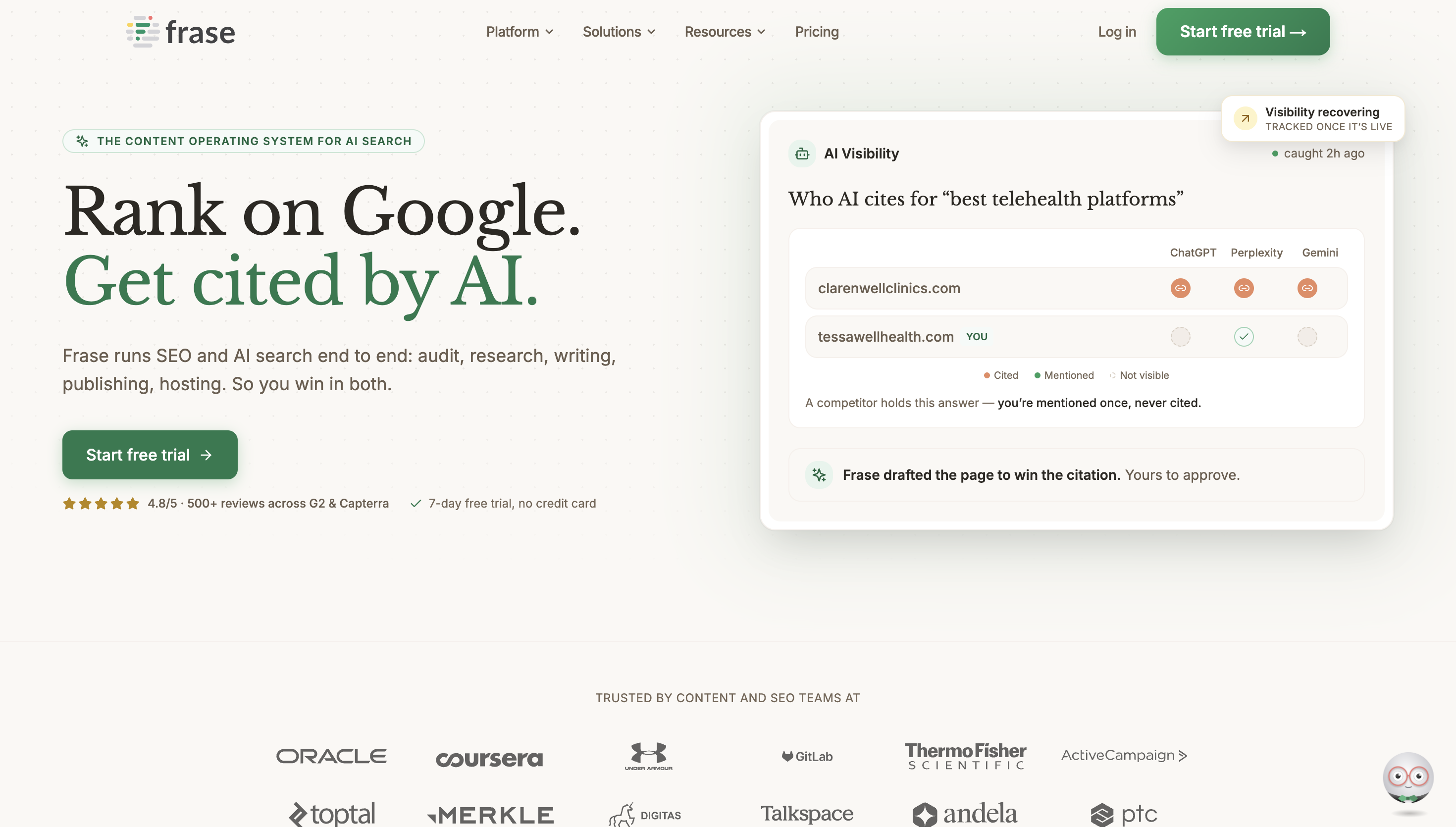
Frase turns SERP research into a usable outline in minutes, which is the step most content operations quietly lose days to. Cheaper than Surfer, faster to first output, and low enough risk to trial without a procurement conversation.
Better than Surfer at: speed from research to brief, and entry price
Falls short on: grading depth, and document limits on cheaper plans bite quickly at any real volume
4. MarketMuse
Best for: teams planning clusters across quarters rather than optimising posts
Pricing: free tier, paid from $99/mo (Optimize)
MarketMuse works at site level where Surfer works at page level. Topic modelling, cluster planning, internal link suggestions and content audits, aimed at owning a subject rather than ranking for a term. It surfaces gaps a page-by-page tool can't see.
Better than Surfer at: site-wide topical planning and authority modelling
Falls short on: the learning curve, the steepest on this list, and it won't help you fix a specific draft this afternoon
5. SearchAtlas
Best for: growing teams and agencies consolidating several tools into one bill
Pricing: from $99/mo (Starter)
A broad SEO platform rather than a content tool. Content scoring sits next to technical audits and ads management, which is the argument for it: one place to watch site health instead of four subscriptions.
Better than Surfer at: breadth, covering technical audits and paid alongside content
Falls short on: simplicity, since the product is complex to configure without someone technical, and depth on grading specifically
6. AirOps
Best for: teams who will actually build and maintain their own workflows
Pricing: not published, sales-led
AirOps gives you composable workflows that chain research, generation and publishing and run at volume against your own data. Maximum flexibility, provided someone will use it. If nobody has a spare afternoon to design a workflow, you'll use three of the available options and pay for the rest.
Better than Surfer at: automating repeatable production and refresh work at volume
Falls short on: cost forecasting on a credit model, and pricing isn't published, so budgeting means a sales call
7. Jasper

Best for: teams where several people write and it all needs one voice
Pricing: from $69/mo per seat (Pro)
The most mature generation platform here, with brand voice controls, multi-model routing and HubSpot and CMS connections. It solves a different problem from Surfer entirely, which is worth saying plainly rather than pretending it's a substitute.
Better than Surfer at: drafting speed and brand voice consistency across writers
Falls short on: optimisation and planning, both of which it does not attempt, so you'll still need a grader alongside it
How to choose an alternative
What actually broke?
If scores stopped predicting traffic, the answer isn't a better grader. If drafts are the bottleneck, Jasper or Frase. If planning is, MarketMuse. If shipping is, Strivelabs.
Is anyone watching for decay?
Most of this list optimises new work. Only Strivelabs and AirOps do anything about a library sliding quietly.
Under or over $100 a month?
Frase at $49 and SearchAtlas and MarketMuse at $99 sit below. Clearscope at $129 and Jasper at $69 per seat scale with headcount. AirOps and Strivelabs are sales-led.
Does it need to see your funnel?
If content decisions have to reflect live ad spend and conversion data, most of this category doesn't reach it.
Who signs off?
Confirm approval steps can be enforced by permission rather than trusted to team discipline.
Running a useful pilot
One to two weeks is enough if you scope it properly.
Pick one topic cluster and 6 to 10 recent posts as a baseline so you're comparing like with like. Run two tools in parallel against the same work. Time every minute spent editing, because that's the real cost per article and no vendor will volunteer it. Confirm Search Console, GA4 and HubSpot data flows rather than trusting the feature list. Keep a human reviewing every draft. Don't scale until you can point at a ranking or pipeline change rather than a score change.
Two things that derail pilots: missing GA4 or Search Console API access on day one, and never agreeing what a good edit looks like, which makes the editing-time numbers meaningless.
Upgrade to an Agentic Marketing OS
Connect your stack, get content work routed to the right person with enforced approvals. No more decisions made blind to what you're spending on paid.
Frequently Asked Questions
What are the best Surfer SEO alternatives?
The seven worth comparing are Strivelabs, Clearscope, Frase, MarketMuse, SearchAtlas, AirOps and Jasper. Frase is cheapest at $49 a month, Clearscope is the closest like-for-like swap at $129, MarketMuse handles planning at $99, and Strivelabs handles execution.
What is Surfer SEO used for?
Grading a draft against pages currently ranking for your target keyword, showing missing terms, headings and length gaps, with keyword research and a SERP analyser alongside. It optimises single pages rather than planning sites or managing production.
Is there a free version of Surfer SEO?
No, it's paid only, starting around $59 a month on Discovery. MarketMuse has a free tier and AirOps offers trial credits if a zero-budget test is what you need.
What is the cheapest Surfer SEO alternative?
Frase at $49 a month. MarketMuse and SearchAtlas both start at $99, and MarketMuse also has a free tier. All three are narrower than Surfer on grading specifically.
Does a high content score guarantee rankings?
No. Grading tools measure how a draft compares to current top pages, which is one input among many alongside links, site authority, page experience and how AI answers surface sources. Treat the score as a guide, not a target.
Surfer SEO vs Clearscope: which is better?
Clearscope's grading is more trusted and its interface is simpler for onboarding writers. Surfer is cheaper at $59 against $129 and has stronger keyword research. For editorial teams with quality standards, Clearscope. For a tighter budget, Surfer.
Which Surfer SEO alternative connects to HubSpot and GA4?
Strivelabs connects to HubSpot, GA4, Google Ads, Search Console, LinkedIn Ads and Slack. Jasper connects to HubSpot and most CMS platforms. SearchAtlas covers Search Console and ads. Most content optimisation tools don't reach live conversion data.
Are there hidden costs in content optimisation tools?
Usually three: extra seats, document or article caps on lower tiers, and AI writing features gated to higher plans. On credit-based tools like AirOps, model your expected monthly usage and add 30 percent before signing.
How long should a pilot run before deciding?
One to two weeks against one cluster and 6 to 10 real posts. Long enough to measure editing time and confirm integrations hold. Shorter than that and you're measuring onboarding rather than the tool.