If you're evaluating Slate and want to see what else is out there, the seven platforms worth comparing are Strivelabs, AirOps, Surfer SEO, Clearscope, MarketMuse, Frase, and Jasper.
This is written for marketing leads at mid-market B2B SaaS companies, usually running teams of two to eight, who need content and AEO work to actually ship rather than to be advised on. The distinction that matters most in this comparison isn't features. It's who sets the product roadmap.
At a Glance
-
Slate is built by TripleDart, a B2B SaaS agency — its practitioner knowledge is real, but the roadmap question is worth asking directly.
-
Frase is the cheapest entry at $49/mo; Surfer is strongest on page optimisation at $59; Clearscope on editorial quality at $129.
-
Jasper is the most mature generation platform (DR 88, ~2,800 ranking keywords) with the most independent validation to check.
-
Strivelabs is the only option here that connects live funnel data to a specific next action with enforced approval.
-
The roadmap question isn't an accusation — it's a procurement question. Ask it on the call.
What Slate is
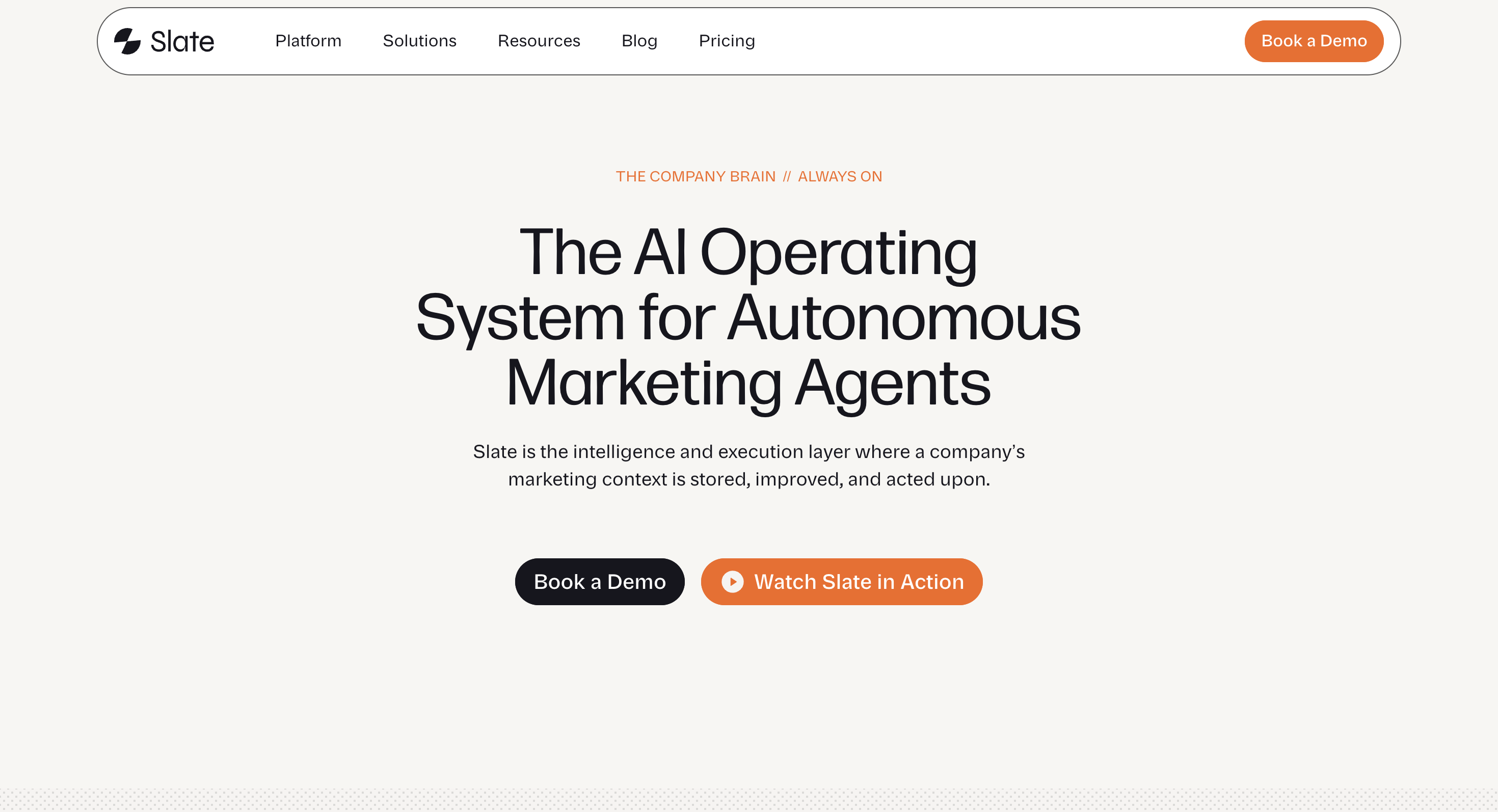
Slate is an AEO and content platform built by TripleDart, a B2B SaaS marketing agency. It combines an AI visibility tracker with content optimisation tooling, aimed at teams trying to show up in AI answers as well as in classic search results.
The agency origin shows up in the product in a useful way. TripleDart runs content and paid programmes for B2B SaaS clients, so Slate is built by people who do this work daily rather than by engineers guessing at it. Their published comparison research across the content-optimisation category is unusually thorough, and that practitioner knowledge is real.
It shows up in the go-to-market too. Slate is sold largely through the agency relationship rather than through self-serve search, which is why its product pages rank for almost nothing and its AI tracker page sits well down the results for the terms it targets. Their own domain authority sits at 41 with roughly 55 ranking keywords, which is small for a funded product in this space.
None of that tells you whether the software works. It does tell you what kind of company you'd be buying from, and that's worth understanding before you sign.
The question worth asking, not the accusation
There's a fair question about any product built inside a services business, and it isn't "is the software bad." It's this: when engineering time is finite, does it go to the published roadmap or to a large client's custom request?
That question has a good answer and a bad one, and only the vendor can tell you which applies. Ask it directly on the call. Specifically:
Who decides what ships next, and does customer feedback from self-serve accounts influence it? Is there a public roadmap or changelog you can see? What proportion of engineering time goes to bespoke client work? Are there features built for one client that never became standard?
A vendor with a clean answer will give it happily. Plenty of good products started inside agencies, and proximity to real client problems is a genuine advantage. The risk is specific and worth naming rather than assuming: your priorities compete with the largest contract's priorities, and you may not be able to see how that resolves.
Why teams look at alternatives
Roadmap visibility. Covered above. It's the main reason this comparison exists.
Small footprint. Slate is a smaller operation than most of this list, and at DR 41 with 55 ranking keywords it hasn't built the third-party evidence base that Jasper or Surfer have. Fewer reviews, fewer independent teardowns, less to check before you commit.
Optimisation depth. Slate covers a lot of ground. If your bottleneck is specifically grading drafts against current search results, Clearscope and Surfer do that one job harder.
Live funnel data. Check whether HubSpot, Google Ads, GA4 and Search Console signals come in as live inputs rather than exports. Content decisions made without visibility into what you're currently spending on can contradict it.
The reason that isn't a criticism: if you already work with TripleDart, the integration between agency delivery and the product is something no independent vendor can offer you.
Quick comparison
| Vendor | What it does | Entry price | Authority (DR / US traffic) | Main limitation |
|---|---|---|---|---|
| Slate | AEO tracking plus content optimisation | Not published, sales-led | DR 41 / 264 | Agency-set roadmap, small evidence base |
| Strivelabs | Turns connected data into approved actions | Quoted | DR 30 / 3 | No page-level draft grading |
| Jasper | Brand-consistent generation at scale | $69/mo per seat | DR 88 / 56,377 | Cost per seat, needs fact-checking |
| Surfer SEO | Page optimisation against live SERPs | $59/mo (Discovery) | DR 85 / 22,668 | No production management |
| Frase | Briefs and SERP research, fast | $49/mo | DR 80 / 8,682 | Thin research in narrow niches |
| Clearscope | Content grading and topical accuracy | $129/mo (Essentials) | DR 78 / 3,163 | Optimisation only |
| MarketMuse | Topic modelling and authority planning | $99/mo (Optimize) | DR 77 / 13,486 | Steep learning curve |
| AirOps | Composable content workflows | Not published, sales-led | DR 76 / 6,205 | Flexibility needs an owner |
Ordered below by fit for a mid-market B2B SaaS team that needs work to ship. A team buying purely for editorial quality would reorder this.
Better decisions start with better infrastructure.
Most mid-market teams pick a channel and hope. Strivelabs gives you the data to know, and the infrastructure to act on it.
The seven alternatives
1. Strivelabs
Best for: teams whose bottleneck is deciding and shipping, not drafting
Pricing: quoted
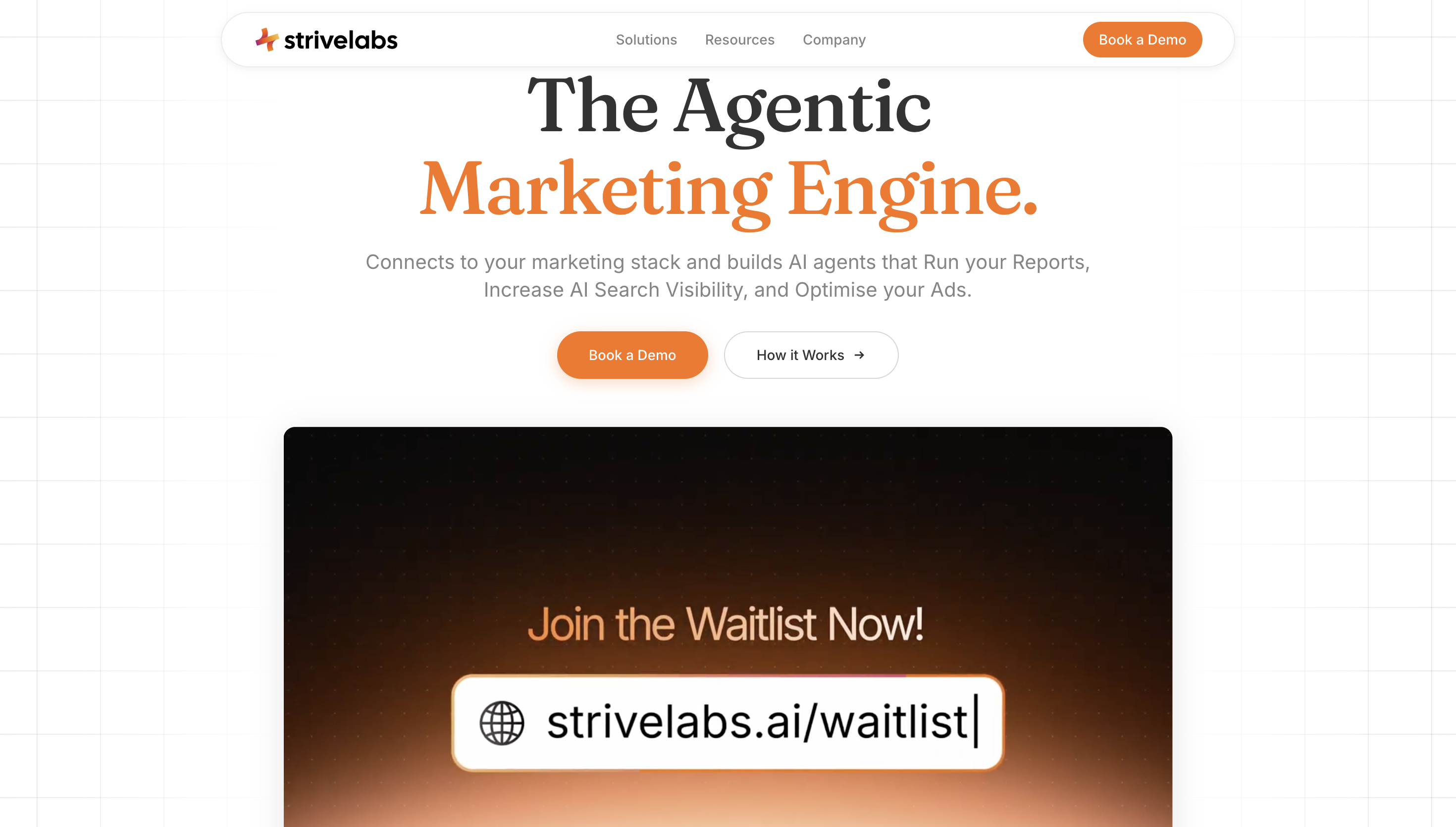
Strivelabs connects to Google Ads, HubSpot, Search Console, GA4, LinkedIn Ads and Slack, then turns signals into work: an SEO brief, a budget shift, a task routed to whoever owns it, with a person approving before anything executes. Approvals are enforced by role permissions rather than by team habit.
Better than Slate at: live connections to first-party funnel data, and routing tasks to specific owners with enforced approval
Falls short on: page-level optimisation, where Surfer and Clearscope grade individual drafts in a way Strivelabs doesn't attempt
2. Jasper
Best for: teams where several people write and it all needs to sound like one company
Pricing: from $69/mo per seat (Pro)
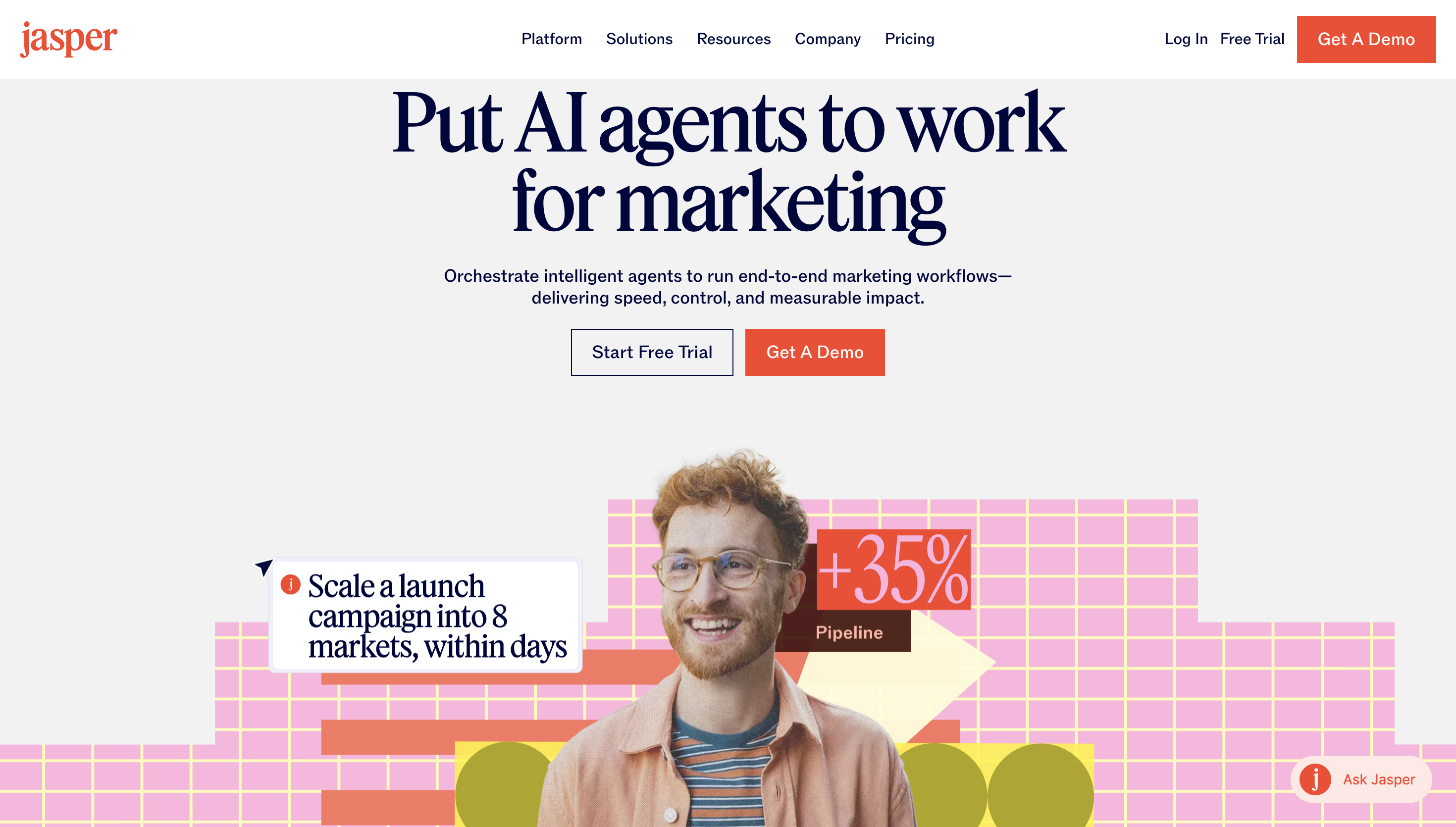
The most mature generation platform here, with brand voice controls, multi-model routing, and HubSpot and CMS connections. DR 88 and nearly 2,800 ranking keywords means plenty of independent evidence to check before buying.
Better than Slate at: generation at volume, brand consistency, and depth of third-party validation
Falls short on: AEO specifically, since it writes rather than tracks visibility, and per-seat cost climbs with headcount
3. Surfer SEO
Best for: teams optimising individual pages against current results
Pricing: from $59/mo (Discovery)
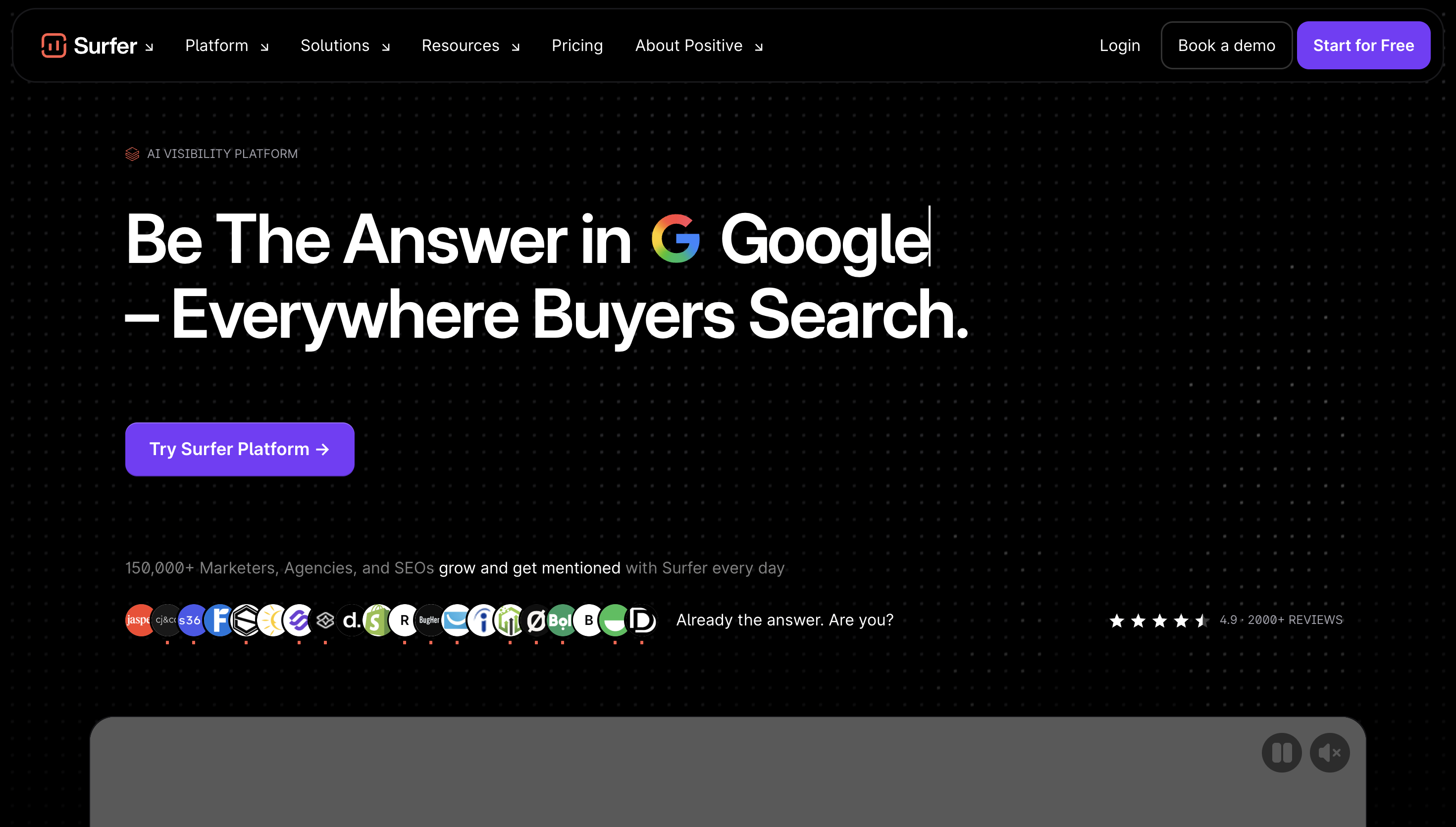
Surfer grades a draft against what's ranking now and tells you what's missing. Focused, fast, and the feedback loop is tight enough that writers actually use it rather than working around it.
Better than Slate at: page-level optimisation depth, and a shorter learning curve
Falls short on: production management, and AI writing features cost extra on top of the base plan
4. Frase
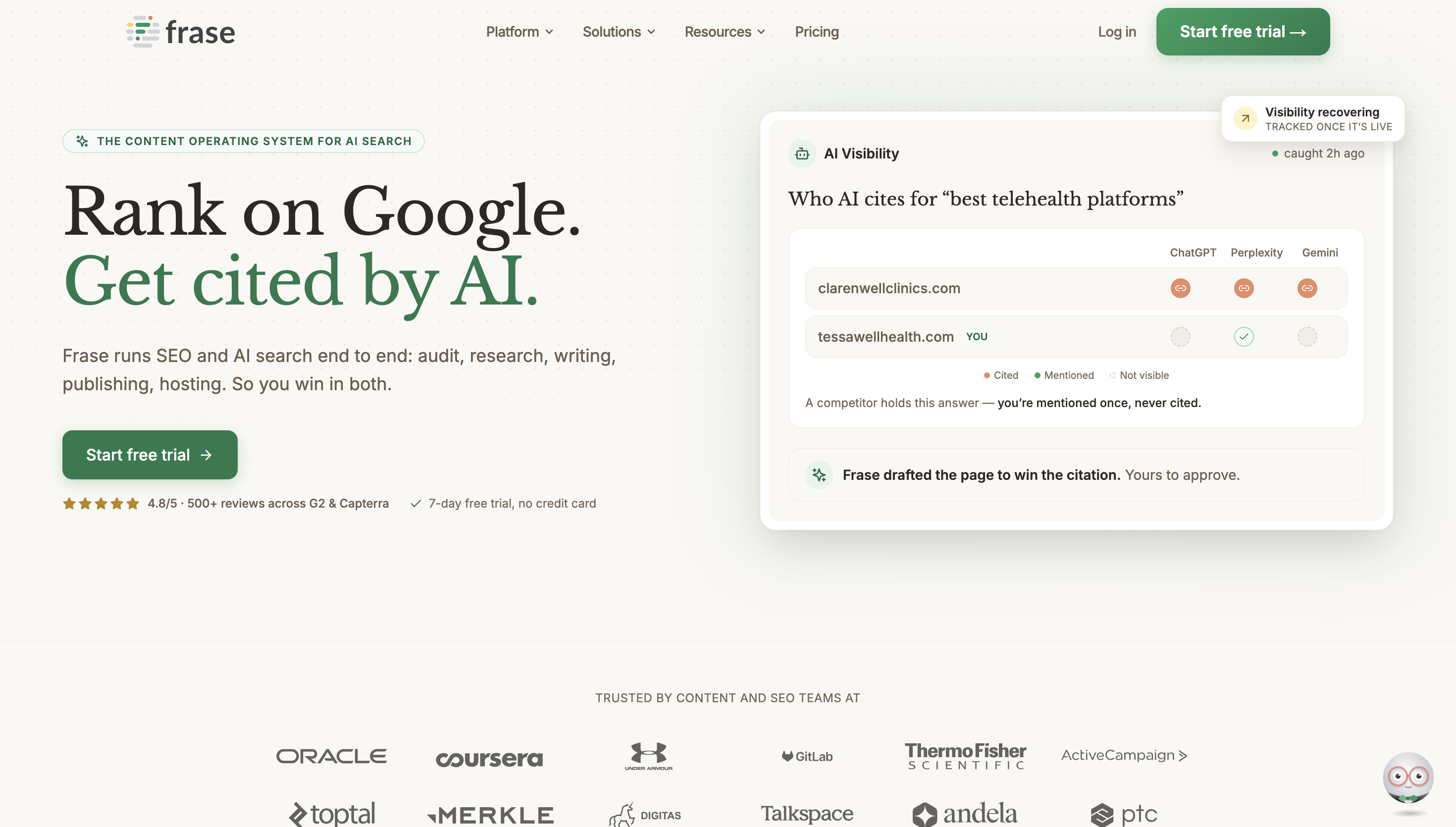
Best for: teams whose real bottleneck is getting briefs written
Pricing: from $49/mo
Frase turns SERP research into a usable brief in minutes, which is the step most content operations quietly lose days to. Cheap enough to trial without a procurement conversation.
Better than Slate at: speed from research to brief, and low-risk entry pricing
Falls short on: research depth in specialised niches, where SERP data thins out quickly
5. Clearscope
Best for: editorial teams where accuracy matters more than throughput
Pricing: from $129/mo (Essentials)
Clearscope's content grading is the most trusted in this category, and editors tend to act on it rather than argue with it. If quality per piece is what you're measured on, this is the opinionated choice.
Better than Slate at: editorial quality signals, and transparent seat-based pricing
Falls short on: scope, since it grades drafts and does nothing about producing or distributing them
6. MarketMuse
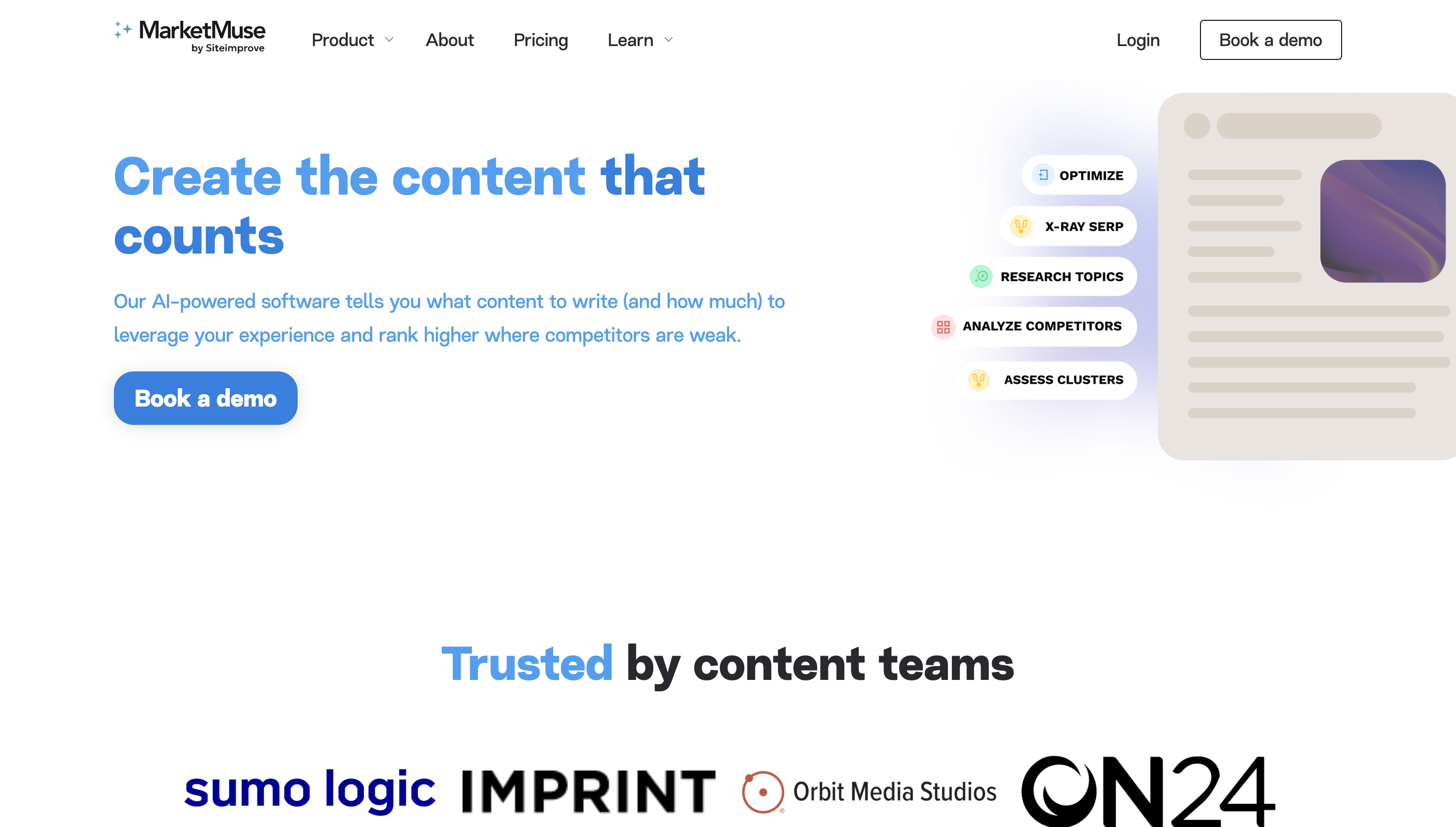
Best for: teams planning topic clusters across quarters
Pricing: from $99/mo (Optimize)
A planning tool rather than a production one, which buyers often miss when they group it with Surfer and Clearscope. Topic modelling, internal link suggestions and content audits are what it's for.
Better than Slate at: long-horizon topical planning and authority modelling
Falls short on: the learning curve, the steepest here, and it won't help you produce anything
7. AirOps
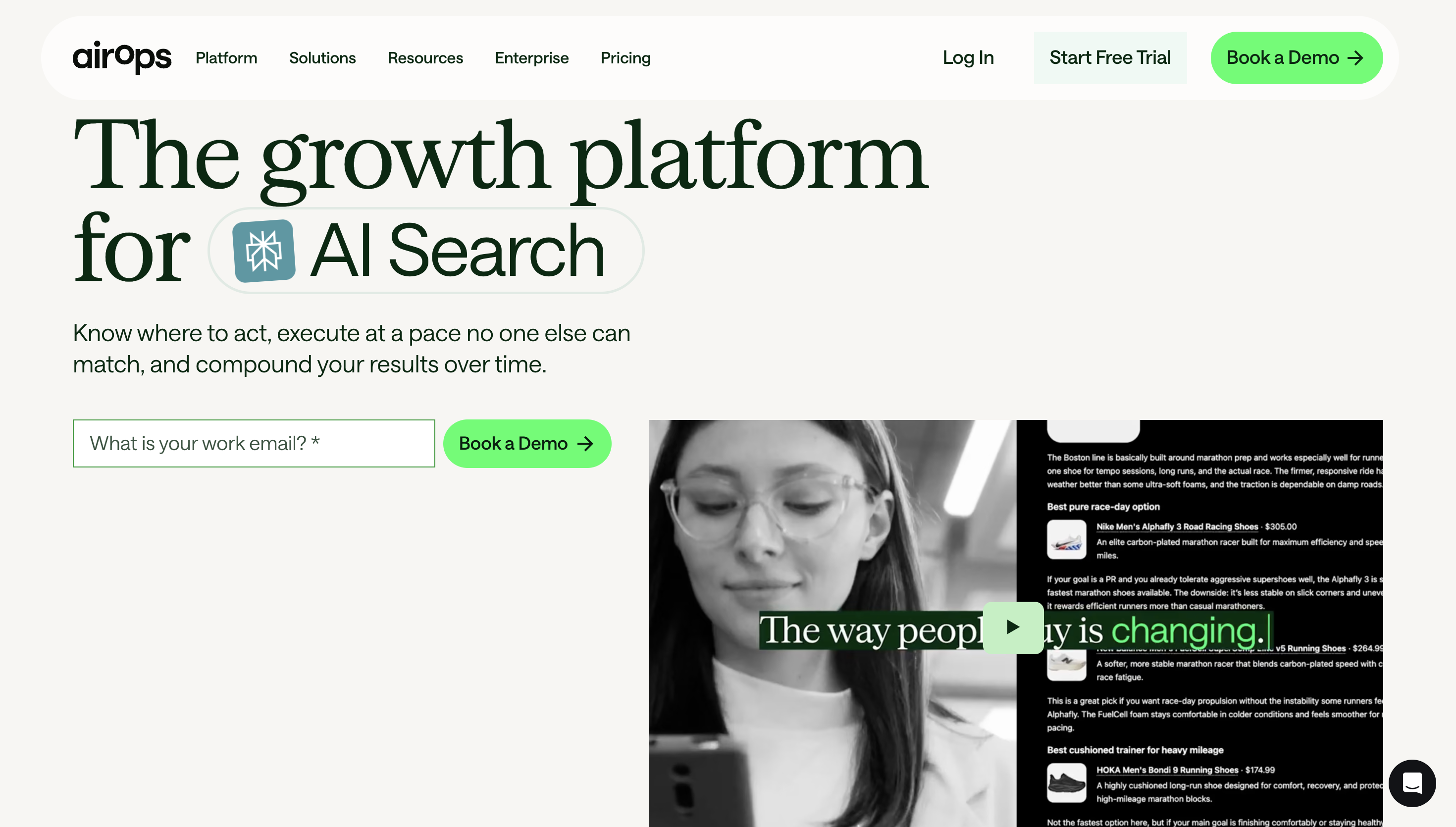
Best for: teams who will build and maintain their own workflows
Pricing: not published, sales-led
AirOps gives you composable workflows that chain research, generation and publishing steps and run at volume against your own data. Maximum flexibility, if someone will use it.
Better than Slate at: custom pipeline flexibility, and breadth of published comparison research
Falls short on: cost forecasting on a credit model, and the flexibility is wasted without a dedicated owner
When Slate is still the right choice
Two situations where switching would be a mistake.
You already work with TripleDart, or you're considering it. The combination of agency delivery and a product built by the same team is genuinely useful, and no independent vendor can replicate it. Buying the software alone gives up most of that.
You want AEO tracking and content optimisation from one vendor. Most of this list does one or the other. If a single contract covering both matters more than best-in-class on either, that's a defensible reason to stay.
What to check in a demo
A short list keeps a demo grounded and stops feature theatre.
Ask who directs the roadmap and whether self-serve feedback reaches it. Confirm live connections to Search Console, HubSpot, GA4, Google Ads and LinkedIn, and whether sync runs both ways or just exports out. Check whether tasks can be assigned to specific people rather than landing in a shared queue. Confirm approval gates can be enforced by permission and not disabled. Verify audit logs and role permissions clear your internal security review. Ask for public API documentation and a sandbox, because both are reliable signals that a product is finished rather than in progress.
Pricing and procurement
Total cost of ownership is a more useful question than sticker price, particularly with sales-led vendors where the number arrives late.
| Cost area | Ask this | Then negotiate |
|---|---|---|
| Licensing | Does price scale by seat, by feature, or by usage? | Run a scoped pilot against named outcomes rather than buying a full year |
| Integrations | Does each connector carry its own fee? | Get connector costs folded into the pilot price |
| Setup | How many implementation hours are included? | Keep the first phase to core requirements only |
| Support | Are SLAs and roadmap commitments contractual? | Put one measurable milestone in the contract |
Bundled service agreements are the ones to read carefully, because recurring costs hide inside them. Ask for a line-item breakdown before you compare anything to a product-led quote.
If your gap is getting work shipped rather than getting it graded, that's the conversation worth having.
Upgrade to an Agentic Marketing OS
Connect your stack, get work routed to the right person with enforced approvals. No more content decisions made blind to what you're spending on paid.
FAQs
What are the best alternatives to Slate?
The seven worth comparing are Strivelabs, AirOps, Surfer SEO, Clearscope, MarketMuse, Frase and Jasper. Frase is cheapest at $49 a month, Surfer strongest on page optimisation at $59, Clearscope on editorial quality at $129, and Strivelabs handles execution rather than optimisation.
What is Slate by TripleDart?
An AEO and content platform built by TripleDart, a B2B SaaS marketing agency. It combines AI visibility tracking with content optimisation and is sold largely through the agency relationship rather than self-serve.
Is agency-built software worse than product-led software?
Not inherently, and proximity to real client work is an advantage. The specific risk is that engineering time competes between the published roadmap and large clients' custom requests. Ask who sets priorities and whether there's a public changelog.
What is the cheapest Slate alternative?
Frase at $49 a month, then Surfer SEO at $59. Both are narrower than Slate, covering briefing and page optimisation rather than tracking and optimisation together.
Which Slate alternative connects to HubSpot and GA4?
Strivelabs connects to HubSpot, GA4, Google Ads, Search Console, LinkedIn Ads and Slack. Jasper connects to HubSpot and most CMS platforms. Surfer and Frase connect to Search Console. Most of this category doesn't reach live conversion data.
What does human-in-the-loop actually mean here?
The system proposes an action, a named person reviews it, and nothing executes until they approve. The useful test is whether approval is enforced by role permissions or is just a team convention someone can skip under deadline.
How long should a pilot run before deciding?
One to two weeks against 6 to 10 real briefs or campaigns. Long enough to measure editing time and confirm integrations hold. Shorter than that and you're measuring onboarding rather than the tool.