
7 Writesonic Alternatives for AEO and Content Teams
If Writesonic is producing drafts but not discovery, the seven platforms worth comparing are Strivelabs, Frase, Surfer SEO, MarketMuse, Clearscope, Jasper, and Copy.ai.
This is written for content and marketing leads at B2B SaaS companies who are being asked whether their content shows up in AI answers, not just whether it got published. The question that sorts this list faster than any feature comparison is your own AEO maturity, and there's a test for that below.
At a Glance
-
Writesonic's argument is consolidation — one subscription covering drafting and visibility. Its weakness is that covering ground means depth is uneven.
-
The AEO maturity test below decides your shortlist in about a minute. Get this wrong and you'll use ten percent of the tool you buy.
-
Copy.ai is cheapest at $29/mo; Frase at $49 for briefing; Surfer at $59 for optimisation; Clearscope at $129 for editorial quality.
-
Sticker price is rarely the bill — seat charges and credit overages are where the difference shows up.
-
Ask every vendor for a sample invoice at your expected monthly volume before signing anything.
What is Writesonic
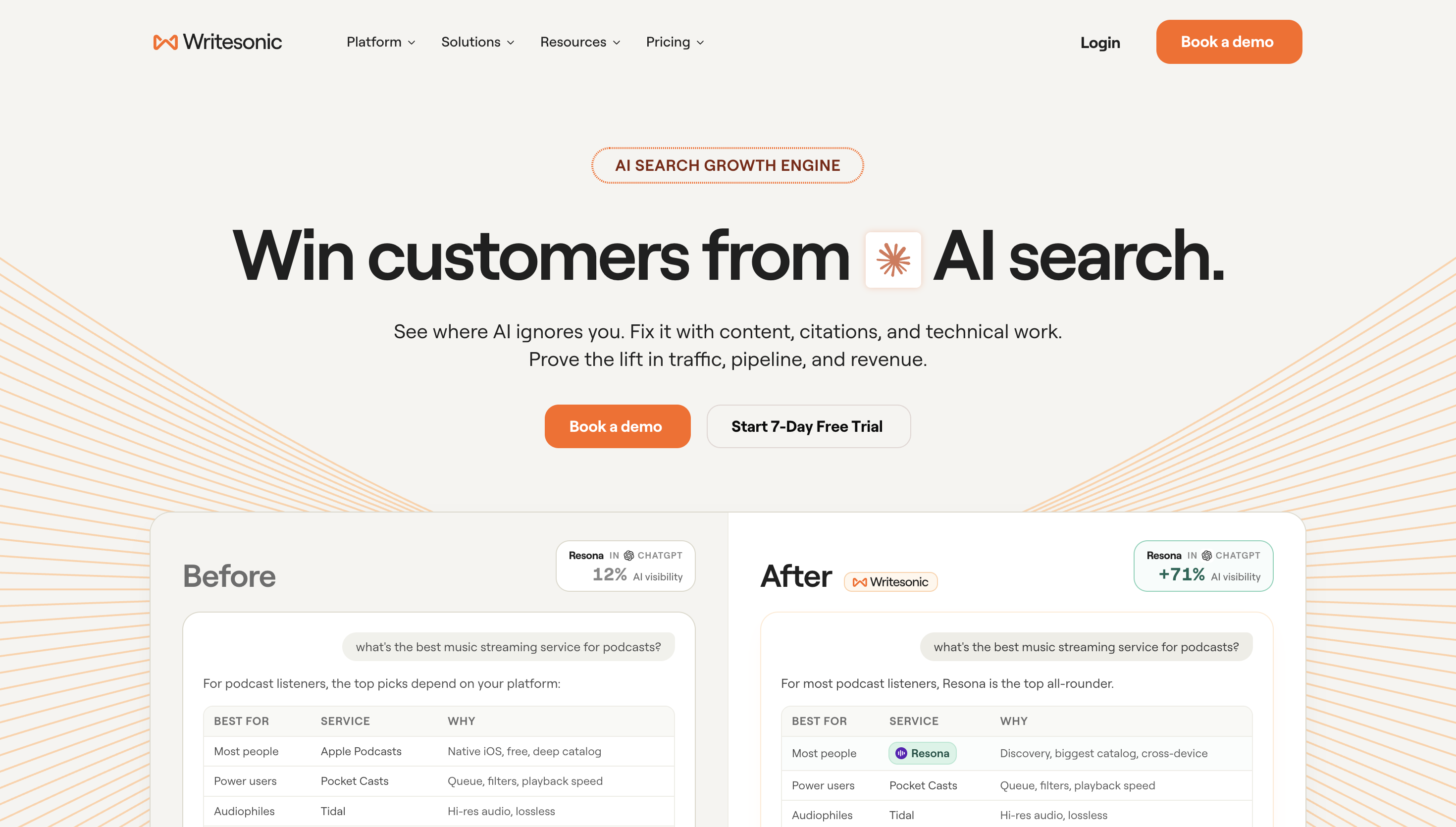
Writesonic started as an AI writing platform and has since added SEO and AI visibility features on top. You get article generation, publishing integrations into common CMS platforms, and a set of tools for tracking how your content performs in search and, increasingly, in AI answers.
Pricing starts around $79 a month on the Starter tier, with a free tier below it. Generation runs on credit caps, and which site tracking and AI visibility features you get depends on your tier.
The argument for it is consolidation. One subscription covering drafting and visibility is genuinely simpler than a drafter plus an optimiser plus a tracker, and for a small team that convenience is worth real money.
The argument against it is the same thing viewed from the other side. Writesonic covers a lot of ground, and covering ground means depth is uneven. Some parts are mature and some are newer, and a buyer evaluating it specifically for AEO needs to know which is which. Both Profound and Slate publish critical reviews of it, which tells you the AEO specialists consider it a competitor worth attacking. Read those alongside this, and read them sceptically, because they're written by vendors too.
The AEO maturity test
This is the question that decides your shortlist, and it takes about a minute to answer.
Are you already acting on specific recommendations from Search Console and GA4? Not looking at them. Acting on them, in a way you could point to.
If yes, buy depth. Frase, Surfer, MarketMuse and Clearscope will give you signals you'll actually use, and the discipline to use them already exists. Depth costs more and rewards teams that have somewhere to put it.
If no, buy speed, or buy execution. If your real position is that content gets published and nobody follows up, a deeper optimisation tool becomes another dashboard. Either lean into volume with Jasper or Copy.ai and accept that discovery is a later problem, or fix the follow-up first.
Getting this wrong in either direction is the most common expensive mistake in this category. Teams with no follow-up habit buy the deepest tool available and use ten percent of it. Teams with real discipline buy a generator and wonder why nothing ranks.
Why do teams leave Writesonic?
Rankings stopped moving. The clearest signal. If output went up and organic clicks on your top pages didn't, more drafting capacity isn't the answer.
Credit caps arriving early in the month. A predictable friction on credit-based plans, and a real constraint on planning.
Uneven depth. The AEO and visibility features sit at different maturity levels from the writing features, and the ones that matter most tend to sit on higher tiers.
Multi-brand work. Teams managing several brands or clients often hit structural limits before they hit feature limits.
And the reason that isn't a criticism: nothing else on this list gives you drafting and visibility in one subscription. If reducing vendor count matters more than best-in-class on either, staying is defensible.
Pricing and limits
| Vendor | Starting price | Free tier | Notable limits |
|---|---|---|---|
| Writesonic (incumbent) | $79/mo (Starter) | Yes | Credit caps on generation, tracking and visibility gated by tier |
| Strivelabs | Quoted | No, demo | Scope and usage set by tier |
| Copy.ai | $29/mo (Chat) | Yes, limited | Credit-based, workflow features on higher tiers |
| Frase | $49/mo | Trial | Caps on AI runs and tracked documents |
| Surfer SEO | $59/mo monthly, lower on annual prepay | Trial | Document quotas by tier, AI features cost extra |
| MarketMuse | $99/mo (Optimize) | Yes | Query caps push cost up at volume |
| Jasper | $69/mo per seat (Pro) | No | Per-seat pricing, Business tier by quote |
| Clearscope | $129/mo (Essentials) | No | Page and seat caps, limited generation |
The sticker price is rarely the bill. Seat charges and credit overages are where the difference shows up, and neither appears on a pricing page.
One request that cuts through this quickly: ask each vendor for a sample invoice at your expected monthly volume, itemising API calls and credit usage. Vendors who won't produce one are telling you something.
Better decisions start with better infrastructure.
Most mid-market teams pick a channel and hope. Strivelabs gives you the data to know, and the infrastructure to act on it.
The seven alternatives to Writesonic
Ordered by how directly each closes the gap between a discovery signal and a shipped change. A team buying purely for drafting speed would reverse this.
1. Strivelabs
Best for: teams where content gets published and nothing follows up
Pricing: quoted
Strivelabs connects to HubSpot, Google Ads, Search Console, GA4, LinkedIn Ads and Slack, then turns signals into work with a named person approving before anything executes. In practice: a page carrying meaningful ad spend starts losing organic clicks, Strivelabs correlates the two, and a task lands with whoever owns that content and a suggested change attached. Refresh schedules run on the same basis, and alerts route by role, so the content owner and the paid owner see different things.
The honest boundary: it doesn't draft and it doesn't grade. If you need more words or a content score, buy one of the six below. Most teams that buy it are pairing it with a writer rather than replacing one.
Better than Writesonic at: deciding what to write or fix next from live funnel data, and routing it to an owner with enforced approval
Falls short on: early-stage sites, since decay detection needs a published library and a few months of Search Console history before it has anything useful to work with
Test it with: connect Search Console and HubSpot for one topic cluster and see what it flags in the first week.
2. Frase
Best for: teams whose bottleneck is research and briefing
Pricing: from $49/mo
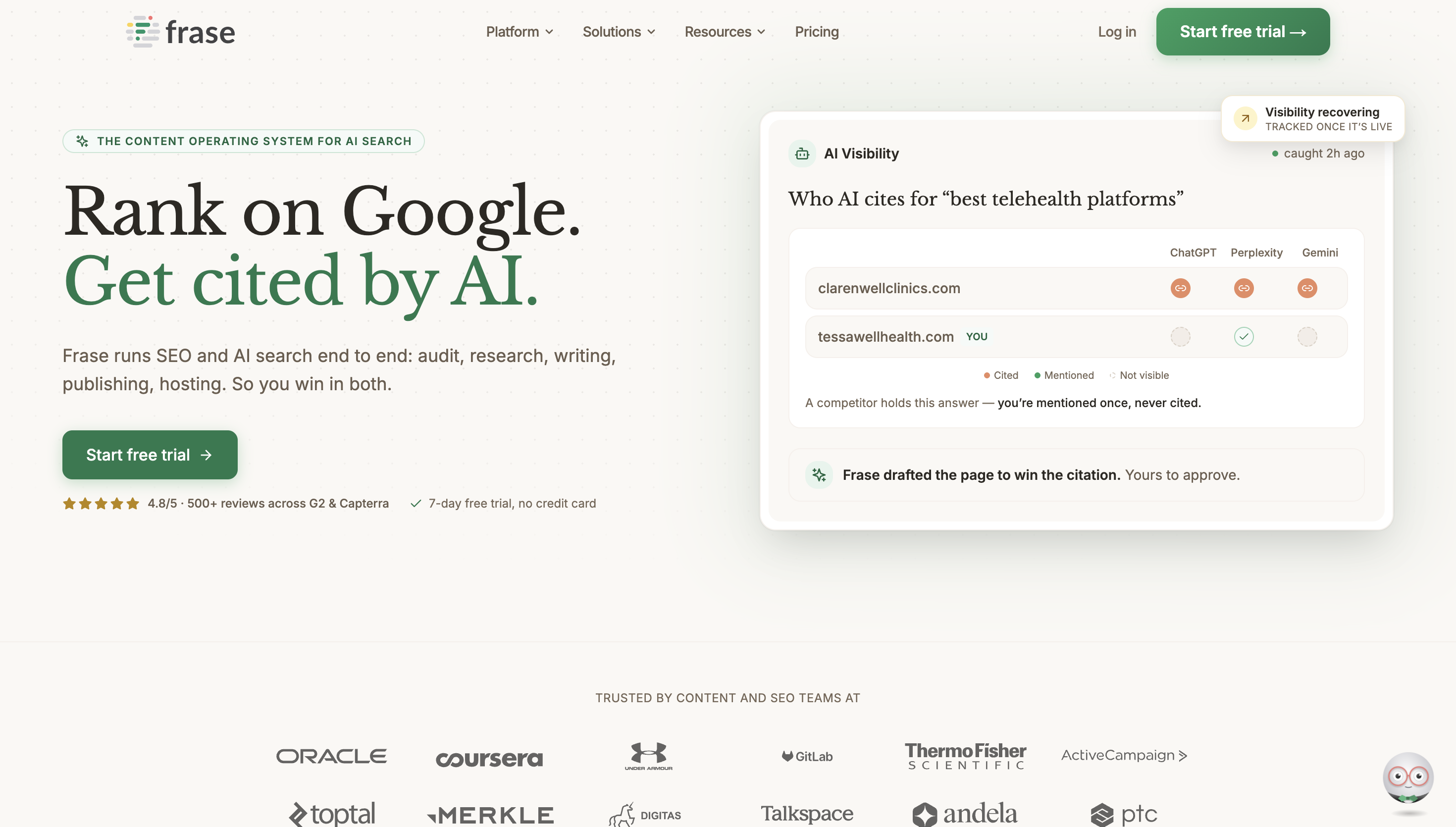
Frase pulls search results into a working outline in minutes and grades drafts against search intent. It's the cheapest way to make briefing repeatable, which is the step most content operations quietly lose days to.
Better than Writesonic at: speed from research to brief, and consistency of scoring across writers
Falls short on: grading depth against Surfer or Clearscope, and document caps bite at real volume
Test it with: brief five posts through it and compare against your usual process on time and writer questions.
3. Surfer SEO
Best for: teams whose drafts are fine but aren't ranking
Pricing: $59/mo monthly on Discovery, lower on annual prepay
Surfer grades a draft against pages currently ranking, with the score updating as you write. The loop is tight enough that writers use it rather than working around it, which is rarer than it sounds.
Better than Writesonic at: page-level optimisation depth against live search results
Falls short on: production, since it grades finished drafts and writes nothing, and visibility tracking costs extra
Test it with: run your three most important landing pages through and act on only the top recommendation for each.
4. MarketMuse
Best for: teams deciding what to write across a quarter, not a week
Pricing: free tier, paid from $99/mo (Optimize)
MarketMuse works at library level: topic gaps, cluster planning, and which existing pages are worth fixing first. That last one is the underrated feature, because most teams have more recoverable traffic in old posts than in new ones.
Better than Writesonic at: finding gaps across an existing library and prioritising refreshes
Falls short on: the learning curve, the steepest here, and it produces no drafts
Test it with: run your top 100 posts through the gap analysis and refresh the ten it ranks highest.
5. Clearscope
Best for: editorial teams held to a quality bar on every piece
Pricing: from $129/mo (Essentials)
The most trusted grading in the category, with Google Docs and WordPress plugins so writers stay where they already are. Editors act on its guidance rather than argue with it, which is what shortens review cycles.
Better than Writesonic at: editorial reliability and shortening the review step
Falls short on: price, the highest entry here, and generation options are limited by design
Test it with: put your single most important page in and see whether the suggested changes tell you something you didn't know.
6. Jasper
Best for: teams where several people write and it all needs one voice
Pricing: from $69/mo per seat (Pro)
The most mature generation platform here, with Brand Voice controls trained on your own writing, multi-model routing, and HubSpot and CMS connections. It's also the most independently validated product on this list, which matters if you have to defend the choice internally.
Better than Writesonic at: brand voice consistency across multiple writers, and depth of third-party evidence
Falls short on: AEO entirely, which it doesn't attempt, and per-seat pricing scales with headcount rather than output
Test it with: ten posts over thirty days, tracking editing minutes per draft rather than output volume.
7. Copy.ai
Best for: teams producing ads, email and social at volume
Pricing: free tier, paid from $29/mo (Chat)
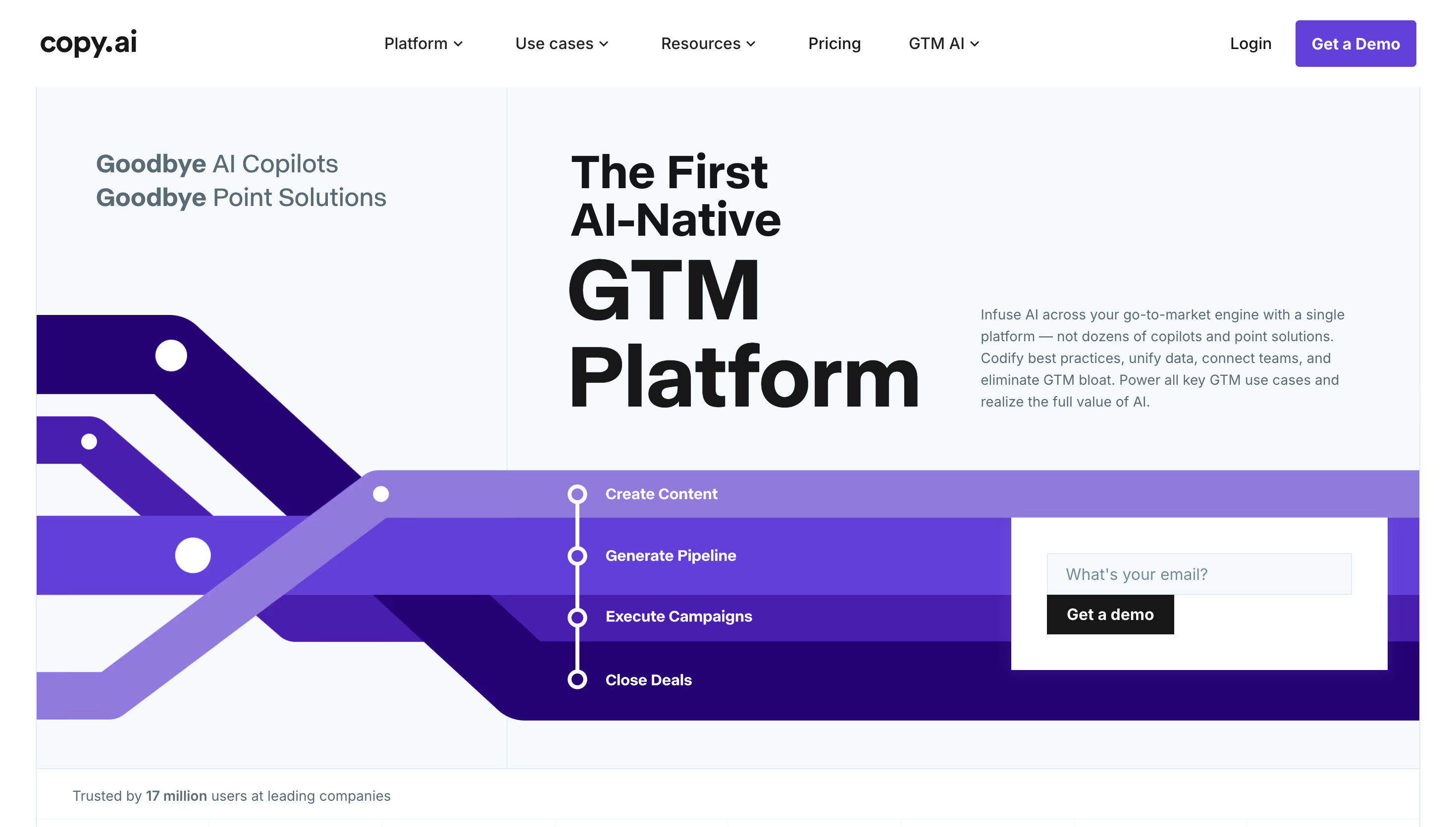
Copy.ai has shifted toward GTM workflows rather than pure copywriting, with workflow blocks and CRM connections. Cheapest credible option here, and the free tier is genuinely usable for testing.
Better than Writesonic at: short-form throughput and entry price
Falls short on: long technical pieces, which read as assembled, and it has no AEO capability at all
Test it with: one campaign's worth of short-form and count how much survived editing unchanged.
When Writesonic is still the right choice
Two situations where switching would be a mistake.
You need drafting and visibility from one vendor. Every alternative above does one or the other. If reducing vendor count and consolidating one bill matters more than depth in either, that's a real reason to stay.
You're early and testing whether AEO matters to you at all. The free tier and the breadth let you find out cheaply, and buying a specialist tool before you know what you need is how budget gets wasted.
A checklist for the demo
Bring Search Console data with you and ask the vendor to interpret it. That single move separates the tools that produce insight from the ones that produce dashboards.
Confirm live connections to HubSpot, GA4, Search Console and LinkedIn, and whether data flows both ways or only out. Ask for a sample invoice at your volume, itemising API calls and credits. Check that tasks can be routed to named owners with an audit trail, and that approval gates are enforced by role permission rather than convention. Confirm whether subject-matter experts can annotate drafts without blocking the pipeline. Negotiate SLAs and full data export rights before signing, not at renewal.
Running a useful pilot
One to two weeks against one topic cluster and 6 to 10 recent posts. Longer pilots mostly measure your own onboarding.
Pick two pages and draft against them with the new tool. Publish. Compare organic impressions and clicks in Search Console against your baseline pages, alongside editing minutes per draft. Keep a person reviewing everything. Expand only if you can point at a ranking or pipeline change rather than a content score.
Upgrade to an Agentic Marketing OS
Connect your stack, get content work routed to the right person with enforced approvals. No more decisions made blind to what you're spending on paid.
Frequently Asked Questions
What are the best Writesonic alternatives?
The seven worth comparing are Strivelabs, Frase, Surfer SEO, MarketMuse, Clearscope, Jasper and Copy.ai. Copy.ai is cheapest at $29 a month, Frase at $49 for briefing, Surfer at $59 for optimisation, Clearscope at $129 for editorial quality, and Strivelabs handles execution.
What is Writesonic used for?
AI article generation with SEO and AI visibility features layered on top, plus publishing integrations. Starter pricing is around $79 a month with a free tier below. Generation runs on credit caps and the visibility features are gated by tier.
How much does Writesonic cost?
Around $79 a month on Starter, with a free tier. For comparison, Copy.ai starts at $29, Frase at $49, Surfer at $59, Jasper at $69 per seat, MarketMuse at $99 and Clearscope at $129.
What is the clearest sign a team has outgrown Writesonic?
Rankings stop moving while output goes up. Hitting credit caps early in the month is the second signal. Both mean the constraint has moved from producing content to getting it found.
Which tool is best for AI Overviews and AI answer performance?
Optimisation tools like Surfer and Frase help by aligning content with the signals engines use, and MarketMuse helps by finding gaps across a library. None of them guarantees citation. Structure, clarity and being genuinely useful matter more than any score.
Is there a free Writesonic alternative?
Copy.ai and MarketMuse both have free tiers, and Frase and Surfer offer trials. Free tiers generally lack brand controls and team features, so treat them as testing rather than as a plan.
What's the difference between an AI writer and an AEO platform?
An AI writer produces drafts from a prompt. An AEO platform measures how you appear in AI answers and, in some cases, tells you what to change. Writesonic attempts both, which is its appeal and the source of its uneven depth.
Is Strivelabs a Writesonic alternative?
Only if your gap is follow-up rather than drafting. Writesonic writes. Strivelabs decides what should be written or fixed from your connected data and routes it for approval. Teams commonly run both.
How long should a pilot run?
One to two weeks against one cluster and 6 to 10 real posts. Long enough to measure editing time and confirm integrations hold. Anything longer measures onboarding rather than the tool.
Related Posts
AI SEO Tools: What Each Category Automates
AI SEO tool means six different jobs and most teams buy from the wrong one. What each category automates, what it can't, and which layer you're missing.
Content Operations for a Team of One: A Practical Guide
Most content ops advice assumes a department. If you're one person, four of the six functions still need a system and two genuinely don't.
Generative Engine Optimization Tools: What Each Does
Most teams buy from the wrong category because vendors describe all three identically. 12 platforms sorted by what they actually do, from $29/mo.