
Jasper Alternatives for B2B SaaS Content Teams
If you're looking past Jasper, the seven platforms worth comparing are Strivelabs, Copy.ai, Writesonic, Surfer SEO, Frase, MarketMuse, and Clearscope.
This is written for content and marketing leads at B2B SaaS companies running teams of two to eight. The premise, which is worth stating early because it shapes the whole comparison: most B2B SaaS teams don't have a writing problem. They have a prioritising problem. Deciding what to write, noticing when something published a year ago has started sliding, and getting a fix shipped are all harder than producing the words. If that matches your situation, a better generation tool won't fix it.
At a Glance
-
Jasper's Brand Voice is the most developed in the market — nothing here matches it for keeping output consistent across multiple writers.
-
Copy.ai is cheapest at $29/mo; Frase at $49 for briefs; Surfer at $59 for optimisation; Clearscope at $129 for editorial quality.
-
Most teams end up running two or three tools rather than one — a drafter, an optimiser, and something watching the data.
-
If content decisions have to reflect live ad spend and conversion data, most of this category doesn't reach it.
-
Measure publish-ready rate, editing minutes per piece and fact-checks per page — not content scores.
What is Jasper
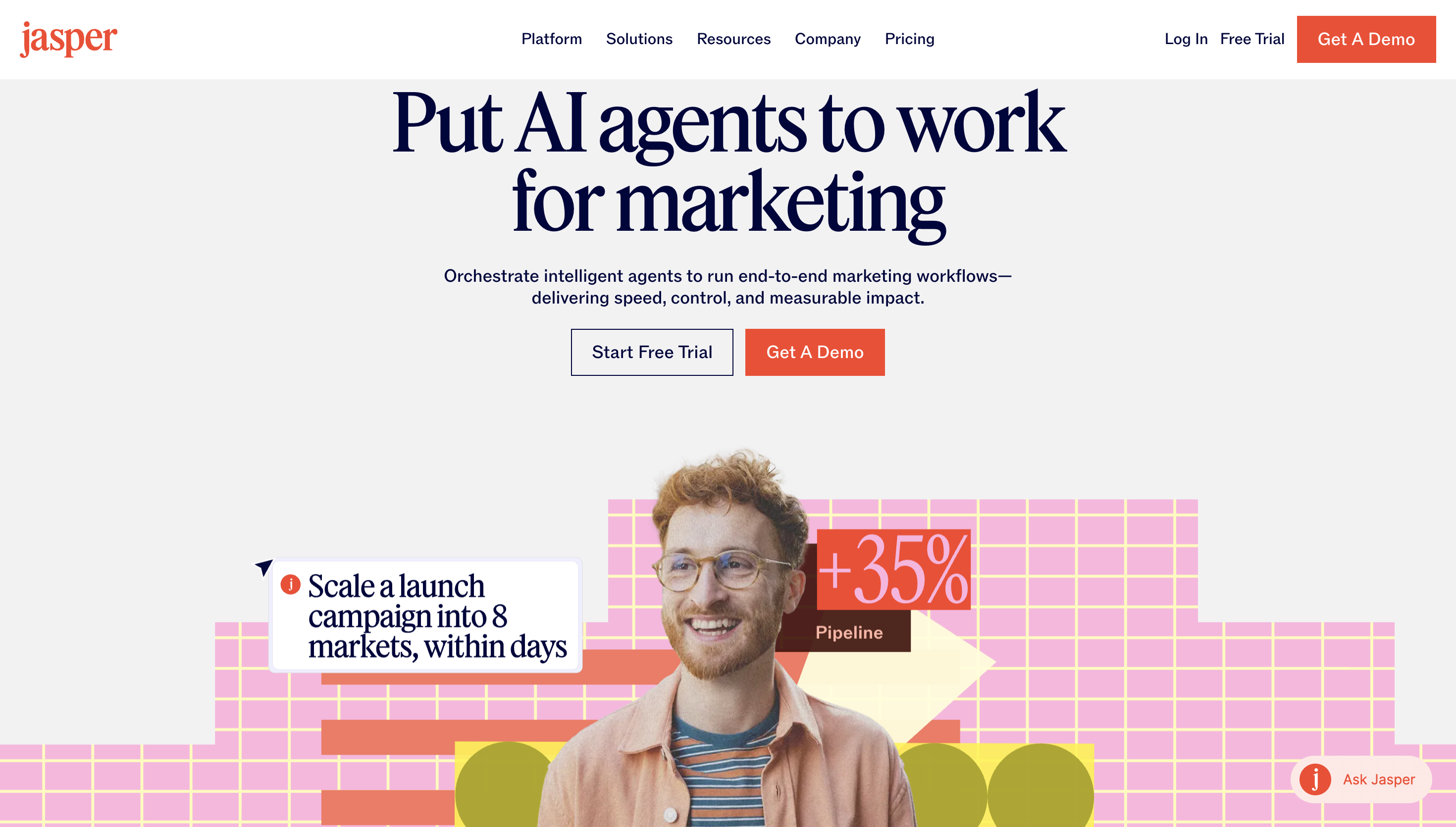
Jasper is an AI content generation platform built for marketing teams. You give it a brief or a prompt and it produces drafts, with templates for common formats and Brand Voice controls that train it on how your company writes so output stays consistent across whoever is using it. It routes between underlying models rather than depending on one, and connects to HubSpot and most CMS platforms.
Pricing starts around $69 a month per seat on the Pro tier, with Business pricing by quote.
It's the most mature product on this list, and by a wide margin the most validated. Jasper's own domain carries authority in the high eighties with well over 2,500 ranking keywords, which means there's more independent evidence about it than about anything else here. If you want to know how a tool behaves in month eight, Jasper is the one where you can actually find out.
Worth being clear about scope, because it drives every switching decision below. Jasper writes. It doesn't tell you what to write, grade the result against what's ranking, plan a cluster, or notice that a page is decaying. That's a deliberate boundary, and for a team whose constraint is genuinely output volume, it's the right tool.
Why B2B SaaS teams look elsewhere
Drafting wasn't the bottleneck. The most common reason, and the one behind the premise above. Teams buy a generation tool, output goes up, and nothing else changes because the queue was never the constraint.
Editorial overhead eats the saving. A draft that needs three hours of rewriting hasn't saved you anything. In B2B SaaS this bites harder than elsewhere, because generic output doesn't survive contact with a technical product. Every tool leaves a different mess, and the size of that mess is the number that matters.
Per-seat pricing scales the wrong way. At $69 a month per seat, adding writers and freelancers means cost climbing in step with headcount rather than with output.
No line to your own data. Check whether HubSpot, GA4, Search Console and Google Ads come in as live signals. A tool that can't see what you're spending on ads can't help you decide what to write next.
And the reason that isn't a criticism: if several people are producing content and it all needs to sound like one company, Jasper's Brand Voice does that better than anything else here. Nothing on this list is a straight replacement for that specific job.
What to actually measure
Three things, all measurable during a short pilot, all more useful than a feature comparison.
Publish-ready rate. What percentage of drafts reach publishable state without a substantial rewrite. Anything under half means you've bought a first-draft machine, which may still be worth it, but price it accordingly.
Editing minutes per piece. Time it properly. Multiply by loaded hourly cost and add the per-article share of the subscription. That's your real cost per post, and no vendor will volunteer the calculation.
Fact-checks per page. Specific to B2B SaaS. Count how many claims about your own product or category needed correcting. This is where generic tools fail and it doesn't show up in any demo.
For the ranking-focused tools, track clicks on your top landing pages and movement on your commercial terms rather than content scores. A score improving while traffic doesn't is the most common false positive in this category.
Quick comparison
| Vendor | What it does | Entry price | Free option | Best-fit team | Main limitation vs Jasper |
|---|---|---|---|---|---|
| Jasper | Brand-consistent generation at scale | $69/mo per seat (Pro) | No | Teams producing volume with one voice | Writes only, no planning or grading |
| Strivelabs | Turns connected data into approved actions | Quoted | No, demo | Teams whose gap is deciding and shipping | Doesn't generate drafts at all |
| Copy.ai | Fast short-form and GTM workflows | $29/mo (Chat) | Yes, limited | Teams producing ads, email and social | Long-form reads assembled |
| Writesonic | SEO-oriented drafting with visibility features | Not published | Reported trial | Teams wanting drafting and tracking together | Breadth over depth |
| Surfer SEO | Grades drafts against live SERPs | $59/mo (Discovery) | Trial | Teams optimising individual pages | Optimises, doesn't write |
| Frase | SERP research into briefs, fast | $49/mo | Trial | Small teams whose gap is briefing | Lighter grading, tight document caps |
| MarketMuse | Topic modelling and cluster planning | $99/mo (Optimize) | Yes | Teams planning authority over quarters | Steep learning curve, plans only |
| Clearscope | Content grading and topical accuracy | $129/mo (Essentials) | No | Editorial teams with quality standards | Optimises, doesn't write or plan |
Most teams end up running two or three of these rather than one. The usual shape is a drafter, an optimiser, and something watching the data. Ordered below by how directly each addresses the prioritising problem rather than the writing one.
Better decisions start with better infrastructure.
Most mid-market teams pick a channel and hope. Strivelabs gives you the data to know, and the infrastructure to act on it.
The seven alternatives to Jasper
1. Strivelabs
Best for: teams whose bottleneck is deciding what to write and getting fixes shipped
Pricing: quoted
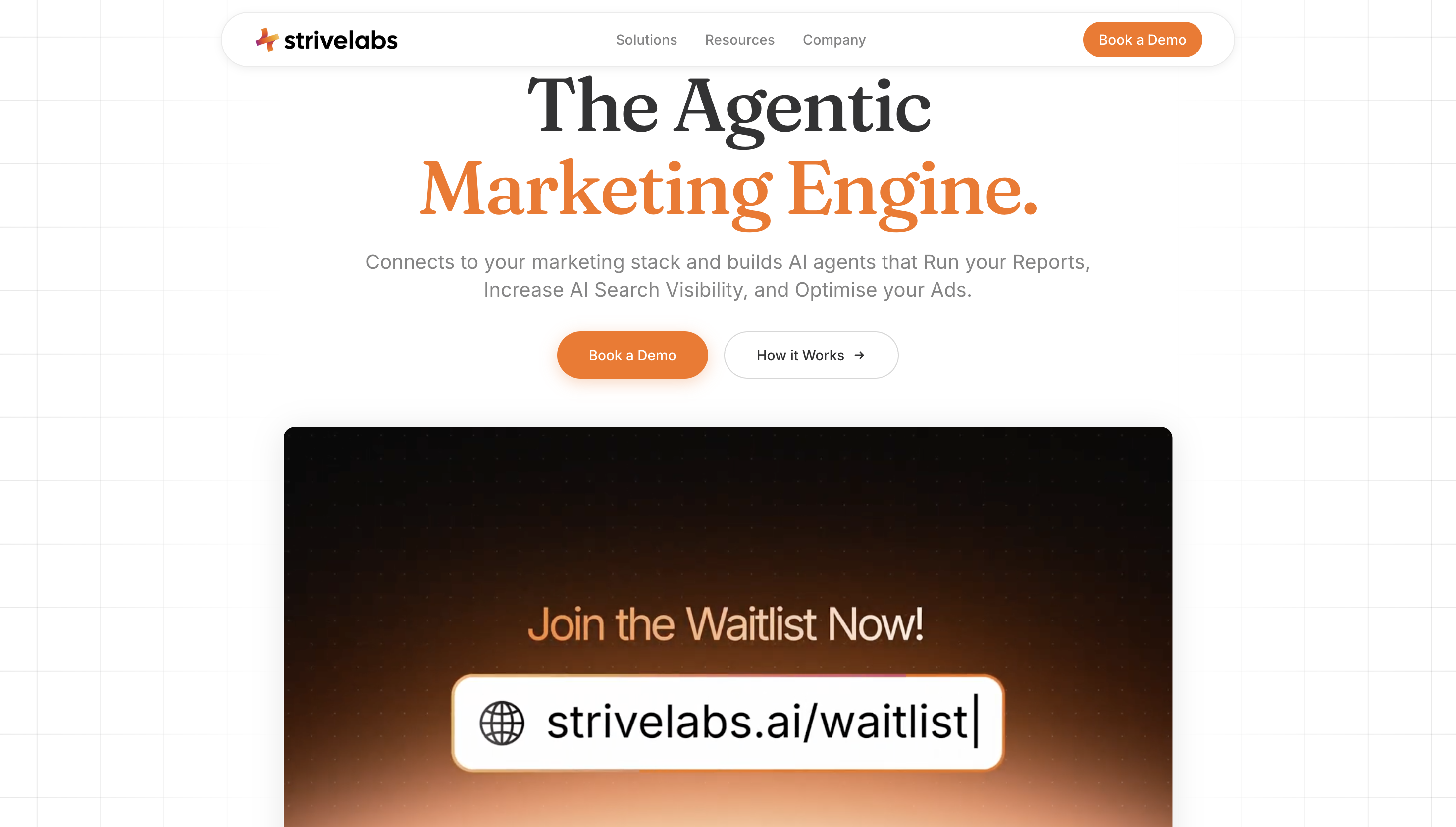
Strivelabs connects to HubSpot, Google Ads, Search Console, GA4, LinkedIn Ads and Slack, then turns signals into work with a named person approving before anything executes. In practice that means noticing that a page carrying real ad spend has started losing organic clicks, correlating the two, and creating a task for whoever owns that content with a suggested change attached. It also runs refresh schedules and routes alerts by role, so the content owner and the paid owner see different things.
The honest boundary: it produces no drafts. If your problem is that you need more words per week, this is the wrong purchase and Jasper or Copy.ai is the right one. Most teams that buy it are pairing it with a writer or a generation tool rather than replacing one.
Better than Jasper at: deciding what to write next from live funnel data, and catching decay across an existing library
Falls short on: drafting, which it doesn't attempt at all, so a writer or generation tool stays in the stack
2. Copy.ai
Best for: teams producing ads, email sequences and social at volume
Pricing: free tier, paid from $29/mo (Chat)
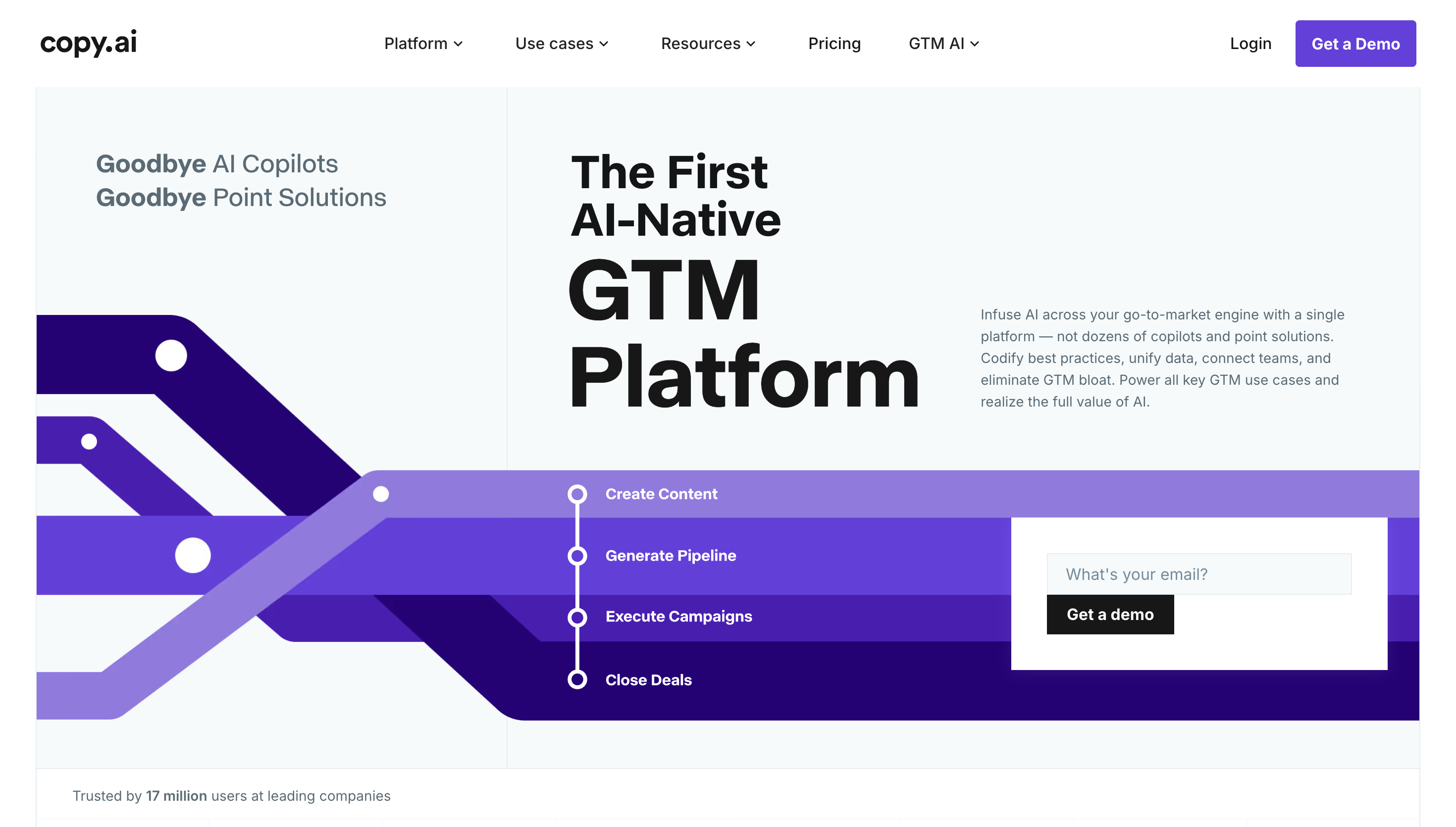
Copy.ai has moved toward GTM workflows rather than pure copywriting, with native workflow blocks and CRM connections that make it straightforward to slot into outbound and campaign work. For short-form at speed it's the cheapest credible option here, and the free tier is genuinely usable for testing.
Better than Jasper at: price at entry, short-form throughput, and a free tier to trial with
Falls short on: long technical pieces, which tend to read as assembled rather than written, and credit-based costs move with usage
3. Writesonic
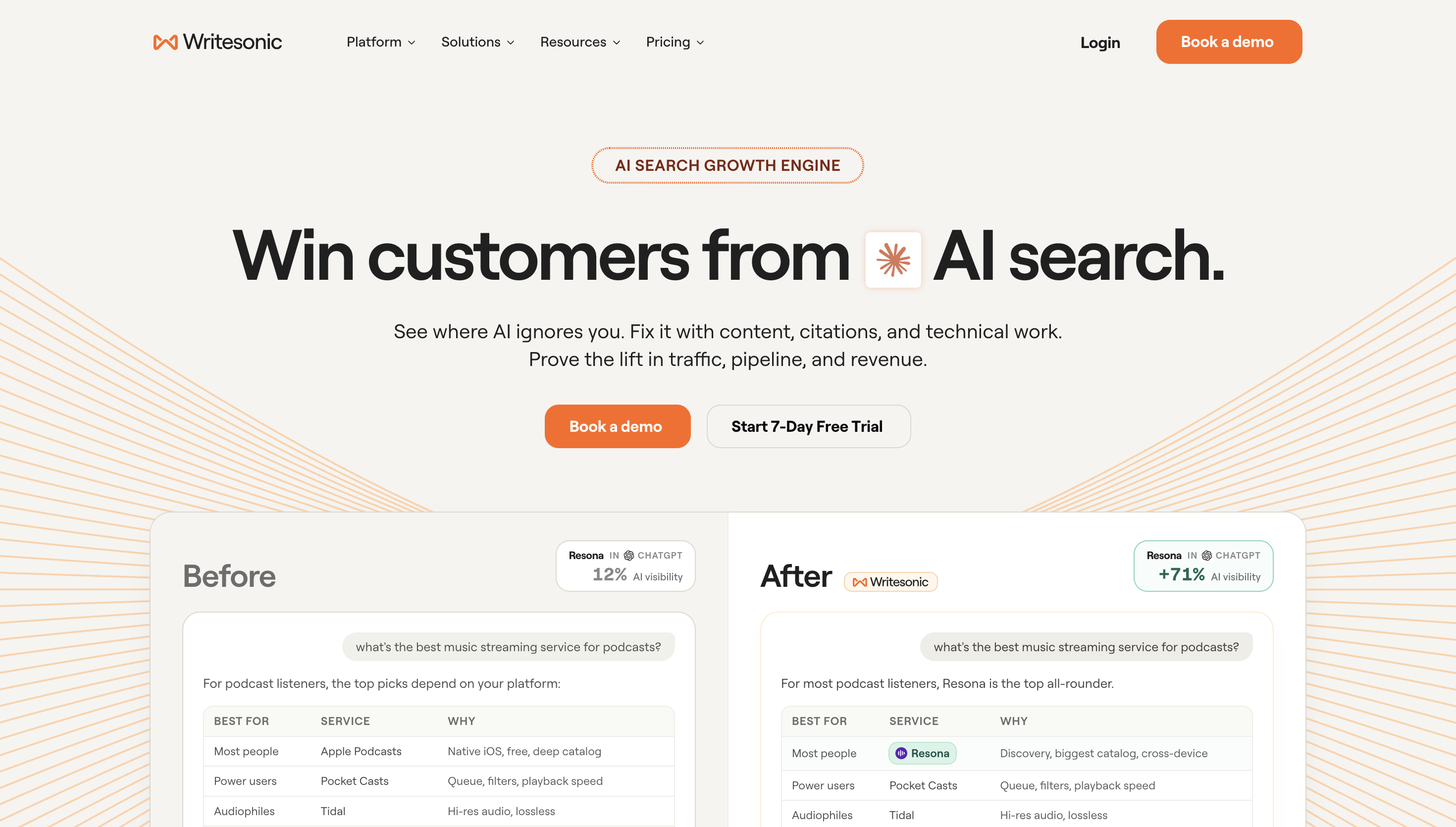
Best for: teams that want drafting and search visibility from one vendor
Pricing: not published in our research, check directly
Writesonic combines article generation with SEO and AI visibility features, which is the argument for it: one stack instead of a drafter plus an optimiser plus a tracker. Publishing integrations and enterprise tiers exist.
Better than Jasper at: covering drafting and search visibility in a single subscription
Falls short on: depth in each area, since breadth is the trade, and the more useful visibility features sit on higher tiers
4. Surfer SEO
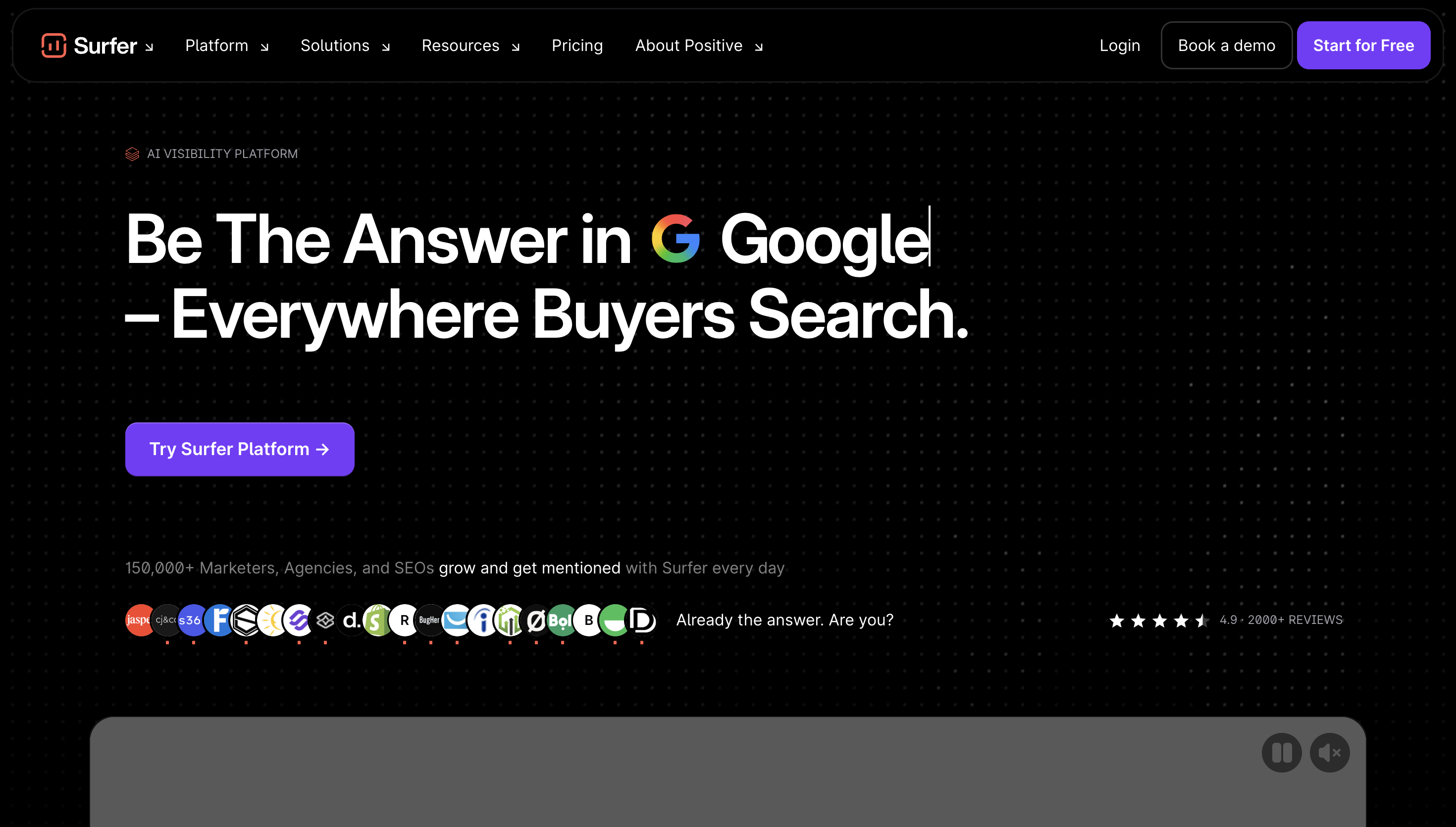
Best for: teams whose drafts are fine but aren't ranking
Pricing: from $59/mo (Discovery)
Surfer grades a draft against the pages currently ranking and tells you what's missing, with the score updating as you write. The feedback loop is tight enough that writers use it rather than working around it, which is rarer than it sounds.
Better than Jasper at: connecting a draft to what actually ranks, and cheaper at entry
Falls short on: production, since it optimises finished drafts and writes nothing, and AI features cost extra
5. Frase
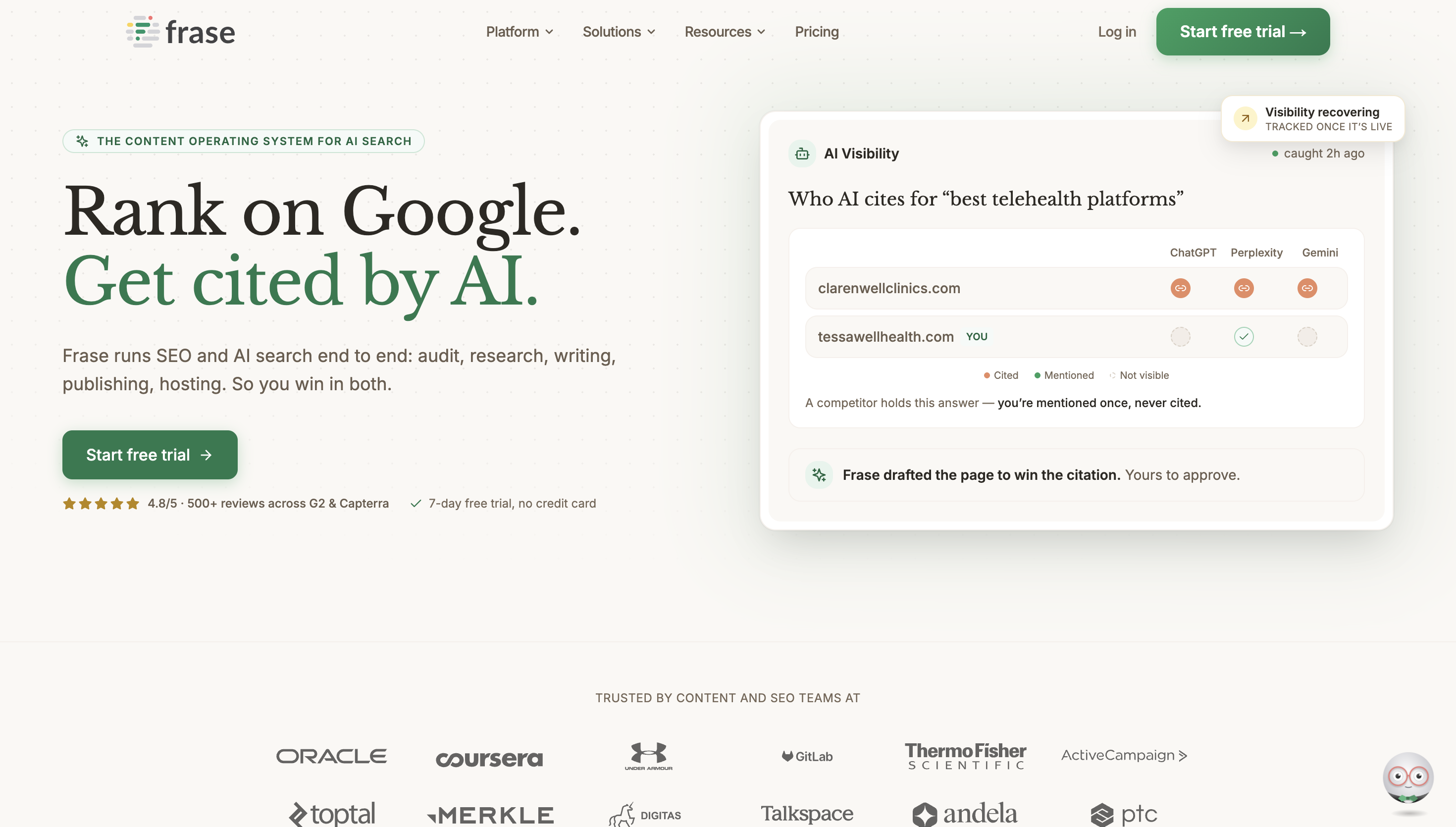
Best for: small teams where getting briefs written is the real delay
Pricing: from $49/mo
Frase turns SERP research into a working outline in minutes. For a team where the writer waits on a brief rather than the brief waiting on a writer, this is the cheapest fix available.
Better than Jasper at: speed from research to brief, and predictable low entry cost
Falls short on: grading depth against Surfer or Clearscope, and document caps bite at real volume
6. MarketMuse
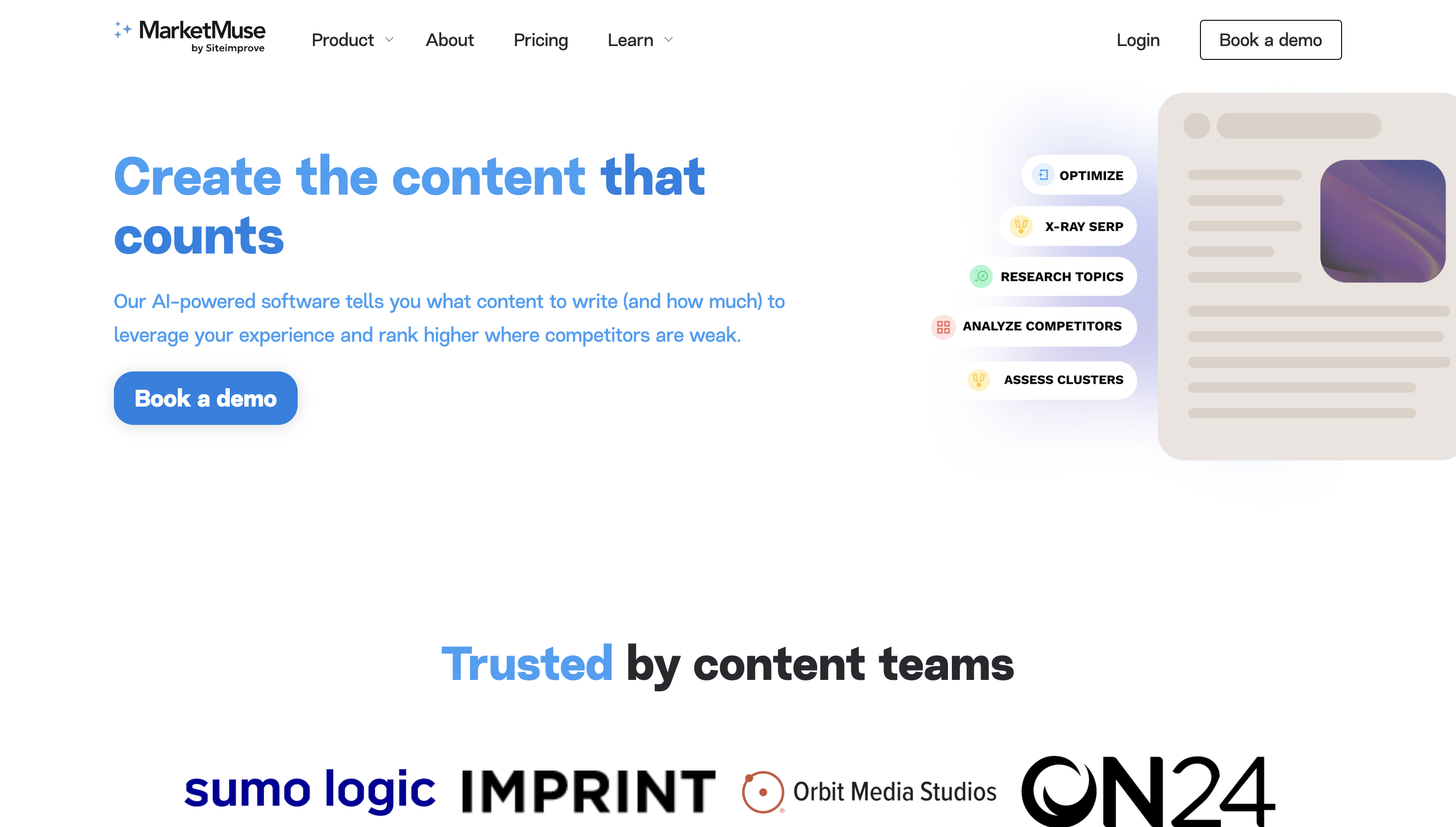
Best for: teams building topical authority across quarters
Pricing: free tier, paid from $99/mo (Optimize)
MarketMuse works at site level: topic clusters, gap analysis, content modelling, internal link suggestions. It's built for owning a subject rather than ranking for a term, which suits product-led growth strategies where the hub matters more than any single post.
Better than Jasper at: long-horizon planning and gap analysis across a content library
Falls short on: the learning curve, the steepest here, and it won't get you a draft or a fix today
7. Clearscope
Best for: editorial teams held to a quality bar on every piece
Pricing: from $129/mo (Essentials)
The most trusted grading in the category, with Google Docs and WordPress plugins so writers stay where they already work. Editors tend to act on its guidance rather than argue with it, which shortens review cycles.
Better than Jasper at: editorial quality signals, and speeding up the review step
Falls short on: price, the highest entry here, and it does no drafting and less planning than MarketMuse
When Jasper is still the right choice
Three situations where switching would be a mistake.
Brand voice across multiple writers is your actual problem. Jasper's Brand Voice is the most developed implementation of this on the market, and none of the alternatives above match it.
You need volume and you need it consistent. If the requirement is genuinely more drafts per week at a reliable standard, that's the job Jasper is built for.
You want the safest available bet. More independent evidence exists about Jasper than about anything else on this list. For a buyer who needs to defend the choice internally, that matters.
How to choose
What actually broke? Output volume points to Jasper or Copy.ai. Rankings point to Surfer or Clearscope. Briefing points to Frase. Planning points to MarketMuse. Deciding and shipping points to Strivelabs.
How many people write? Per-seat pricing on Jasper and Clearscope scales with headcount. Frase, Surfer and MarketMuse are cheaper across a small team.
Are you publishing more than twenty pieces a month? Above that, automation and planning matter more than drafting speed.
Does it need to see your funnel? Most of this category doesn't reach HubSpot, GA4 or Google Ads data. If content decisions have to reflect live spend, that narrows things fast.
Who signs off? Confirm approval steps can be enforced by permission rather than trusted to discipline.
Running a useful pilot
One to two weeks against one topic cluster and 6 to 10 recent posts as a baseline. Longer pilots mostly measure your own onboarding.
Run two tools in parallel on the same work. Time editing minutes on every draft. Count fact-checks. Track clicks on the test pages in Search Console rather than watching content scores move. Keep a person reviewing everything. Don't scale until you can point at a ranking or pipeline change.
Before you start, confirm the connections: HubSpot lead stages mapping correctly, GA4 tying page views to the right content, Search Console authorised, Google Ads pulling in if paid signals matter, and one live test post through your CMS. Missing API access on day one is the most common reason a pilot produces nothing usable.
One more thing worth settling in advance: agree what a good edit looks like. Without that, your editing-time numbers mean nothing and the whole comparison collapses.
If the gap is between knowing what needs doing and getting it done, that's the conversation worth having. Book a demo
Upgrade to an Agentic Marketing OS
Connect your stack, get content work routed to the right person with enforced approvals. No more decisions made blind to what you're spending on paid.
Frequently Asked Questions
What are the best Jasper alternatives for B2B SaaS?
The seven worth comparing are Strivelabs, Copy.ai, Writesonic, Surfer SEO, Frase, MarketMuse and Clearscope. Copy.ai is cheapest at $29 a month, Frase at $49 for briefs, Surfer at $59 for optimisation, Clearscope at $129 for editorial quality, and Strivelabs handles execution.
What is Jasper used for?
Generating marketing content at volume with consistent brand voice. Templates for common formats, Brand Voice training on your own writing, multi-model routing, and HubSpot and CMS connections. It writes rather than plans, grades or measures.
How much does Jasper cost?
Around $69 a month per seat on the Pro tier, with Business pricing by quote. That's higher than Copy.ai at $29, Frase at $49 and Surfer at $59, and lower than Clearscope at $129.
Why is Jasper considered expensive?
Mainly the per-seat model. Cost scales with how many people have access rather than with how much you publish, so a team adding freelancers sees the bill climb without output necessarily following. Compare how each vendor handles multi-user accounts before committing.
Can I use ChatGPT instead of Jasper?
For solo work, often yes, and there's a free tier. What you give up is brand voice controls trained on your writing, marketing templates and shared team workspaces. For a team maintaining one voice across several writers, that gap is the whole reason Jasper exists.
Is there a free Jasper alternative?
Copy.ai and MarketMuse both have free tiers, and Surfer and Frase offer trials. Free tiers in this category generally lack brand voice management and team controls, so treat them as testing rather than as a plan.
What's the difference between an AI drafting tool and a content optimisation tool?
A drafting tool produces text from a prompt, like Jasper or Copy.ai. An optimisation tool analyses pages already ranking and grades your draft against them, like Surfer or Clearscope. Different jobs, and most teams end up using one of each.
Is Strivelabs a Jasper alternative?
Only if your bottleneck isn't writing. Jasper generates drafts. Strivelabs decides what should be written or fixed from your connected data and routes it for approval. Teams often run both rather than choosing.
How should a B2B team measure ROI on an AI content tool?
Three production metrics and two outcome metrics. Publish-ready rate, editing minutes per piece and fact-checks per page on the production side. Organic clicks and movement on commercial keywords on the outcome side. Content scores are not an outcome metric.
How long should a pilot run?
One to two weeks against one cluster and 6 to 10 real posts. That's enough to measure editing time and confirm integrations hold. Anything longer mostly measures onboarding.
Related Posts
AI SEO Tools: What Each Category Automates
AI SEO tool means six different jobs and most teams buy from the wrong one. What each category automates, what it can't, and which layer you're missing.
Content Operations for a Team of One: A Practical Guide
Most content ops advice assumes a department. If you're one person, four of the six functions still need a system and two genuinely don't.
Generative Engine Optimization Tools: What Each Does
Most teams buy from the wrong category because vendors describe all three identically. 12 platforms sorted by what they actually do, from $29/mo.